
Vertical Number Line: Free Printable for the Elementary Classroom
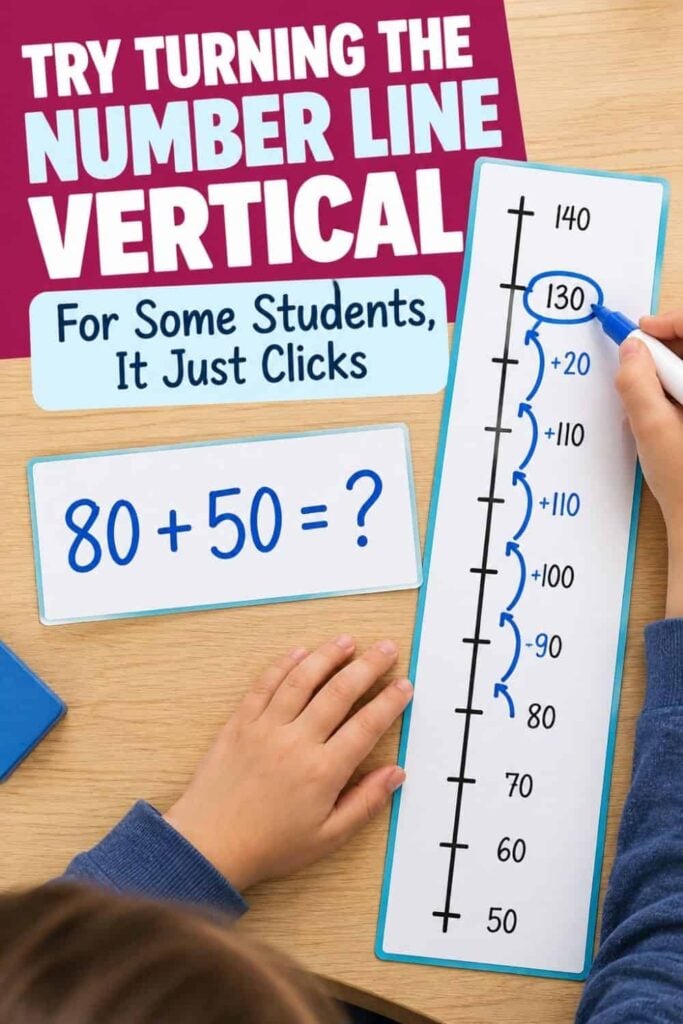
A few years ago, a special education teacher at a staff meeting pulled out a vertical number line and showed how she used it with her students. I filed it away. A couple of weeks later, my own students started struggling to add tens across a hundred (problems like 80 + 50), and that memory came right back. I printed out a vertical number line printable, laminated a set, and watched several of my students suddenly click with number concepts they had been fighting for weeks.
If you have students who are hitting a wall with a traditional horizontal number line, a vertical number line might be exactly what they need. Below, I’ll share what it is, when to use it, and how to get the free printable vertical number line template at the bottom of this post.
What Is a Vertical Number Line?
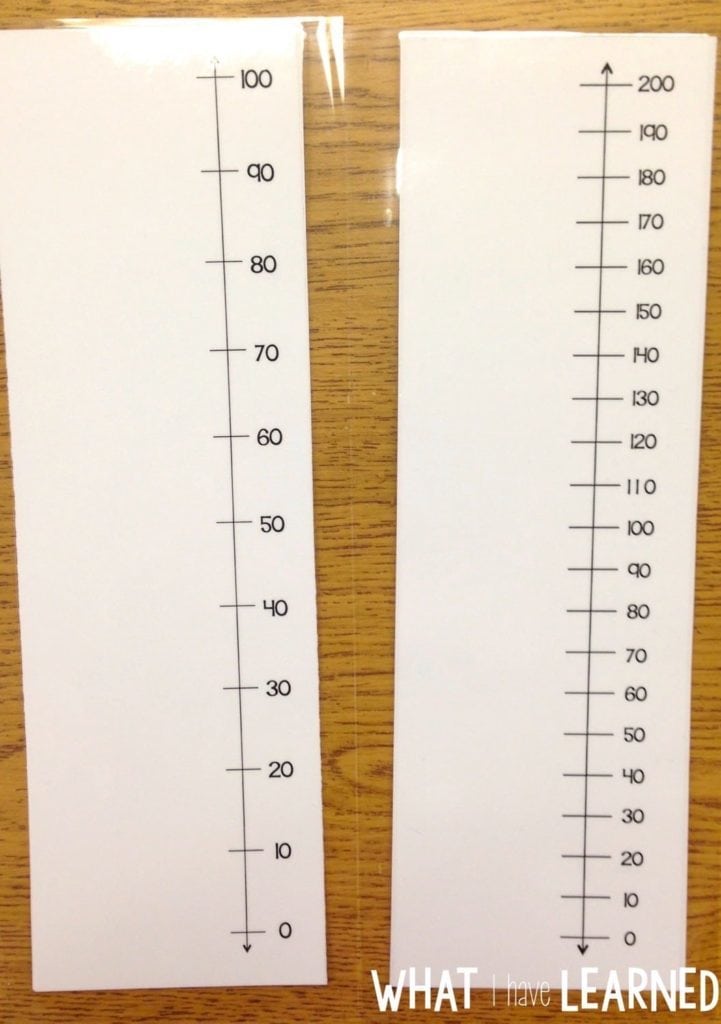
A vertical number line is simply a number line that runs up and down instead of left to right. Numbers increase as you move up and decrease as you move down. That’s the whole difference, and yet for some students it changes everything about how they think about numbers.
Why Use a Vertical Number Line?
The most honest answer: some students just need to see numbers differently. A vertical number line isn’t a replacement for a horizontal one. It is one more way to represent numbers, and for certain learners, it is the representation that finally makes sense.
There are a few reasons it works well:
It looks like a thermometer. For students who are starting to work with negative numbers, the thermometer comparison is natural and concrete. Numbers above zero go up; numbers below zero go down. The visual matches the mental model.
It emphasizes the language we already use. We say “count up,” “go up by tens,” “higher numbers.” A vertical number line makes that language literal.
It can reach students who have stalled. I have seen students struggle for weeks with a horizontal number line, try the vertical version, and immediately succeed. They were not behind in their thinking. They just needed a different layout.

How to Use a Vertical Number Line in Your Classroom
Adding and Subtracting Multi-Digit Numbers
This is where I started, and it is still my favorite use. When students are working on multi-digit addition and subtraction, you can use a vertical number line as a visual scaffold. Students start at a number, count up or down by tens, and track each jump. The vertical orientation often makes it easier for them to see why they are “going up” or “going down” on the number line when adding or subtracting.
For students who understand that 8 + 5 = 13 but cannot see why 80 + 50 = 130, walking it out on a vertical number line with jumps of ten can make the pattern visible.
Counting by Tens and Place Value
A vertical number line to 100 or 120, marked in increments of 10, is a useful tool for place value work. Students can see the structure of the number system laid out vertically (10, 20, 30) and match it to what they know about tens and ones.
You can also use a vertical number line to 20 with younger students for foundational counting and number order work before moving to larger ranges.
Negative Numbers and Integers
For upper elementary students beginning to work with integers, a vertical number line that includes negative numbers is particularly clear. Positive integers go above zero, negative integers go below. Students can use it to compare and order integers, add and subtract with negatives, and reason about which numbers are greater or smaller.
If you are teaching fourth or fifth grade and introducing negative numbers, a blank vertical number line with both positive and negative integers is worth having in students’ desks or math folders. The vertical format makes the direction of positive and negative concrete in a way that a horizontal version sometimes doesn’t.
Rounding
A vertical number line is an excellent tool for teaching rounding. When students need to round 47 to the nearest ten, they can find 47 on the vertical number line, see that 40 is below it and 50 is above it, and determine which benchmark they are closer to. The up-down orientation often makes the concept of “which way do we go” more intuitive than a horizontal number line, where left and right can feel arbitrary.
This works well for rounding to the nearest ten, hundred, or any benchmark, depending on the range of your vertical number line template.
Connecting to the Coordinate Plane
One note for upper elementary teachers: a vertical number line is also the first step toward understanding the coordinate plane. The y-axis on a coordinate plane is a vertical number line running through the origin. When students are familiar with vertical number lines before coordinate plane work begins, that connection is much easier to make.
Vertical Number Line vs. Horizontal Number Line
Neither format is better. Both belong in a well-stocked math toolkit. Most students will be comfortable with horizontal number lines, but some students who struggle with the horizontal format will thrive with a vertical one.
If a student is consistently making errors on horizontal number line tasks, try switching to vertical before assuming the concept itself is the problem. Sometimes it is just the layout.
I laminate a class set of vertical number lines so students can use them repeatedly with dry-erase markers. Keeping them at the ready means students can reach for one whenever they need support, without it feeling like a special intervention.
Free Printable Vertical Number Line
The free download below includes a vertical number line printable and two practice worksheets to go with it. The printable works as a classroom tool students can keep in their math folders or you can laminate for repeated use.

This comment has been removed by the author.
Thanks so much – I have never thought of doing vertical number lines before!
Awesome resource – Thanks for sharing!
Erin
Learning to be AWESOME
I like the idea, it is an interesting approach and would certainly help some visualize the process differently and more clearly. Thanks to the teacher that brought it up and thanks for bringing it to my attention.
I would love the vertical number lines and sheets but can’t find the link?
Hi, Donna,
There’s a link above that says, Click here to download.
Best,
Jessica
Hello, I can’t see a download link anywhere. Is this resource still available?
Yes! Right above the first photo and right above the word “Video” are download links.
Vertical number lines are critical for working in the coordinate plane, which is just a horizontal number line and a vertical number line with zero overlapping (the origin).
Yes! This is a great correlation!
I am finding that I personally like vertical number lines, too! Thanks for this! How long does it take for your class to cover multi-digit addition with and without regrouping?
We usually do two-digit in the Fall and three-digit in the Winter. It takes a while and we’re continually revisiting it in different ways.