
Blending and Segmenting Tips for Student Success
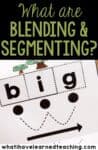
If you teach early reading, consider how you are teaching your students to read. Do you teach students to memorize words? Or, do you teach them to sound out a word and to depend on their knowledge of phonetic sounds? Two important skills that early readers must develop are the ability to blend and segment words.

Blending involves pulling together individual sounds or syllables within words; segmenting involves breaking words down into individual sounds or syllables. These are two different foundational skills that will assist children in the art of reading for most of their reading careers.
If you have students who can identify individual sounds but cannot pull them together into a word, they may need a more targeted approach. Successive blending is a phonics intervention strategy that breaks the blending process into two steps rather than three, reducing the demand on working memory for students who struggle with continuous blending.
How do students develop Blending and Segmenting skills?
Blending and segmenting words is a skill developed in both phonemic awareness and phonics instruction. Remember, phonemic awareness is all done orally, without print, and phonics learning is done with print. This blog post will focus on blending and segmenting with print, specifically. Like most phonics concepts, students will find more success if the skills are first developed orally through phonemic awareness activities before developing them with print.
When working with young readers who are attempting to figure out a word, I often hear students say the sounds of each letter in a word and then say the whole word.
Is this blending? No, it is not. It is segmenting. The student has said each sound and then figured out how to put them together, but there is no connection between the sounds in the word.
If students can segment a word, like above, do they still need to learn to blend? Yes! Students need to know how to connect the sounds together so that when they encounter bigger words, the skills are in place. Teaching a student to both segment and blend a word gives them the building blocks for reading success.
The missing skill of my second graders who struggled in reading was blending. They could not connect the sounds together, and thus, couldn’t figure out the word.
What does it mean to blend sounds together?
Once students know several common sounds, such as s, m, a, t, n, it is time to help students blend those sounds together into simple words. Blending means that students are connecting the sounds together without stopping in between each sound. This can be a difficult skill for students to grasp.
As a teacher, it is helpful to teach this skill in both whole group and during small group instruction so that you can listen to each individual student. Some students will also need you right next to them helping them blend the sounds continuously until they understand that it has to be smooth.
A couple of key things to remember when teaching students to blend sounds
Practice, Practice, Practice
As much as you can. Really. It’s all about the practice. Practice whole group. Practice in small groups. Give parents some ways to practice at home. Don’t go overboard, but if you can blend and segment sounds several times throughout the day, students will find success with the process.
Start with Continuous Sounds
Students will find more success if you start with continuous sounds. Common sounds to start with include s, m, a, n. There are more, but those sounds tend to be the first ones students learn. As students find success with those sounds add one more sound to the mix and continue practicing.
Connect a Stop Sound to the Continuous Sound After It
When blending with stop sounds, start by using the stop sounds at the end of a word, like mat. Students can quickly stop blending at that final sound. As students become proficient with blending continuous sounds, move on to blending stop sounds at the beginning of words, like cat. When blending with stop sounds at the beginning of the word, it is often helpful to prompt students to blend the stop sound with the continuous sound next to it. For instance in cat, the ca would be blended together.
Elongate the sounds
Be sure that when you (or the students) are saying the continuous sounds you elongate the continuous sounds. Really. Overemphasize them. You want students to hear all the sounds in the word.
Connect the sounds
As students are blending the sounds in the word, be sure that they’re connecting each sound together. Often, I will hear students elongate the first sound, pause slightly and then start the second sound. Listen carefully and be sure that students are connecting all the sounds together throughout the word.
What does it mean to segment sounds?
Segmenting sounds is the opposite of blending sounds. While segmenting sounds is an important reading skill, I find that the best application for it is for writing. If students can hear and say each sound in a word and match it to a symbol, they can write words!
Some things to keep in mind when teaching students to segment sounds
Below are some things to be aware of when you teach students to segment sounds. They may not seem like significant changes to your practice, but sometimes the small changes can help your struggling learners anchor their new learning.
Have Students Use their Hands and Fingers
Little kids are tactile creatures. They love using their hands. Teach students to use their hands to count the sounds in a word.
I have students hold up a fist on their right hand. It’s important that they use their right hand because when counting, they start with their index finger and move to the right. It’s the same way we read, from left to right. Have students say each sound and raise a finger for each sound that they say.
So for cat, they would say, /c/, /a/, /t/ and each sound would be a different finger. Do that over and over again with different words.
Keep in mind that developing this skill orally through phonemic awareness activities is best. Then move on to phonics activities that include print.
Make Stop Sounds Quick
When counting sounds, be sure that the stop sound has a distinct, quick stop sound. Be sure that the stop sounds don’t have a schwa sound attached to the end of it. The schwa sound is that -uh sound that you sometimes hear people put at the end of a sound, like buh, duh, etc. Don’t elongate stop sounds. We don’t say buh-a-t. It’s b-a-t.
Often, when teaching students about stop sounds, I’ll have them hold their hand in front of their mount and feel their breath. When a stop sound stops, there’s a little puff of breath. Try it. Do you get that puff of air at the end of /p/? Now, try putting a schwa sound at the end and say puh. Do you feel the air at the end of the sound? No, because you tacked on that schwa. That’s one way to tell if you (or the students) are saying the word correctly.
Make Continuous Sounds a little bit longer, but not too long
When students say a continuous sound, don’t make it too long. You don’t want students to blend the sounds but count them quickly. There will be a difference between how a stop and continuous sound is heard. Try it. Segment cat, rat, man, can. Can you hear the difference between the /r/ in rat and the /c/ in cat?
Resources to Teach Blending and Segmenting for Most Phonics Patterns
Do you need some resources to teach blending and segmenting to your early readers? Here are a few of my favorite resources. Resources are also available on TPT.
Blending cards are available for most phonics patterns and include both blending and segmenting cues as well as images!
-

-
-
-
-
VCE Words Blending Cards$6.75
-
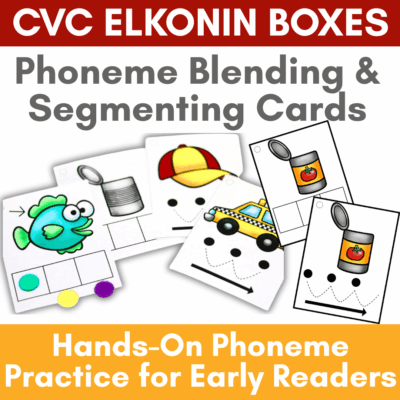
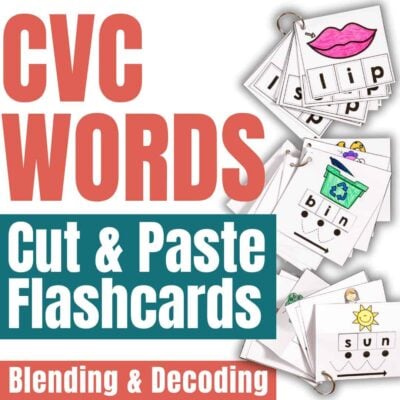


How do you teach blending and segmenting?
When using print, I often use dots and looped lines, like in the photo above. It really helps students to see the individual sounds in each word.
Do you have any tips for teaching blending and segmenting? I’d love to hear them in the comments below.
In the above photo are pictures of my CVC Cut and Paste Cards. They’re a traditional worksheet that can be transformed into a ring of review cards. If you’d more information on them, click here.

We have also created Phonics Worksheets that utilize these blending cues. Check out the Short A Phonics Worksheets and the Short I Worksheets. These worksheets have 18 different templates with over 140 usable pages per vowel.


Hello! This is terrific! I’m teaching my (pre-k) son to “read”. Can you do a video on the order of building these skills and what they look like when we teach them? Something short; I’m sure you’re super busy. It would help me and other homeschooling mamas out A LOT!
Thank you for taking your time to read my comment and thank you even more for sharing your techniques. They’re very helpful.
Keep up the great work!
Tori
Hi, Tori,
There is no one right order of skills when teaching a child to read. Children will move through “levels” when learning to read, but it’s not a straight pathway and it’s difficult to tell you specific skills to work on with specific students. Reading skills include concepts of print, phonemic awareness, letter names and letter sounds, blending and segmenting words with a wide range of vowel patterns, then an automatic stage where students are reading multisyllabic words and working on becoming fluent readers.
For pre-k, I would just read a ton of books to your child and start working on concepts of print, phonemic awareness, and some letter names and letter sounds. In Kinder, start blending and segmenting CVC words in print form and then move on from there, based on his readiness. Developing his phonemic awareness skills at this age is really the best thing you can do for future success. His ability to hear and manipulate sounds orally without print is a strong indicator of his ability to learn to read easily.
Of course, with all this, read a lot of good books and ask questions about the books. You don’t want to let go of reading comprehension while you’re focusing on phonemic awareness and phonics instruction. Help him to love reading and love stories.
Good day.what a lovely write- up.i am a teacher,i just introduced my pupils to oral blending,word building,and reading with vowel sounds to my pupils.My coordinator insisted that the pupils should read without sound talking(segmenting) the sounds.though some can do this,but i felt it is too early to stop the skill of sound talking before reading a word.what do you think?
Children progress through the foundational skills of reading at different rates. Some will need more time in the blending and segmenting stage than others. Generally, students will move to automaticity with easier, familiar words more quickly but need to continue to sound out newly learned patterns.
Hi,
my son also had speech delay and is now in his first year of school. He is trying hard to catch up but obviously a little behind his peers. Do you have any advice to give me in helping him to realise the phonics he has learnt make actual words? He is very good with the individual sounds but not started blending yet. I want him to be comfortable enough to go at his own pace too!
You can use the blending cards and that will help. I think it’s key to just do a little bit each day, about 20 minutes. My son wasn’t blending words about a year and a half ago and now he is. He’s come a long way, though he still struggles with reading. It takes a little bit of time and consistency. We used the Bob books. Those are short and controlled for phonics patterns. We’re also using All About Reading as our reading program and that has helped a ton. If it’s your son’s first year, I’d slow down a bit just do some blending exercises every day for a little bit. Another book that is good is Teach Your Child to Read in 100 Easy Lessons. If by the end of the year he’s still not blending after having several months of consistent work, then look into some further interventions.
Thanks so much for your advice Jessica! I really appreciate it
Hi Jessica, I have a few students who are not reading yet in my Grade 2 class so I will be using up the blending cards.I’ll keep you up to date with their progress
I would like to share the information on this page with my students’ parents. Am I able to do that? May I share this info if I give you credit? This information is invaluable. Than you!
Thanks so much for being willing to share the information on this page with others! Yes, you can share it via a link or by printing the pages for parents. You cannot copy the text from the page, though. However, you can direct parents to the source of the information!
Thanks you so much for the in sight I work in a after school program with children of lower incomes le e all of them from 1st to 2nd grade seem to be struggling a lot with blending and letter sounds if you can give any tip I would be very grateful.
Hi. Thanks so much for this great ideas. Are the activities printable?
Yes, the resources you see here are PDF downloads available for purchase.
This is very nice!
I actually have a 5 year old daughter who is currently enrolled in the online learning of an international school in the Philippines and I am preparing activities weekly so that we can practice counting, reading and writing since she is already in the kindergarten level. Your suggestion about BLENDING and SEGMENTING words is really a nice idea and we’ll definitely try this at home so she can learn how to read as soon as possible. Please share more activities like this. More power to your blog!
Hi Jessica,
I have taught short vowels to my kid and he can do blending. So if i give him a word, say “daddy”, he will sound the individual letters, d-a-d-d-y, then say “daddy”. May i know what is the next step i should do from here?
I was wondering how/when does he get past blending and straight away read without blending?
Daddy is a multisyllabic word. Make sure the child can blend and read single syllable words quickly before starting multisyllabic decoding. Daddy should be read “dad-dy”. Students need to be taught the rule for the y at the end of a word.