
How to Teach Word Problems: Strategies and Lesson Plans for Addition and Subtraction
A second grader reads, “Maya had 14 stickers. She gave 6 to her brother. How many does she have now?” Knowing how to teach word problems means knowing why this student writes 14 plus 6: she circles “gave,” remembers that “gave” means addition, and stops thinking. The five strategies below replace that quick trick with something durable. Students learn to read the problem, picture what’s happening, choose an appropriate operation, and check their answer. They hold up from kindergarten through fifth grade.

The five strategies below replace keyword shortcuts with more durable alternatives. Students learn to read the problem, picture what’s happening, choose an appropriate operation, and check their answer — and the same framework holds from kindergarten through fifth grade.
How to Teach Addition and Subtraction Word Problems
The main components of teaching addition and subtraction word problems include:
- Teaching the Relationship of the Numbers – As a teacher, know the problem type and help students solve the action in the problem
- Differentiate the Numbers – Give students just the right numbers so that they can read the problem without getting bogged down with the computation
- Use Academic Vocabulary – and be consistent in what you use.
- Stop Searching for the “Answer” – it’s not about the answer; it’s about the process
- Differentiate between the Models and the Strategies – one has to do with the relationship
between the numbers, and the other has to do with how students “solve” or compute the problem.
Why Keyword Lists for Word Problems Don’t Work
I am a firm believer in not teaching keyword lists for word problems. They produce exactly the kind of mistake in the opening example: a student circles “gave,” recalls that “gave” means addition, and stops thinking. It works on simple problems and fails on anything more complex.
The deeper issue is that keyword lists teach students to search for clues rather than understand situations. A student who understands the situation doesn’t need a keyword — and a student who only knows keywords is lost the moment a problem uses unfamiliar language. Instead of a keyword list, I help students build a list of actions: verbs that describe what’s happening in the problem. Is something being joined or separated? That question does more than any keyword list.
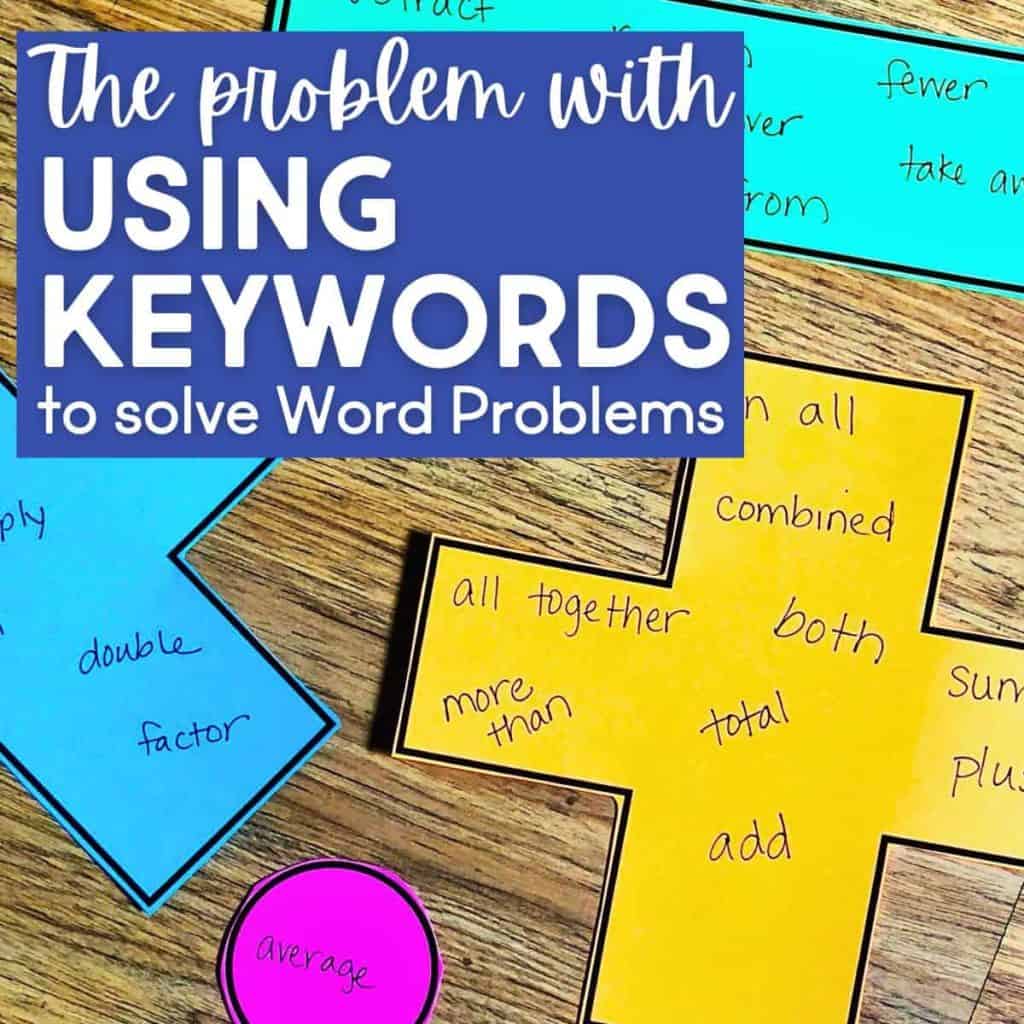
I talk in more depth about why it doesn’t work in “The Problem with Using Keywords to Solve Word Problems.”
Teach the Relationship of the Numbers in Math Word Problems
One way to help your students solve word problems is to teach them the relationship between numbers. In other words, help them understand that the numbers in the problem are related to one another.
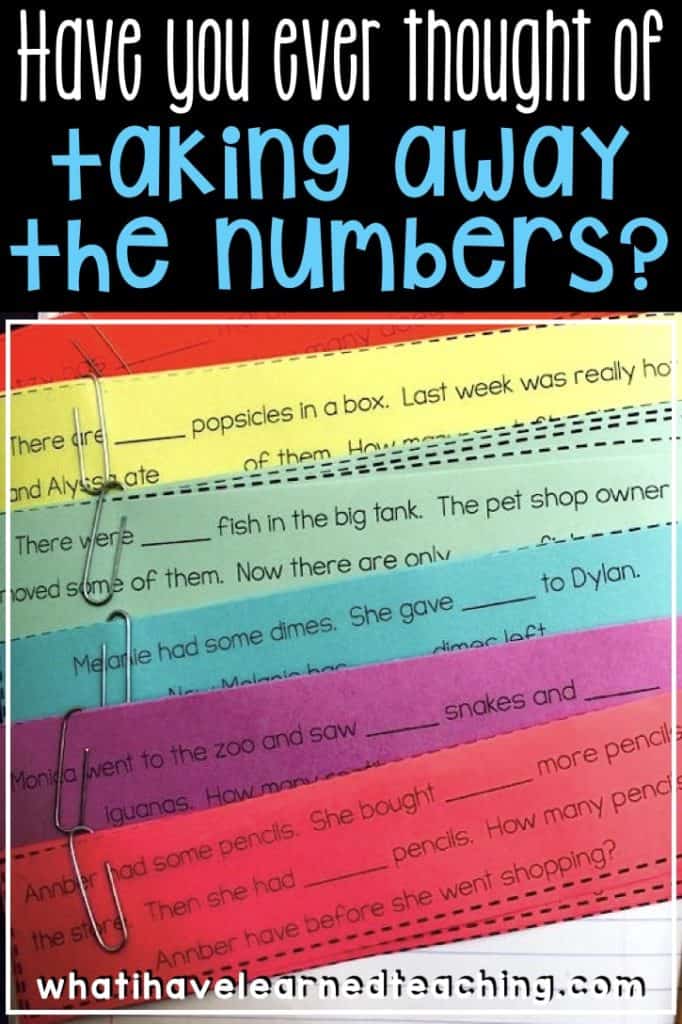
I teach word problems by removing the numbers. Sounds strange, right?
Removing the distraction of the numbers helps students focus on the situation of the problem and understand the action or relationship of the numbers. It also keeps students from solving the problem before we talk about the relationship of the numbers.

When I teach word problems, I give students problems with blank spaces and no numbers. We first talk about the action in the problem. We identify whether something is being added to or taken from something else. That becomes our equation. We identify what we have to solve and set up the equation with blank spaces and a square for the unknown number
___ + ___ = unknown
Do you want a free sample of the word problems I use in my classroom?

Addition and Subtraction Word Problems: Teach the Types of Word Problems
Master addition and subtraction word problems with this year-long resource! Covers all types of word problems, including first grade addition word problems and 2nd grade subtraction word problems, with built-in differentiation, models, and vocabulary support.
Differentiate the numbers in the Word Problems
Only after we have discussed the problem do I give students numbers. I differentiate numbers based on student needs. At the beginning of the year, we all use the same numbers, so I can make sure students understand the process.
After students are familiar with the process, I start giving different students different numbers based on their level of mathematical thinking.
I also change numbers throughout the year, from one-digit to two-digit numbers. The beauty of the blank spaces is that I can put any numbers I want into the problem, to practice the strategies we have been working on in class.
At some point, we do create a list of words, but not a keyword list. We create a list of actions or verbs and determine whether each action joins or separates something. How many can you think of?
Here are a few ideas:
Join: put, got, picked up, bought, made
Separate: ate, lost, put down, dropped, used
Don’t be afraid to use academic vocabulary when teaching word problems
I teach my students to identify the problem’s start, the change in the problem, and the problem’s result. I teach them to look for the unknown.
These are all words we use when solving problems, and we learn the structure of a word problem through the vocabulary and the relationship of the numbers.
In fact, using the same vocabulary across problem types helps students see the relationship of the numbers at a deeper level.


Take these examples, can you identify the start, change, and result in each problem? Hint: Look at the code used for the problem type in the lower right corner.
For comparison problems, we use the terms larger, smaller, more, and less. Try out these problems and see if you can identify the components of the word problems.


Stop searching for “the answer” when solving word problems
This is the most difficult misconception to break.
Students are not solving a word problem to find “the answer”. Although the answer helps me, the teacher, understand whether the student understood the relationship between the numbers, I want students to be able to explain their process and understand the depth of word problems.
Okay, they’re first and second-graders. I know.
My students can still explain, after instruction, that they started with one number. The problem resulted in another number. Students then know that they are searching for the change between those two numbers.
It’s all about the relationship.
Addition and Subtraction Word Problems: Teach the Types of Word Problems
Master addition and subtraction word problems with this year-long resource! Covers all types of word problems, including first grade addition word problems and 2nd grade subtraction word problems, with built-in differentiation, models, and vocabulary support.
Differentiate between the models and the strategies
A couple of years ago, I came across this article about the need to help students develop adequate models to understand the relationships among the numbers in the problem.
A light bulb went off in my head. I needed to distinguish between the models students use to understand the relationship among the numbers in the problem and the strategies for solving the computation in the problem. Models and strategies work in tandem but are very different.
Models are visual representations of problems. Strategies are the ways a student solves a problem by putting numbers together and taking them apart.
The most important thing about models is to move away from them. I know that sounds odd.
You spend so long teaching students how to use models, and then you don’t want them to use a model. Well, actually, you want students to move toward efficiency.
Younger students will act out problems, draw out problems with representations, and draw out problems with circles or lines. Move students toward efficiency. As the numbers get larger, the model needs to represent the relationship between the numbers

This is a prime example of moving from an inverted-V model to a bar model.


Here is a student moving from drawing circles to using an inverted-V.
Students should be solidly using one model before transitioning to another. They may even use two at the same time while they work out the similarities between the models.
Students should also be able to create their own models. You’ll see how I sometimes gave students copies of the model that they could glue into their notebooks, and sometimes students drew their own model. They need to be responsible for choosing what works best for them. Start your instruction with specific models and then allow students to choose one to use. Always move students toward more efficient models.
The same goes for computational strategies. Teach the strategies first through math fact practice before applying them to word problems, so students understand the strategies and can quickly choose one to use. When teaching, focus on one or two strategies. Once students have some fluency in a few strategies, have them choose strategies that work for different problems.
Which numbers do you put in the blank spaces?
Be purposeful in the numbers that you choose for your word problems. Different number sets will lend themselves to different strategies and different models. Use number sets that students have already practiced computationally.
If you’ve been taught to make 10, use numbers that make 10. If you’re working on addition without regrouping, use those number sets. The more connections you can make between the computation and the problem-solving, the better.
The examples above are mainly for join and separate problems. It’s no wonder our students have so much difficulty with comparison problems since we don’t teach them to the same degree as join and separate problems.
Our students need even more practice with those types of problems because the relationships among the numbers are more abstract. I’m going to leave that for another blog post, though.
Do you want a FREE sample of the resource that I use to teach Addition & Subtraction Word Problems by Problem Type?
A Simple Addition and Subtraction Word Problems Lesson Plan
This framework works across grade levels. The numbers change; the structure doesn’t.
Step 1: Present the problem without numbers
Give students the situation with blank spaces where the numbers will go. “Maya had ___ stickers. She gave ___ to her brother. How many does she have now?” Ask students to describe what’s happening before any numbers appear. Is something being added to or taken from something else? What do we know? What are we trying to find?
Step 2: Set up the equation structure
Together, identify the start, the change, and the result. Write the equation with blank spaces and a box for the unknown: ___ + ___ = □ or ___ − ___ = □. Students should be able to defend their equation before any numbers go in.
Step 3: Insert differentiated numbers
Now give students numbers — but not necessarily the same numbers. Match number sets to what each student has been practicing computationally. If one group is working on making ten, give them numbers that make ten. If another group is ready for two-digit addition without regrouping, use those number sets.
Step 4: Choose a model, then solve
Students select a model to represent the relationship — an inverted-V, a bar model, or a drawing — and then choose a computational strategy to solve. The model and the strategy are two separate decisions. Reinforce this distinction explicitly: the model shows the relationship; the strategy handles the computation.
Step 5: Explain the answer in context
Students don’t just write a number — they answer the original question. “Maya has ___ stickers now.” This step catches students who computed correctly but solved the wrong unknown, and it reinforces that word problems are about situations, not just numbers.
Addition and Subtraction Word Problems: Teach the Types of Word Problems
Master addition and subtraction word problems with this year-long resource! Covers all types of word problems, including first grade addition word problems and 2nd grade subtraction word problems, with built-in differentiation, models, and vocabulary support.
How to Purchase the Addition & Subtraction Word Problems
The full resource is also available for purchase in my store and on Teachers Pay Teachers.

LOVE LOVE LOVE THIS!
Thanks for linking up to Great Blog Posts for Kindergarten Teachers.
Jennifer with Simply Kinder
This is great! I teach high school math, and always ask them to “Tell me the story” before we start looking at the numbers. If, in telling the story, they tell me a number, I stop them, and remind them that we’re just looking at what is happening, and ignore the numbers. They look at me like I am crazy, “Ignore the numbers?” Yes, I tell them. The numbers are not important until you understand the story, and even then, meh. I am thinking about giving them word problems without numbers, and use some of your suggestions. Maybe even let them put in numbers and solve their own problems. I’ve seen the word lists like you mentioned, and they’re ok, but they are not always true. Like, “how many all together?” usually means add, but in higher math, it could be addition in the form of repeated addition, aka, multiplication. Those little phrases are usually true for the early word problem problems, but as the students get older, they will need to be able to think about what the problem means, rather than just hunting for words and numbers. LOVE this approach!
I love the perspective of a high school math teacher! This is why I want to emphasize teaching about the situation and action of a word problem. I know it can be so simple when students are young, but once they hit third grade and are doing both multiplication and addition within the same problem, boy, does it get complicated! Students really need to understand the problem. Using blank spaces has helped most of my students focus on what is happening in the problem. If you try it, I’d love to hear how it goes!
Thank you for presenting your work in such an organized fashion. Your thought process is so clear a beginning teacher will be able to instruct children brilliantly! I appreciated the work samples you included. Hope you continue this blog, you’re very talented.
Wow! Thank you for posting such an in-depth, organized lesson! My students, as well, struggle with the concept of word problems. This is wonderful!
You did a great job presenting this information. I absolutely love your way of teaching students how to think about word problems. Superior work!
Thank you so much! I have a lot of fun teaching word problems in the classroom, too.
Hi Jessica,
I work with Deaf and Hard of Hearing students at the elementary level. The overall and profound struggle of the deaf child is that of access to language(written). For those children not born into Deaf, ASL, 1st language household, we, in many cases, consider these children to be language deprived. Math is typically the stronger subject for my students as it has been, up until recently, the most visual subject, one which requires less reading and more computation and visual or spacial awareness. When the Common Core rolled out, I looked at the Math, more specifically, the word problems with the addition of explaining ones answer, I thought…”if it isn’t already so difficult for my students to navigate the written language presented to them but to now need to explain themselves mathematically” I figured I would go on just blocking out the story and focus on numbers and key words/indicators…. After reading your blog on the topic of word problems and looking at your products I have decided to start a new!!! Knowing the story, for some of my students, might better help them visualize the WHY and the reality of the numbers and their relationships. Knowing the story will also provide context to real life scenarios, which will translate to them being able to better explain their result, outcome or answer. An ah-ha moment for me! Cheers!!!
I am in my senior year @ UNCG for Deaf Education k-12 and we JUST discussed this today! Things like ‘CUBES’ and other key word memorization methods take away from the importance of understanding the story/situation. Being able to use these real life situations to make connections to the concept helps tremendously, even with large gaps in background knowledge/language. ASL provides the ability to SHOW the story problem, so I hope to take advantage of that when I teach math lessons. I love finding deaf educators!
Hello Jessica,
I think your strategy is interesting.
I already subsribe, but how to get your free sample of addition word problems.
Thank you
Hi, Kadek,
It looks like you’ve already downloaded the free sample. Let me know if you’re not able to access it.
Jessica
Hi, Jessica,
I already got it yesterday.
Thank you so much for your free sample.
Kadek
I purchased your word problems pack and LOVE it! My 2nd graders are forced to slow down and analyze the story. We’ve had some GREAT discussions in math lately. Another strategy I like to do in problem solving is show the word problem but leave the question out. Kids brainstorm what questions could we ask to go with the problem. Fun stuff happening in math!
— so do you wait on teaching compare until they are a little good at joining and separating?
“The examples above are mainly for join and separate problems. It’s no wonder out students have so much difficulty with compare problems, since we don’t teaching them to the same degree as join and separate problems. Our students need even more practice with those types of problems because the relationship of the numbers is more abstract. I’m going to leave that for another blog post, though”
I totally forgot that I was going to do a follow-up post on compare problems! Thank you for reminding me!
I do introduce join and separate problems first, but I don’t necessarily wait on teaching compare problems until students are proficient solving join/separate problems. Students will progress at different rates and I don’t want to wait to teach something that others’ might be ready to learn. I teach compare problems with a lot of physical modeling first and then we move into using a bar-model as the written model. The other thing I do with these types of problems is use concrete sentence frames. Sometimes, especially my English learners, need some of the vocabulary and sentence structure to better understand the relationship of the numbers.
I vary when I teach them every year. I often do it around Halloween, when we talk about pumpkins and who had a larger pumpkin or more seeds. I also do it when we measure our feet and we discuss the size of feet. It’s a great problem type for measurement, although you can compare any two quantities. Although I have taught a problem type, we continue to use it all year long as we relate to the math around us.
Hi. Just wondering if you did have a follow up post on compare problems. Thank you!
Not yet, but it’s on the plan for this month. I took a (long) break from doing FB lives and am starting back up again. That is one that I’ll do this month. I don’t have an exact date yet – kinda depends on when I can get my kids out of the house! 🙂
I cannot wait to try this with my students! We are getting their baseline today and then we are going to start on Thursday. I wish I could pick your brain about this and how you teach this beginning to end. Do you start by teaching them the vocabulary and just labeling the parts (start, change, result)?
I love how you teach student to label parts of the word problem while trying to solve it (S for Start, C for Change, etc.) You seem to have easily clarified the steps of solving problems in very clear (and cute) kid friendly language. Nice job. Thank you for sharing.
I love this idea of having the students organize the information. My question is how do you teach them when to add or multiply or subtract/divide? At that point do they look for works like equal groups?
I’m sorry…I have one more question. Can you apply this method to multi-step word problems?
Yes! Each “step” in the word problem would have its own equation, which may be dependent on the first equation. You’re using the same process, reading the problem for a context, setting up an equation, then giving students the numbers. With second graders, I do a lot of acting out for multistep problems, as it’s generally a new concept for them.
We don’t look for keywords but set up an equation based on the situation or context of the word problem. The situation in the word problem will illustrate the operation, like someone dropping papers, adding items to their cart, sharing something with friends, etc. The situation will tell the operation.
I love , love , love this concept my year 1 pupils easily grasps the lesson. Thanks a bunch! Do you have strategies like this for multiplication and division?
I do have a resource for multiplication and division: https://www.teacherspayteachers.com/Product/Multiplication-and-Division-Word-Problems-by-Problem-Type-2805226
Hi Jessica, this is simply great. My 7 year old struggles with worded problems and I’ll try to method with him and hopefully it’ll help him grasp the methodology better. On w different note, I’ve been trying teach him how to solve simple addition and subtraction in the form of an equation. For example 15+—= 43 or 113- = 34. But despite multiple attempts of explaining the logic using beans and smaller numbers, he is struggling to understand. Would you have any tips on those.
Many thanks,
Varsha
Thank you so much! This is super helpful for me. I’m currently student teaching in a 2nd grade class. My cooperating teach is EXTREMELY uncooperative and hasn’t/won’t help me in planning lessons. She told me to teach word problems and despite my follow up questions I don’t know what exactly they’ve done already this year or where to start. This post gave me lots of ideas and helped me prepare for last minute shifts as I teach without a plan (unfortunately). If I wasn’t a poor college student I would definitely buy the pack, especially after getting the free samples! These samples are so helpful!
Thanks! It is very interesting! Good!
Hey! You’re amazing! I’ve heard that this really help kids comprehend better & I want to try it! I sent my info but haven’t received the freebie.
Hi, Gisel,
You need to confirm your email address before I can send you any emails. The confirmation may have gone to your spam folder. I also have a different email address than the one for this comment. Feel free to fill out the contact form if you need me to switch the email address. For now, I’ll assume that this comment is a confirmation and manually approve it.
This worked amazingly well! My second graders were having such a tough time understanding how to do word problems. This strategy helped most of them with the ability to understand how to do word problems and demonstrate their knowledge on testing. Most importantly, after learning this strategy, the students kept asking for more problems to solve.
What pacing do you suggest for introducing the different types of problems? Should students master one type before moving on to another?
Great question! I would consider your students, grade level, and curriculum. I generally spend more time at the beginning of the year, with easier problem types to establish routines. Some problem types are complementary and easier to teach and practice after students learn one. I also cycle back through problem types as we learn new computation strategies. For instance, in second grade, we do single-digit addition at the beginning of the year, mid-year we move onto two-digit addition and mid- to end-of-the-year we do three-digit addition. We will cycle through problem types we’re already learned but increase the complexity of the numbers.
I would make sure a majority of your class has mastered the process of reading a word problem and identifying the parts. Also, be sure you’re separating student mistakes between computational or mathematical errors and problem-solving errors. As I said in the beginning, I’d take the cues based on your students, grade level, and curriculum. Some years I have spent more time because my students needed more time. Other years I was able to move quicker.
Makes sense! Thanks so much!
I absolutely LOVE this post. Thank you for sharing it! I teach third grade and my babies are struggling with what to actually DO in a word problem. I’m going to be trying this with them immediately. Do you have any suggestions for how to incorporate it with multiplication and division problems?
I do have a resource for multiplication & division word problems. In it are explanations about the problem types for multiplication and division. The 5 Tips in this blog post would be the same for multiplication and division. You can check it out here: https://whatihavelearnedteaching.com/product/multiplication-division-word-problems/
I also have a course about word problems that covers all four operations. https://premium.whatihavelearnedteaching.com/word-problems-course/
Thank you for sharing this wonderful resource! Could you explain how you teach your students to use the inverted V model? I noticed the 3 points are labelled as start, change, and result differently for each problem. I am very interested in teaching my students this model!
Great question! The start, change, and result are different for join and separate problems. I have a course on How to Teach Word Problems, that goes into detail about how to teach word problems, including labeling and using models like an inverted-v. You can check it out here: https://premium.whatihavelearnedteaching.com/word-problems-course/
Can you go over for me about “start, change and results”? Thanks.
This blog post may give you a bit more insight: https://whatihavelearnedteaching.com/the-problem-with-using-keywords-to-solve-word-problems/ or these videos: https://whatihavelearnedteaching.com/?s=word+problems
I also have a course on How to Teach Word Problems here: https://premium.whatihavelearnedteaching.com/word-problems-course/
My 9yr old struggles with word problems to. He’s good in performing the calculations but struggles with tracking and comprehension of word problems. I look forward to giving your tips a try.
Thank you for sharing!!
Really its fantastic strategy. Great ideas!
Thank you for sharing this great resource. Teaching math word problems to students with disabilities is never easy. I have to come up with a variety of different ways to teach my students on how to make word problem with connections to the real world.
First of all ,thanks for sharing this article. you explained it very well and my children learn so many things from this article. i wish you will post more article just like this one