
Structure and Function: How Organisms Live, Behave, Reproduce, and Grow
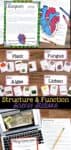
What body parts do living things have that allow them to function in their environment? How do plants and animals live and behave within their communities? Why do birds fly? Why do trees have rings? How do animals survive in the Arctic? All these questions and more are answered in these Structure and Function Science Stations. Structure and function is the cross-cutting concept that ties together every elementary life science topic — from plant parts to animal adaptations.

Included are 8 different elementary science stations where students deepen their understanding of the internal and external structure and function of plants and animal species that support survival, growth, behavior, and reproduction. The focus is on 4-LS1.A and includes concepts such structure and function of flowers, belly buttons, muscular and skeletal systems, bird structures to support flight, the human heart, trees, animals in arctic areas, leaves, and other organisms.
Background about Structure and Function Science Stations
In Fourth Grade, students are expected to “construct an argument that plants and animals have internal and external structures that function to support survival, growth, behavior, and reproduction” (4-LS1-1). This correlates with the DCI 4- LS1.A, which states, “Plants and animals have both internal and external structures that serve various functions in growth, survival, behavior, and reproduction.”
All stations in this set meet the DCI, helping students gain an understanding of the biological principle that “form fits function,” or organisms’ structures are necessary for the survival of the organism and of the species. The Investigate and Model stations go into more detail and help students construct arguments that specific structures are necessary for specific functions in the organism’s life, as outlined in the Performance Expectation.
Many of the stations found in the Third Grade Plant and Animal Life Cycle Unit 3-LS1.B could support this standard. In particular, the Model Station (Flower Dissection) introduces students to how flowers are necessary for some plants’ reproduction.
Other stations in the 3-LS1.B station set address plant and animal life cycles and may be useful for students to begin to understand how certain structures are necessary for the different phases of plants’ and animals’ life cycles.
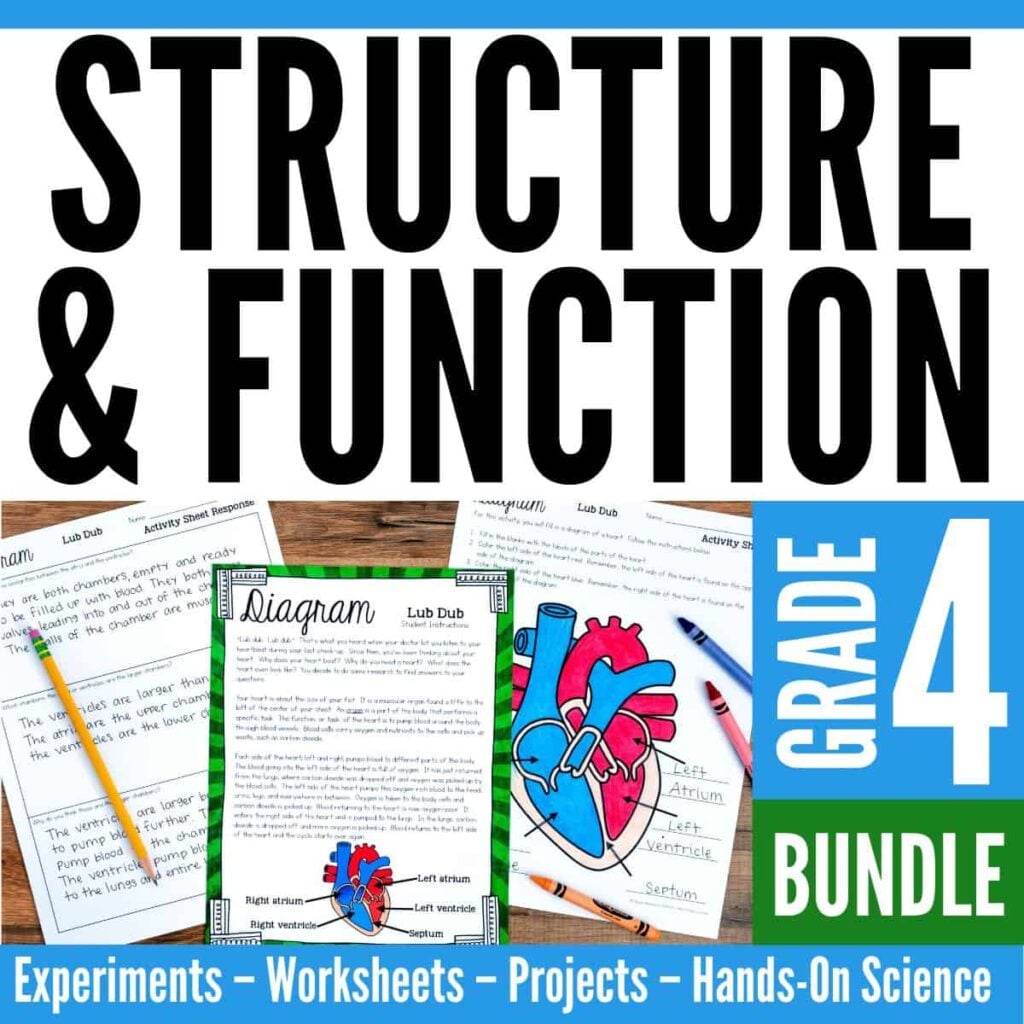
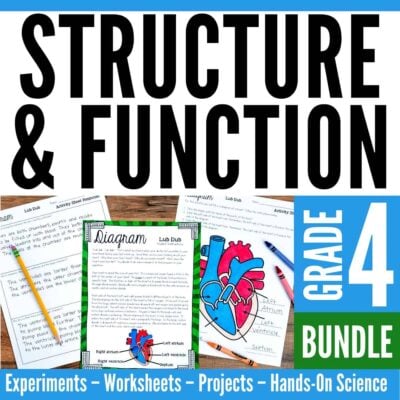
Structure & Function BUNDLE: How Organisms Live, Behave, Reproduce, Grow
Structure & Function: How Organisms Live, Behave, Reproduce, Grow Science Stations for Fourth Grade Next Generation Science Standards include 8 different science stations where students deepen their understanding of internal and external structures and functions of plants and animals that support survival, growth, behavior, and reproduction.
An In-Depth Look at the Structure and Function of the Elementary Science Stations
Vocabulary Cards for Structure and Function Science Stations
The vocabulary cards come in two formats: a three-part card with pictures and full-page cards with just the word and definition. The full-page cards are great for a science word wall.


The three-part cards can be used as a ninth science station or an early finisher station. Cut apart the cards and have students match the word, definition, and picture. Extend the learning and have students record some of the words in their science journals.
Differentiated Responses for Each Science Station
The Science Stations have several different ways students can display their understanding. Most of the variations are similar to each other but differentiated for various classrooms and learning styles.
Included are worksheets for both short-answer and fill-in-the-blank and task cards for both short-answer and multiple-choice responses.
To provide even more support, give students a word list for the fill-in-the-blank options. Also included are vocabulary cards in two formats which could become a ninth station if needed.
Watch a Video about Flowers or Why We Have Belly Buttons
The Watch a Video science station has two videos. One, pictured below, is about the structure of flowers and the functions of the parts of the flower. Included are differentiated responses, including the short answer task cards pictured below.

The second video in the watch a video science station explains the structure and function of belly buttons. Students will learn why animals have a belly button and the use of the umbilical cord in animals and humans.
Play a Video Game about Muscles and Skeletons or Extinct Plants
The Play a Video Game station includes two video games. One video game is about skeletons and muscles in animals. Students learn about the bones of elephants, humans, frogs, and falcons. This station is pictured below.

A second Play a Video Game station is called, Extinct! Are You Smarter Than a Plant? and has students look at plant seeds, roots, leaves, photosynthesis, and carbon dioxide.
Investigate Bird Flight and Bone Structure
In this station, called So, You Think You Can Fly, students read about the structures of birds that enable them to fly. During the investigation, students take a close look at a bird’s keel, femur, and feather.

There is a little bit of prep work involved with this station, but it’s entirely worth it! You will need to cook a chicken, remove the meat from it, and soak the bones in bleach overnight. The picture above shows both a whole keel and femur as well as those that are cut.
You may need to clean out the marrow from the femur. We found that using a straw was the easiest way to do this.

Feathers are sold at many craft stores. Full directions on how to prep this station are in the teacher notes in the resource.
Diagram a Human Heart
In this Structure and Function station, students read about the human heart and create a diagram of it. Students learn about the structure, including the chambers and the valves, as well as the function of the heart. After the activity sheet, students respond to questions in either a short answer, fill-in-the-blank or multiple-choice format. Here is an example of the diagram.

Read a Passage about Tree Growth
How do trees grow? Read all about it! In this station, students find out about how trees are different from other plants, the layers of a tree trunk, tree rings, photosynthesis, chloroplasts, evergreen and deciduous trees, and much more.
After reading students answer questions about the passage. You can choose to have students answer short-answer, fill-in-the-blank, or multiple-choice questions.

Model Animal Insulation
This model station is a fun one! It does take a little be of prep work, as seen below. We got the feathers from a craft store and the fur from an old stuffed animal.
Students read a passage about arctic animals, such as the polar bear, Weddell seal, and snowy petrel. After reading the passage, students use the below types of insulation and a thermometer to model a variety of types of insulation. Which one will keep your hand the warmest?
There is an included activity sheet to record the temperature and description as well as reflect on the exercise as well as an optional extension where students combine types of insulation. Also included are the differentiated responses to reflect on the learning.

Explore Photosynthesis
In this station, students explore photosynthesis using leaves from a deciduous tree. This station is an extension of a Third Grade Investigate Station where students were introduced to pigments and chromatography by separating the colors found in black watercolor markers. It may be helpful to show students the results of the investigation with markers as the separation of color is much more apparent.
We also found that there is sometimes a difference between materials found in local stores versus materials found at scientific supply companies. Laboratory-grade isopropyl alcohol is 99% pure. It is common to only be able to find 50% pure alcohol in grocery stores. We did find 91% isopropyl alcohol at a Walgreens Pharmacy that had a large section for home health care. 91% isopropyl alcohol was sufficient to do the activity. We also found that 100% acetone worked equally well. Look for either of those two products for the exploration.
In the photo below, you can see the results of the investigation with the marker alongside the exploration of the leaves using both 91% isopropyl alcohol and 100% acetone. The separation of colors of the pigments was very subtle in mid-spring when there is so much chlorophyll relative to the other pigments. These results can be much different in the fall when the amount of chlorophyll begins to decrease. It is less likely to overpower the other pigments

The other factor that can influence the success of this exploration is the grinding up of the leaves. Make sure you grind the leaves up to a pulp, and that the liquid is dark green. If needed, let the beaker and leaves sit for 30 minutes, covered.
We created a short video to show how the leaves should be ground up:
Sort Plants and Organisms into Kingdoms
The last station in this Structure and Function set is a sort station that comes with colored cards pictured below or a cut-and-paste worksheet format as well. In this station, students sort the organisms into plant, fungus, algae, or lichen after reading a descriptive text about the kingdom Plantae, Fungi, and Protista as well as Lichen.

Like all the stations there are differentiated responses in the form of short answer, fill-in-the-blank, and multiple choice.

Structure & Function BUNDLE: How Organisms Live, Behave, Reproduce, Grow
Structure & Function: How Organisms Live, Behave, Reproduce, Grow Science Stations for Fourth Grade Next Generation Science Standards include 8 different science stations where students deepen their understanding of internal and external structures and functions of plants and animals that support survival, growth, behavior, and reproduction.
How to Purchase the Structure and Function Science Stations
Related: Elementary Life Science Activities and Resources — explore K–5 life science from life cycles through ecosystems.
The Structure and Function NGSS Science Stations for Fourth Grade are available on my website and on Teachers Pay Teachers. Also available is a yearlong Fourth Grade Science Stations BUNDLE for a reduced price. You can see a full preview of the station on Teachers Pay Teachers.
Other Fourth Grade Science Stations
-
 Product on sale4th Grade NGSS Science Station Yearlong BUNDLEOriginal price was: $287.57.$159.00Current price is: $159.00.
 -
-
-
-
-
-
-
-
-
-
-





Jessica BOschen
Jessica is a teacher, homeschool parent, and entrepreneur. She shares her passion for teaching and education on What I Have Learned. Jessica has 16 years of experience teaching elementary school and currently homeschools her two middle and high school boys. She enjoys scaffolding learning for students, focusing on helping our most challenging learners achieve success in all academic areas.