
Make 10 Strategy – Develop 10 as a Benchmark Number
Teaching students to use 10 as a benchmark number is one of the most effective ways to build strong number sense in early elementary math. When students understand how to make 10, add 10, and use 10 to solve problems, they begin to move away from counting and toward more efficient strategies.
If you’ve ever watched students rely on their fingers for every problem, you know how hard it can be to shift their thinking. The make 10 strategy helps bridge that gap by giving students a reliable way to figure out math facts—even when they don’t have them memorized yet.
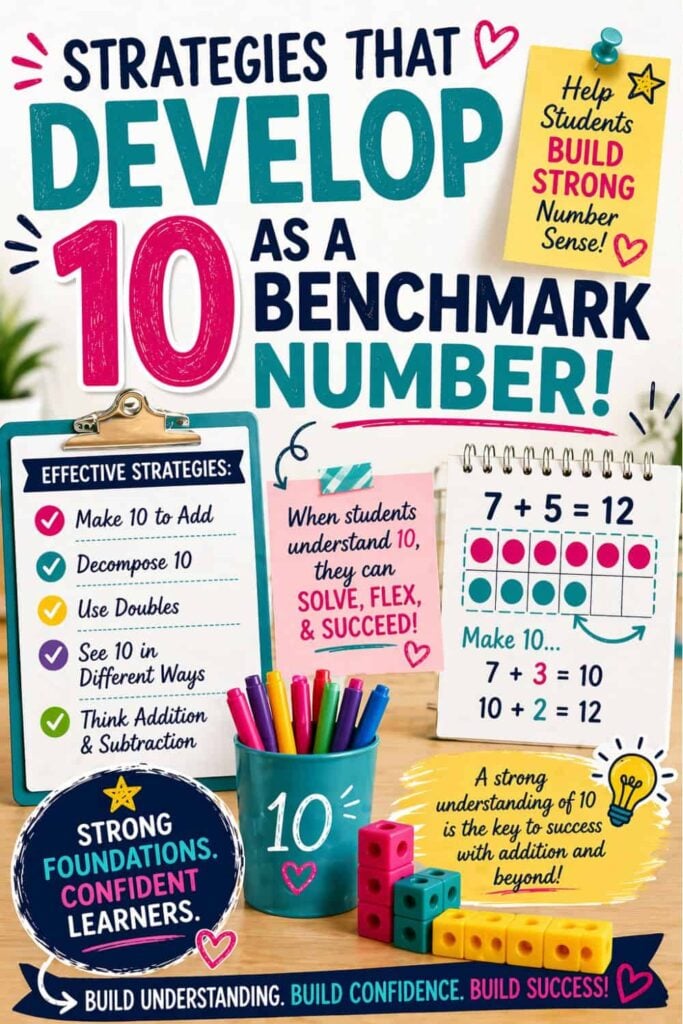
Students work with tens as they explore place value, ten frames, and hundreds charts. Our entire number system is built from a system of tens. Developing a solid understanding of 10 as a benchmark number and how it works within our number system is key for students’ mathematical development.
Counting by 10s and seeing how each decade is organized build numeracy, but they also support students as they begin to add and subtract larger numbers.
When you teach students math facts, do you help students understand, learn, and develop strategies for solving different math facts? Do you work on memorizing math facts with a variety of flashcards and games? Or do you do a combination of teaching strategies and fact memorization?
Why should I teach students Make 10 strategies to solve math facts?
Many students come into second grade still counting on their fingers when adding larger numbers. They need to move toward more efficient strategies, but they’re glued to their fingers because it’s safe and easy. Memorization may be difficult for them, or maybe they haven’t had enough practice.
We help students develop fluency with basic facts so that they can learn to think strategically. Between a student who counts each object and a student who has a fact memorized, there are students who use a variety of strategies to solve problems. Strategies help students find the answers to math facts, even if they forget.
Using 10 as a benchmark doesn’t just help with basic facts—it builds a foundation for more complex math. When students learn to think flexibly with numbers, they can apply the same strategy to problems like 38 + 57 by adjusting numbers to make friendlier combinations.
This kind of thinking helps students solve problems mentally and builds confidence as they begin working with larger numbers.
Students often use a strategy called compensation to solve math problems.
What is compensation?
Compensation is when students adjust numbers to make a problem easier to solve.
For example:
8 + 4
→ take 2 from the 4
→ give it to the 8
→ 10 + 2 = 12
Students aren’t changing the value—they’re just rearranging the numbers to make the math easier.
Why is this significant?
It allows students to solve the problem in their heads rather than with paper and pencil. Students become flexible in their thinking. Their brains become attuned to solving math problems, looking for patterns, and figuring it out. Not only is a sense of perseverance built up, but so are pathways in the brain. Over time, these pathways become faster and faster at finding patterns and solving problems.
This same thinking later becomes:
38 + 57
→ 40 + 55
That’s why understanding compensation early is so powerful.
As students develop fluency with different strategies, they are able to choose which strategy works best for certain types of problems and solve them easily, not because they “know” the answer, but because they can figure it out. It is helpful to teach addition strategies by helping students see the value of making 10, adding 10, and using 10 to become more efficient in figuring out math facts and adding larger numbers.
Strategies that Help Students Develop 10 as a Benchmark
Now that you understand why you should teach strategies and the concept of compensation, here are the strategies that I focus on at the beginning of second grade. Although I teach the “count on” strategy, most students are familiar with it, so we spend the majority of our time making 10, adding 10, and using 10 to add and subtract.
Make 10 Math Facts
One of the most important sets of math facts students memorize is the Make 10 facts (1+9, 2+8, 3+7, 4+6, 5+5). Automatic recall of these number combinations allows students to efficiently do mental math calculations. It is foundational not only to learning math facts but also to multi-digit addition and subtraction later on. Remember the above example with 38+57?
In kindergarten and first grade, we emphasize the importance of knowing your Make 10 facts (1+9, 2+8, 3+7, 4+6, 5+5, and the reverse). We do fun, cute activities that show the relationships among the numbers and help students memorize key math facts.
Some of my kiddos don’t come into second grade with their make-10 facts memorized, so we usually start here as a whole group. They are generally familiar with the concept but need a lot of practice to memorize it.
Add 10
Another key strategy is Add 10. This one is relatively easy to teach once students understand place value. Add 10 should have been developed in first grade, but again, some students might not know the pattern at the beginning of second grade. Although it is a key skill to develop, it can be developed quickly once students recognize the pattern.
Adding 10 is all about understanding place value patterns. It is a key skill because students need to understand how two-digit numbers are composed of 10 and a number in order to use 10 to add and subtract.
Also, once students are subtracting two-digit numbers, understanding how to decompose a 10 (like 42 can be written as 30 + 12) helps them solve more complicated problems.
Use 10 to Add & Subtract or the Make 10 Strategy
What is the Make 10 strategy? The Make 10 strategy is when you can turn one number into 10 by using compensation to add or subtract that value from another number in the problem.
This is a key strategy for the end of first grade and the beginning of second grade. Students develop this skill at around that time, but it may take some students a bit longer for this strategy to “click” in their brains.
Using 10 to add and subtract depends on the ability to see equality and know that 9+6 is the same as 10+5. Students must be able to use compensation, which is knowing that they can take one away from the 6 and give it to the 9 to make 10+5.
Consider it. When you add 8+7, 8+3, 8+4, do you ever think about how 8+2=10 and think about how many more there are to get to the sum?
Here’s what this looks like in action:
9 + 6
→ 10 + 5
→ 15
8 + 7
→ 10 + 5
→ 15
Students need repeated opportunities to see and practice these relationships so they can recognize them quickly and use them automatically.
One place students often begin using this strategy is with +9 facts. These problems are perfect for practicing how to make 10 because students can quickly adjust one number to create a more familiar fact.
If you want to see how this works step-by-step with real examples, you can read more about how to teach +9 addition strategies here.
Now that you’ve read this far, do you get a better sense of why using 10 to add is an important skill to develop? Not only can it be used to figure out single-digit math facts, but it also transfers to multi-digit addition.
Make 10 Strategy Activities That Build Real Understanding
Once students understand how to use 10 as a benchmark number, they need structured practice applying the strategy in different ways.
Worksheets alone aren’t enough. Students benefit from activities that help them see, match, and talk about how numbers relate to 10.
Here are a few effective ways to build that understanding:
Make 10 Math Fact Activities
Here are some of the activities we do to practice making 10s when adding. You can see more of them in this blog post. My goal is to develop fluency and flexibility in mathematical thinking. Students are provided with many different opportunities to interact with making 10.


Add 10 Activities
Here are some examples of the Add 10 activities. You can see more in this blog post. While adding 10 is a relatively simple skill to develop, it is not one to skip over!

Use 10 to Add & Subtract Activities
Here are some Use 10 math activities. You can see more of them in this blog post.


How to Use These Strategies in Your Classroom
Teaching students to use 10 as a benchmark number isn’t something that happens in one lesson. It takes consistent exposure, intentional modeling, and plenty of opportunities to practice in different ways.
Here’s what that can look like in your classroom:
Start with Concrete and Visual Models
Begin by helping students see how numbers can be broken apart and recombined. Use tools like ten frames, counters, or number bonds to show how numbers make 10. When students can physically move objects, the strategy becomes much easier to understand.
Model Your Thinking Out Loud
As you solve problems, talk through your thinking step by step:
9 + 6
“I know 9 needs 1 more to make 10. I can take 1 from the 6 and give it to the 9. Now I have 10 + 5.”
Hearing this process repeatedly helps students internalize how the strategy works.
Practice with Familiar Fact Patterns
Focus on problem types that naturally connect to 10, like +9 and +8 facts. These give students repeated opportunities to apply the strategy and begin recognizing patterns across problems.
Use Partner Talk and Math Discussions
Give students time to explain their thinking to each other. When students talk through how they made 10, they strengthen their understanding and begin to use more precise math language.
Provide a Variety of Practice Opportunities
Students need more than one type of practice. Mix in:
- quick whole-group practice
- math centers or stations
- partner games
- independent work
This helps students apply the strategy in different contexts and builds flexibility in their thinking.
Revisit the Strategy Often
Even after students seem comfortable, continue to bring the strategy back during daily math. Use it during warm-ups, number talks, or when solving new types of problems so students see how it connects to other math skills.
Over time, students begin to rely less on counting and more on recognizing number relationships. That’s when you know the strategy is starting to stick.
Frequently Asked Questions about the Make 10 Strategy
Ready-to-Use Make 10 Activities and Math Centers
If you’re looking for ready-to-use activities that give students consistent practice with making 10, adding 10, and using 10 to solve problems, I’ve put together a set of math resources that do exactly that.
These activities include games, matching tasks, and hands-on practice designed to help students build fluency with strategies—not just memorize answers.
They work well for math centers, small groups, or independent practice and are especially helpful for students who are still relying on counting strategies.
You can take a closer look at those resources here.
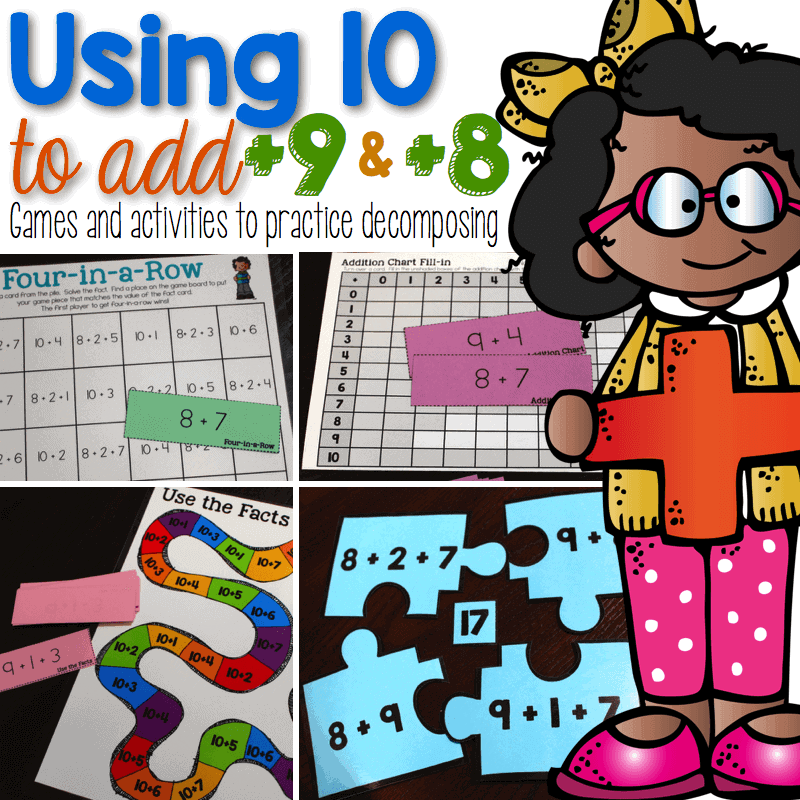
Using 10s to Add (+9 and +8)
Using 10 to Add is full of a variety of games and activities to engage your students in using ten to add +9 and +8 facts. These games and activities specifically focus on establishing 10 as a benchmark number to give students practice in developing automaticity with larger math facts before moving on to multi-digit addition and subtraction.
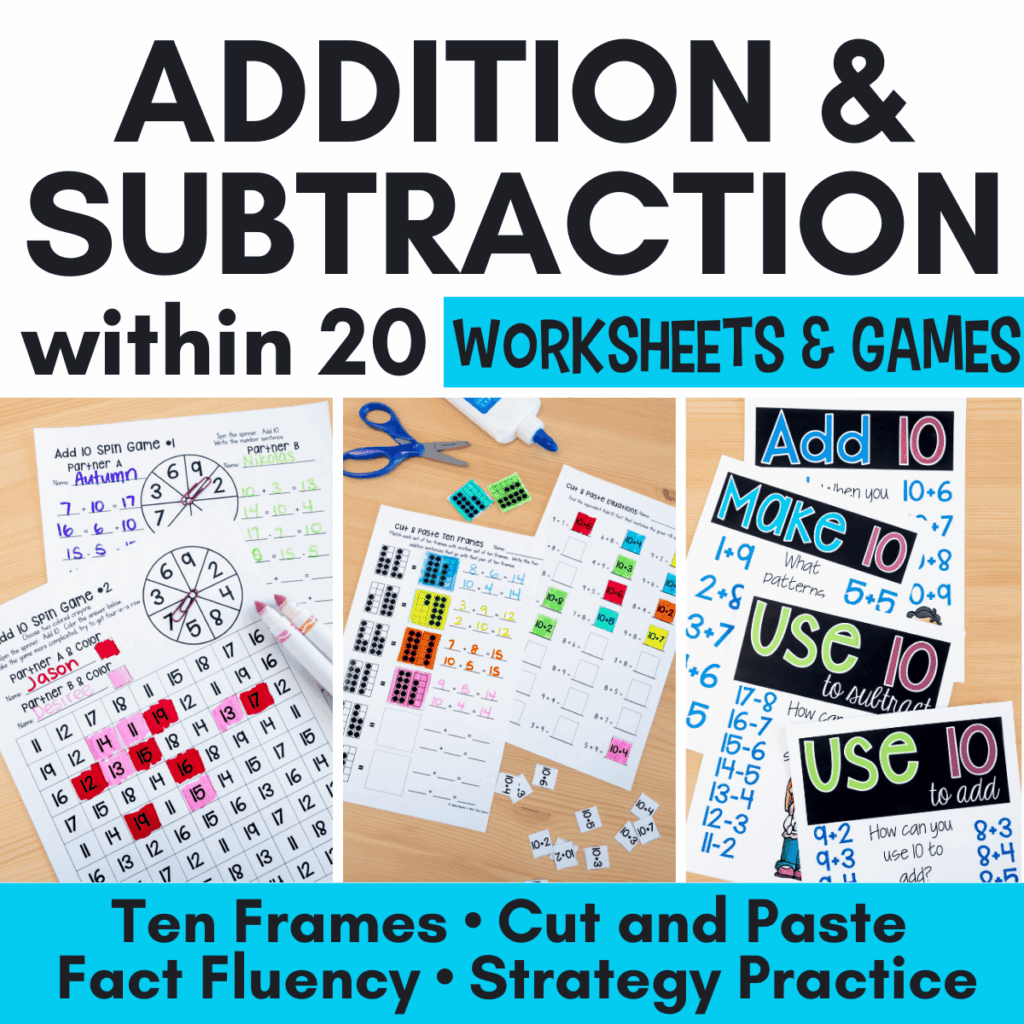
Addition and Subtraction Within 20 Using Ten as a Benchmark
Help second grade students build addition and subtraction fluency within 20 by using 10 as a benchmark number. This math unit includes no-prep worksheets, cut-and-paste activities, partner matching cards, and quick checks focused on making ten, adding ten, using ten to add, and using ten to subtract.

me gusta mucho su aplicacion pero mas me gustaria que los videos sean en espanol
I was a bit confused by your Use 10 to Add and Subtract. When I look at the sums 16-9 = (This does NOT equal 9+1+7). If you are trying to regroup the first number to make 17, then THAT makes sense, but then this equation above is incorrect. Not quite sure what the aim was with this cut and paste worksheet.
Thanks for letting me know! That piece was in the wrong place; I’ve corrected it.
The cut and paste option is a great way for students to “try out” different answers in different places and figure out which one makes sense. I also like it because all of the answers are given to students. They just need to figure out which answer goes with which problem.
The idea is that students “make 10” when adding, so looking at 16-9, they could figure out that one added to nine is ten then six more is 16.