
Partitioning Rectangles: Hands-On Activities for 2nd Grade Math
Partitioning rectangles takes a bit of spatial reasoning and the ability to draw straight lines. It’s a difficult skill for second graders, especially those with poor printing skills.

Partitioning rectangles is one of the 2nd grade Common Core geometry standards that requires both spatial reasoning and the ability to draw fairly straight lines — a combination that is harder for some second graders than it sounds.
CCSS.MATH.CONTENT.2.G.A.2
Partition a rectangle into rows and columns of same-size squares and count to find the total number of them.
This standard also serves as an early foundation for multiplication and area. When students count the squares in a 3-row, 4-column rectangle, they are building toward the array model of multiplication and the area formula they will use in 3rd grade. Make that connection explicit with students, even if you don’t introduce multiplication as a term yet.
Partition Rectangles by Folding Paper
On Monday, we folded and cut paper into halves, unfolded the paper, drew the lines, and numbered the squares. We also folded paper more times to make more squares! This was some hard folding for some of my kiddos, but they were able to do it. I really emphasized following directions and making a hard crease.

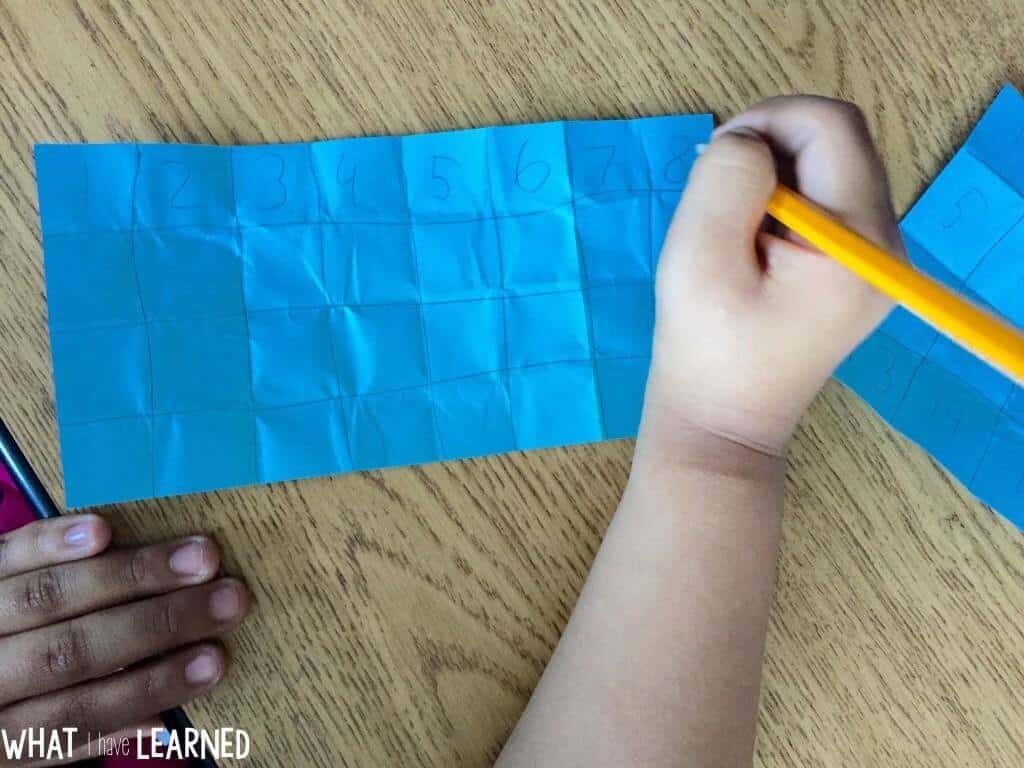
After folding and counting the squares, we glued them in our composition books and I had students write in the number of rows and columns and use sentence frames to tell how many rows, columns, and squares there were in each rectangle.

This little guy needed to finish his labeling, but he’s got the concept!

This anchor chart has helped us throughout the unit. I keep it simple: the word “rows” with a horizontal arrow showing left to right, and the word “columns” with a vertical arrow showing top to bottom. Students refer back to it constantly when they mix them up, which most second graders do at some point.
I also use sentence frames throughout this unit, especially for English learners. Starting with simpler frames (“There are ____ rows. There are ____ columns. There are ____ squares.”) and progressing to the combined form (“Since there are ____ rows and ____ columns, there are ____ squares.”) gives students a scaffold for the math vocabulary before they can articulate it independently.
Partition Rectangles Practice Sheets
I put together a unit on partitioning rectangles this week and created a few practice sheets, in addition to our class activities.
The Partition into Rows & Columns mini unit includes everything needed to teach and practice this standard:
Sentence frames for rows, columns, and squares — two levels, from simple three-sentence frames to a combined sentence
Folded paper activity directions — step-by-step instructions for creating 5×5 and 8×4 inch partitioned rectangles through folding, drawing, and numbering
Six practice sheets — counting squares, partitioning with scaffolding (tick marks provided), and partitioning without scaffolding, each with answer keys
Class partitioning project directions — the wall display project shown above, where student pairs create labeled rectangles for numbers up to 25 and tape them to a number chart
24 task cards (A-X) with a recording sheet and answer key — students either draw a rectangle and partition it, or count rows, columns, and squares from a pre-drawn rectangle. Laminate the cards for whiteboard marker use.

Partition Rectangles into Rows and Columns
This mini unit teaches students how to partition rectangles into rows and columns and then count the squares.
Partition Rectangles with Markers
Tomorrow, we’ll practice with whiteboard markers on desks. Students love writing on their desks, and this gives me one more way to make the content feel new. The photo on the product page above, drawn with whiteboard markers, is what we’re doing. I’ll have students draw a rectangle that mirrors what I draw on the board, and they’ll partition it into a given number of rows and columns. Using sentence frames will help solidify the learning even more.
Partition Rectangles through a Class Project
We will also start our class project tomorrow. I’ve done this class project for a few years in varying formats.

This year, we will create the rectangles and label them with the rows, columns, and squares. In past years, I’ve done all the numbers, but this year, I may just target the composite numbers and not list all the numbers
between 1-30.
All of these activities are available in the Partition into Rows & Columns mini unit.
If you teach this standard alongside a multiplication or arrays unit, the multiplication building arrays and area post shows how the same hands-on approach extends into 3rd grade. The rows-and-columns vocabulary students build in 2nd grade carries directly into area and multiplication work in the following year.
Partition Rectangles into Rows and Columns
This mini unit teaches students how to partition rectangles into rows and columns and then count the squares.

Right now I teach 2nd grade but next school year I will be teaching 1st grade. I love your activities. You explain things so well. We are teaching this school now and they were having trouble getting it. But once I did the folding paper activity with them they got it!
Thank you, the idea is great especially now that I am doing online classes.
This was very helpful with my second grade small groups. They were having trouble with partitioning, rows and columns. We used the folding paper lesson and once they saw how the squares from folding the paper, they all understood it much better. This is a great way to make sure students are mastering this lesson. Thank you we truly appreciate this resource here at Gladys Noon Spellman E.S. in Cheverly, MD
That’s awesome! I’m so glad the lesson worked well with your students and that they could see the connection between the folded paper and rows and columns in an area model. Hands on activities are the best! Thank you so much for taking the time to share your experience