
How to Teach a Second Grade Number Line for Addition and Subtraction
If you teach second grade, you know that number lines show up everywhere: in addition, subtraction, place value, and mental math. A strong 2nd grade number line strategy helps students move beyond counting on their fingers and into real place value reasoning. For second grade teachers, understanding how to teach a second grade number line effectively can make multi-digit addition and subtraction far less intimidating for students.
In second grade, students begin using number lines for multi-digit addition and subtraction. They learn how to make jumps of 10 and 100, break apart numbers by place value, and use friendly numbers to solve problems efficiently. A well-taught number line strategy builds flexibility and prepares students for larger numbers in third grade and beyond.
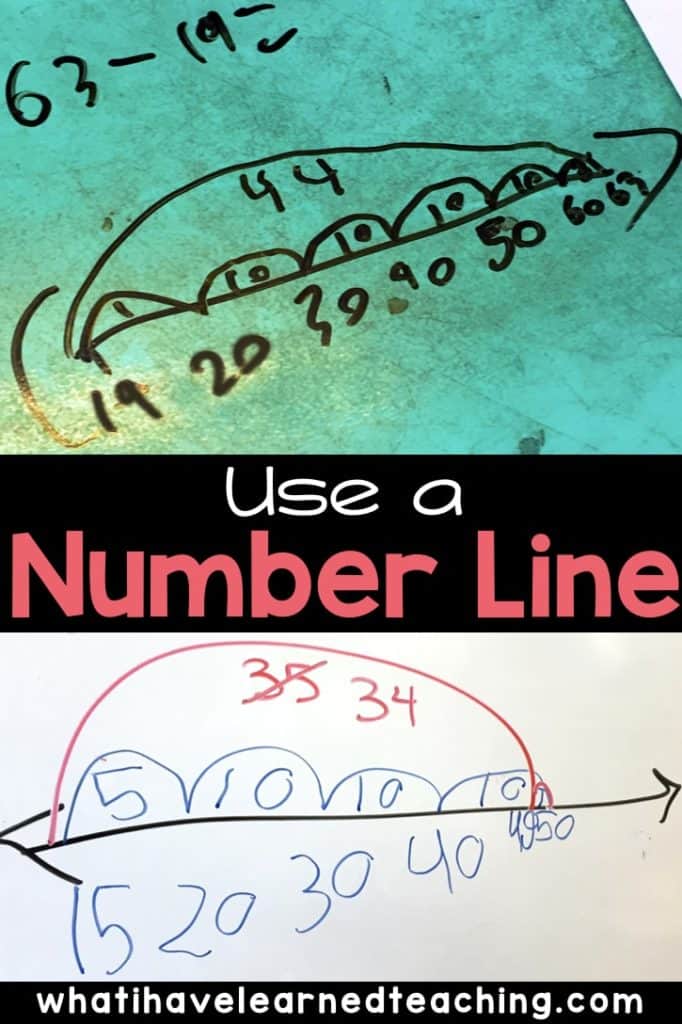
This guide walks through how to teach a 2nd grade number line for addition and subtraction, how to build prerequisite skills, and how to help students move from labeled number lines to open number lines with confidence.
Why Number Lines Matter in Second Grade
In second grade, students move into two- and three-digit addition and subtraction. This is the year place value becomes the backbone of math instruction.
A number line supports:
- Place value understanding
- Mental math development
- Flexible thinking
- Preparation for third-grade strategies
Using a number line for addition and subtraction becomes one of the most powerful place value strategies students learn in second grade.
Prerequisite Skills for Using a Number Line
Using a Hundreds Chart
A number line is essentially an expanded hundreds chart.
Before students master number lines, they need strong hundreds chart skills:
- Moving up and down by 10
- Identifying number patterns
- Decomposing numbers into tens and ones
If students struggle on a number line, revisit the hundreds chart. The gap often starts there. Without strong hundreds chart skills, a number line strategy in second grade becomes much more difficult for students to apply.
These Addition Task Cards help students break a number apart by place value and add the parts. It’s exactly like using a number line, but with a hundreds chart instead.
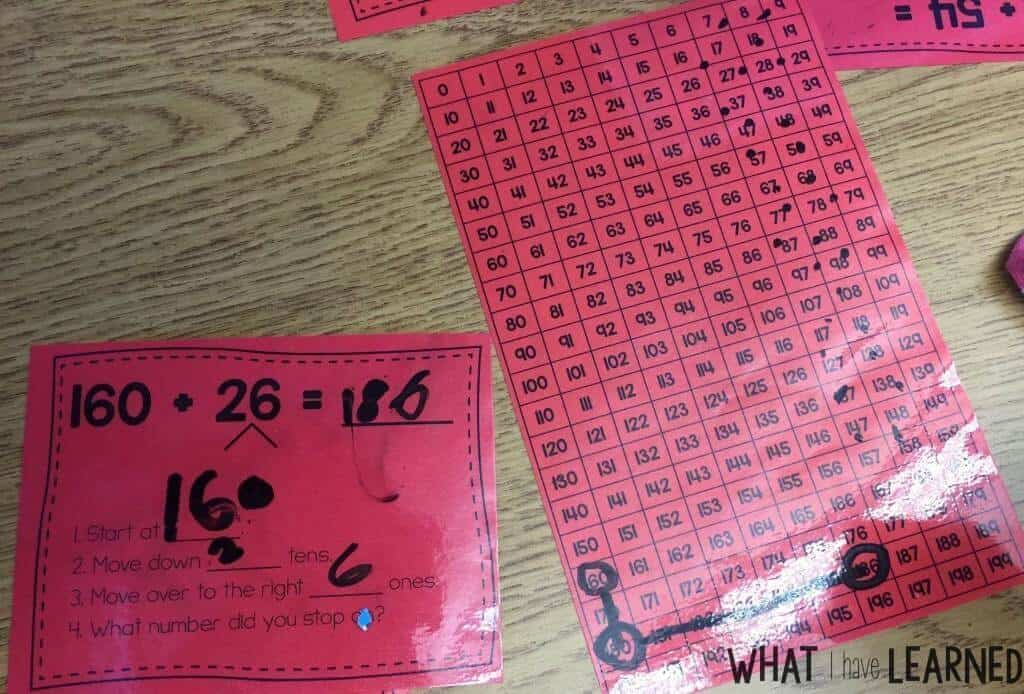
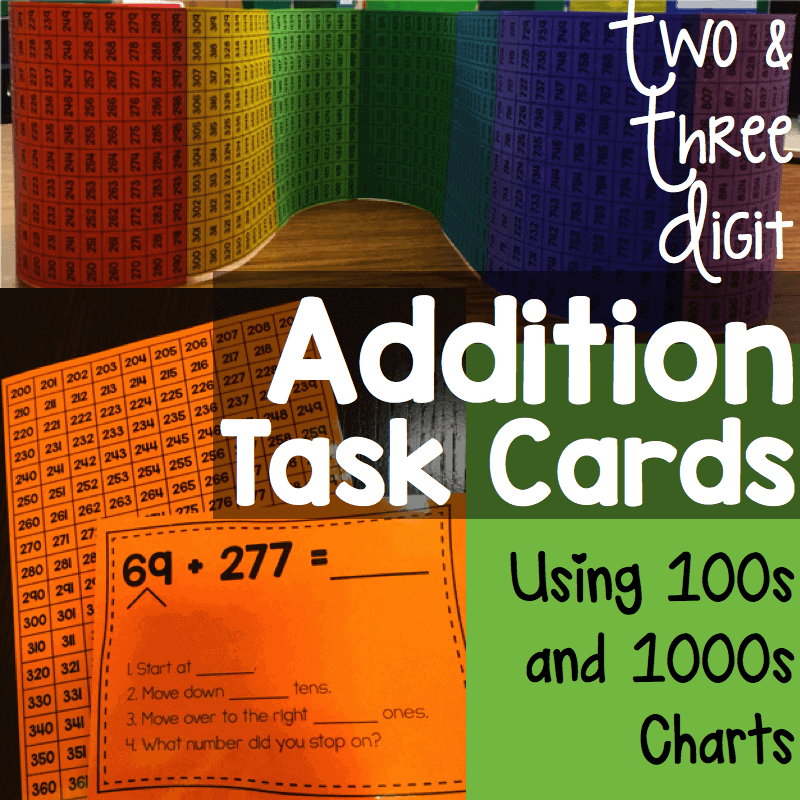
Addition Task Cards Using 100s Charts
Addition task cards in which students use 100s charts to solve two- and three-digit addition problems. Charts and task cards are divided into sets numbered 0-999, with 200 numbers on each chart. For example, if a problem is 345 + 86, students can use the chart that goes from 300 – 499 and travel across 400 when adding.Using these task cards will help students visualize larger numbers on a chart and add larger numbers by tens and ones.
Composing and Decomposing Numbers
Before students can confidently use a second grade number line, they need to understand how to compose and decompose numbers by place value.
A number line strategy depends on students seeing numbers in parts — not as single, solid digits.
For example, when solving the addition equation 58 + 34 on a number line, students must understand that:
34 = 30 + 4
Without that understanding, they are more likely to count by ones instead of making efficient jumps of tens and ones.
If students struggle with number lines, the gap is often not the number line itself. It is difficulty composing and decomposing numbers in expanded form.
Strong skills with:
- Expanded notation
- Breaking numbers into hundreds, tens, and ones
- Rebuilding numbers from place value parts
make number line strategies far more successful.
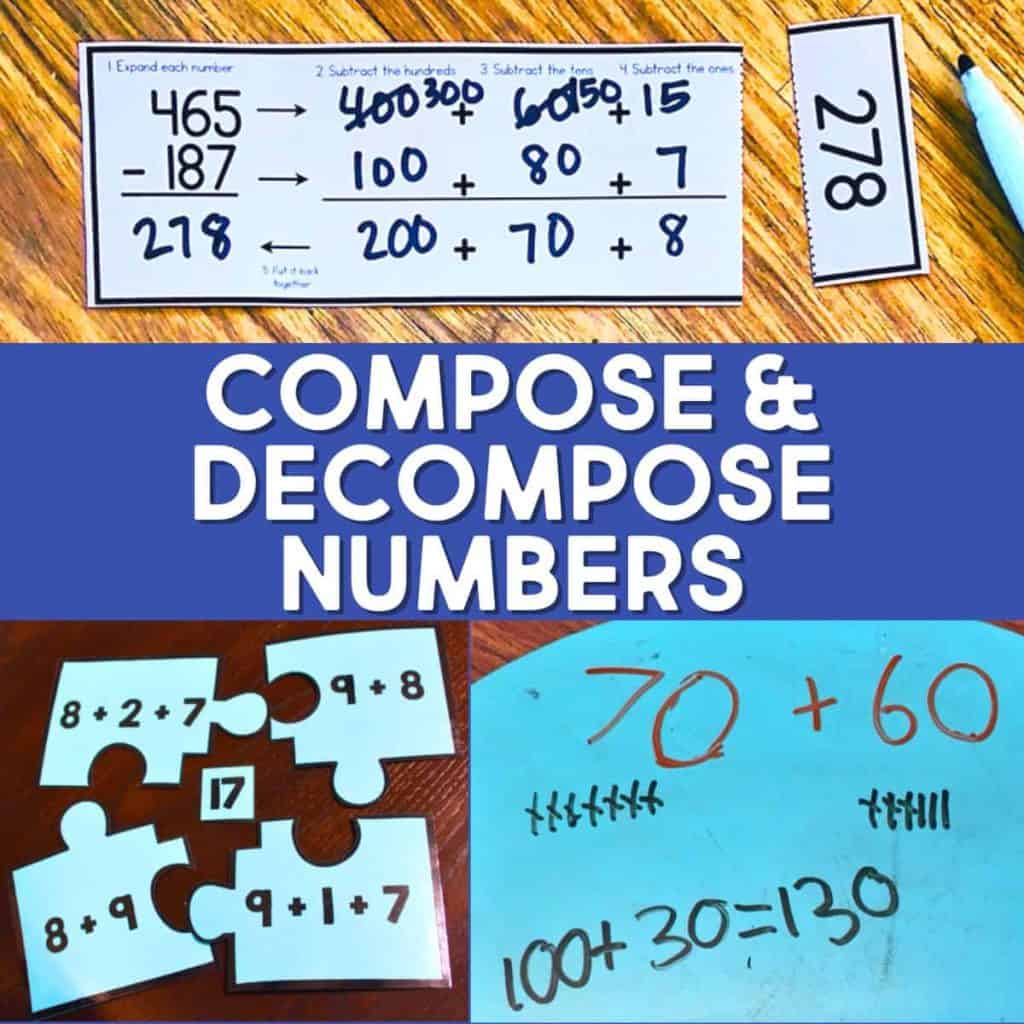
More about Composing & Decomposing Numbers
If you want a deeper look at how to teach these skills, you can read more about composing and decomposing numbers.
What Is a Number Line Strategy?
A number line strategy is how students use a number line model to solve addition and subtraction problems.
The number line is the tool.
The strategy is how students move along it.
A number line strategy in second grade focuses on using place value to make efficient jumps instead of counting by ones.
In second grade, students typically use:
- Open number lines
- Vertical number lines
- Count up strategy
- Break apart strategy
- Friendly numbers
Let’s break those down.
Open Number Line
An open number line does not have all the numbers labeled. Students decide where to place numbers and how large each jump should be. This encourages place value thinking instead of counting by ones.
For example, when solving 46 + 27, students might:
- Start at 46
- Jump 20 to 66
- Jump 7 more to 73
They are breaking apart the 27 into tens and ones.
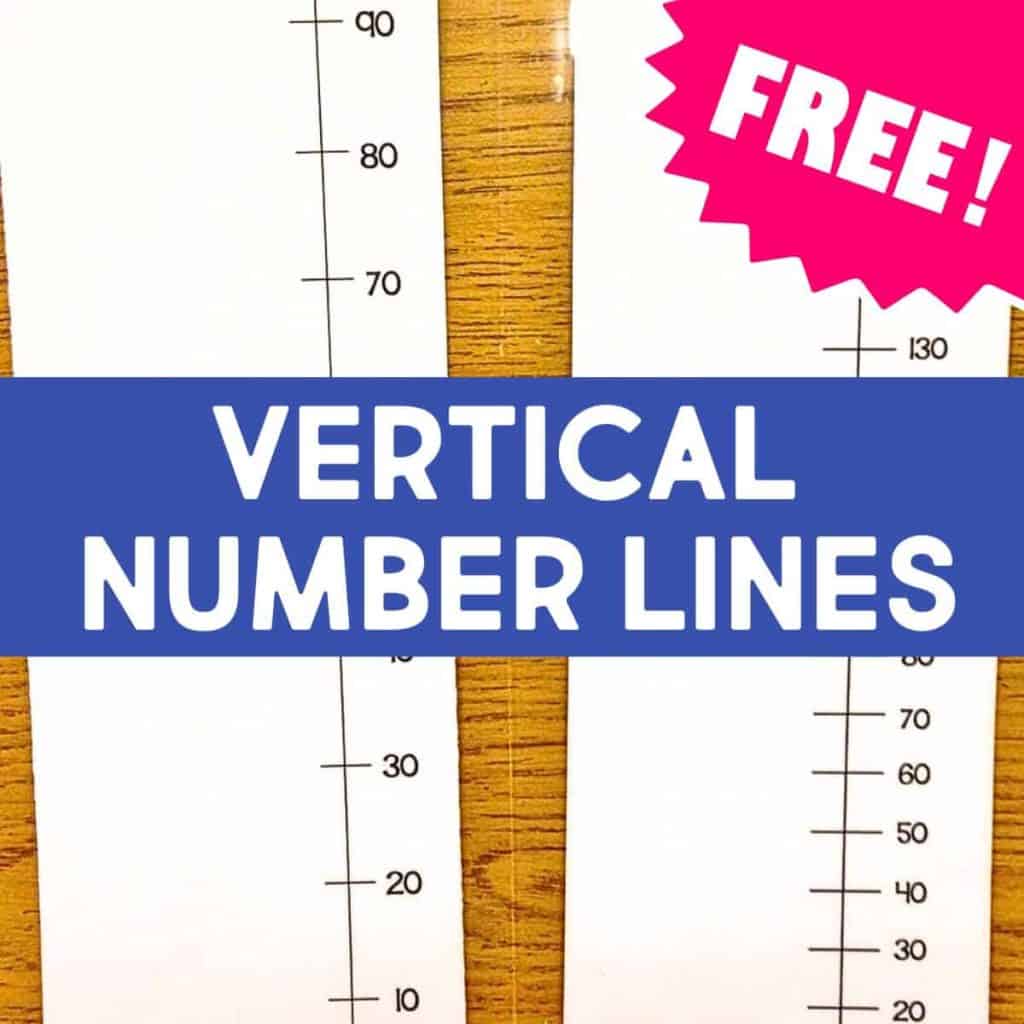
Vertical Number Line
A vertical number line is simply a number line drawn from bottom to top instead of left to right. Some students process numbers better vertically because it resembles a thermometer or the layout of a standard subtraction problem.

Vertical number lines can be especially helpful for subtraction when students use a count-up strategy. A vertical number line for subtraction often helps students visually organize their thinking more clearly than a horizontal model.
More about Vertical Number Lines
Read more about vertical number lines and how to use them in your classroom.
Count Up Strategy for Subtraction
The count up strategy is often used for subtraction. Instead of subtracting backward, students start at the smaller number and count up to the larger number. They then add the jumps together to find the difference.
This number line subtraction strategy strengthens number sense and is often easier for students than traditional regrouping.
Break Apart Strategy for Addition
The break apart strategy is when students decompose numbers into tens and ones before making jumps.
For example:
58 + 34
Break apart 34 into 30 and 4
Jump 30, then jump 4
This number line addition strategy reinforces place value understanding.
Using a Second Grade Number Line for Addition (2-Digit & 3-Digit Problems)
Break Apart Strategy or Partial Sums Addition
When solving 46 + 27, students can:
Start at 46
Jump 20 to 66
Jump 7 to 73
Instead of counting by ones, they break apart 27 into tens and ones. In second grade, this helps students solve two-digit addition problems without relying solely on the standard algorithm.
This is one of the most powerful ways to use a number line for addition in second grade.

More about the Break Apart Strategy
The break apart strategy is also called partial sums addition. Learn how I use it to teach three-digit addition.
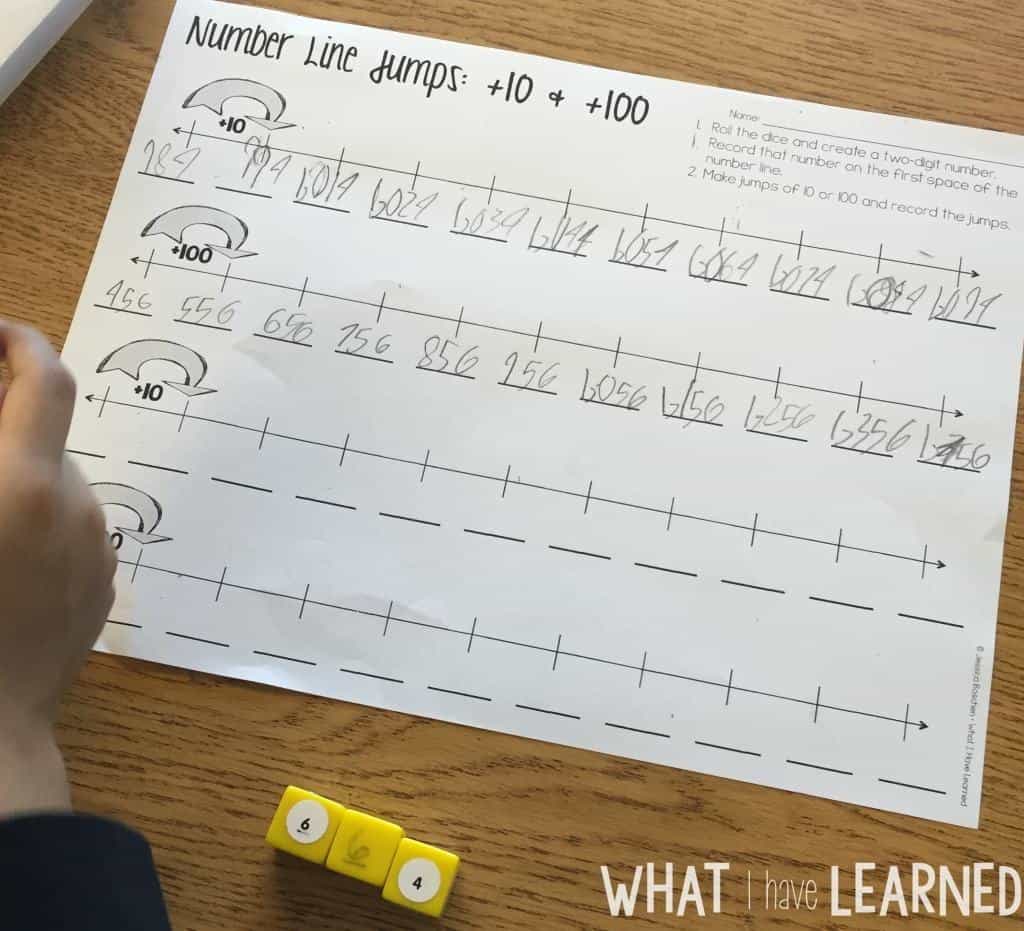
Making Jumps of 10 and 100
Students must become comfortable moving by 10s and 100s. Teaching a number line by 10s and 100s builds the foundation for multi-digit addition and subtraction.
If kids cannot count fluently forward and backward by 10s and 100s, number line strategies become frustrating instead of helpful.
Practice includes:
- Counting up and down by 10s
- Counting up and down by 100s
- Identifying where 500 would fall on a 0–1000 number line
- Estimating intervals
These skills directly support multi-digit addition.
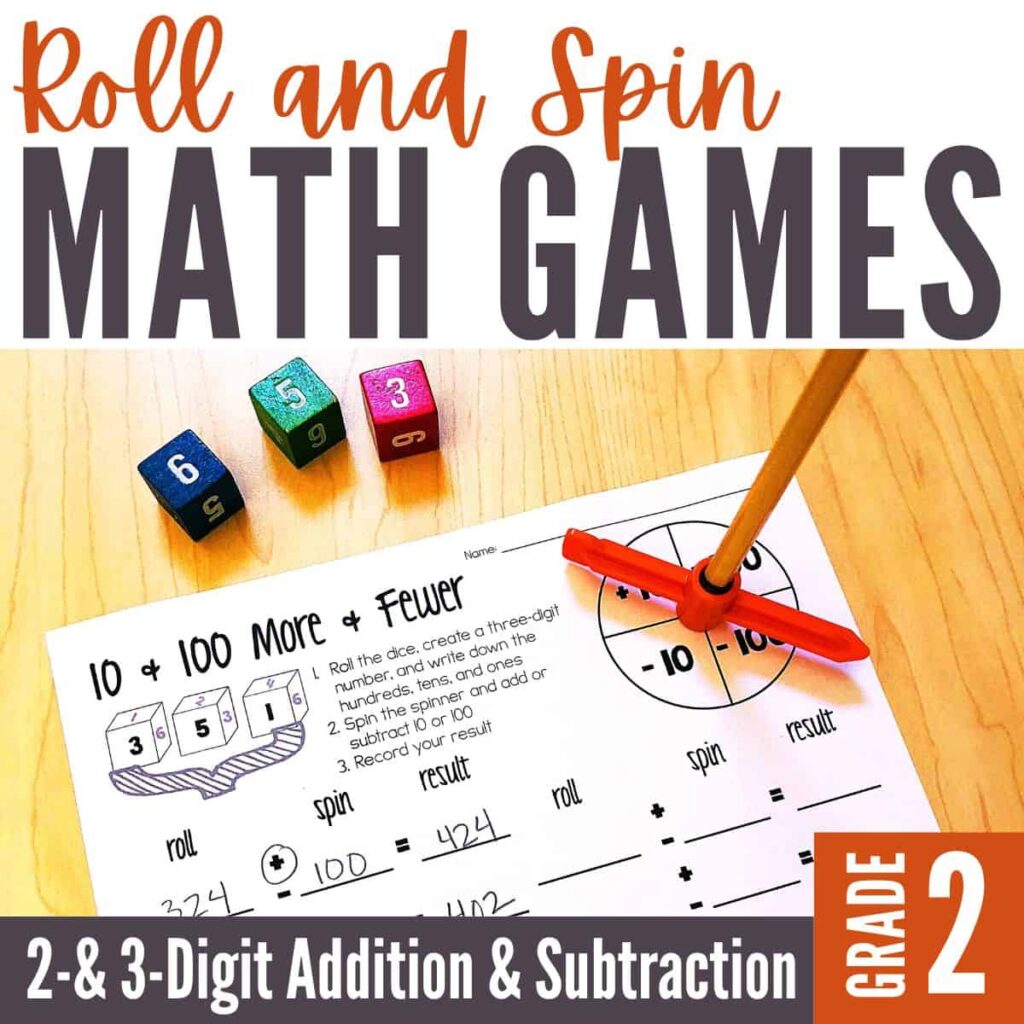
We practice this skill a lot using our Roll & Spin Math Games.
Roll and Spin Math Games for Multi-Digit Addition & Subtraction
These Roll and Spin Math Games focus on developing number sense for two-digit and three-digit addition. The activities help students develop competencies in using a number line and other place-value strategies when adding two- and three-digit numbers.
Using a Number Line for Subtraction
Counting Up to Find the Difference
For subtraction, many students benefit from counting up instead of subtracting backward.
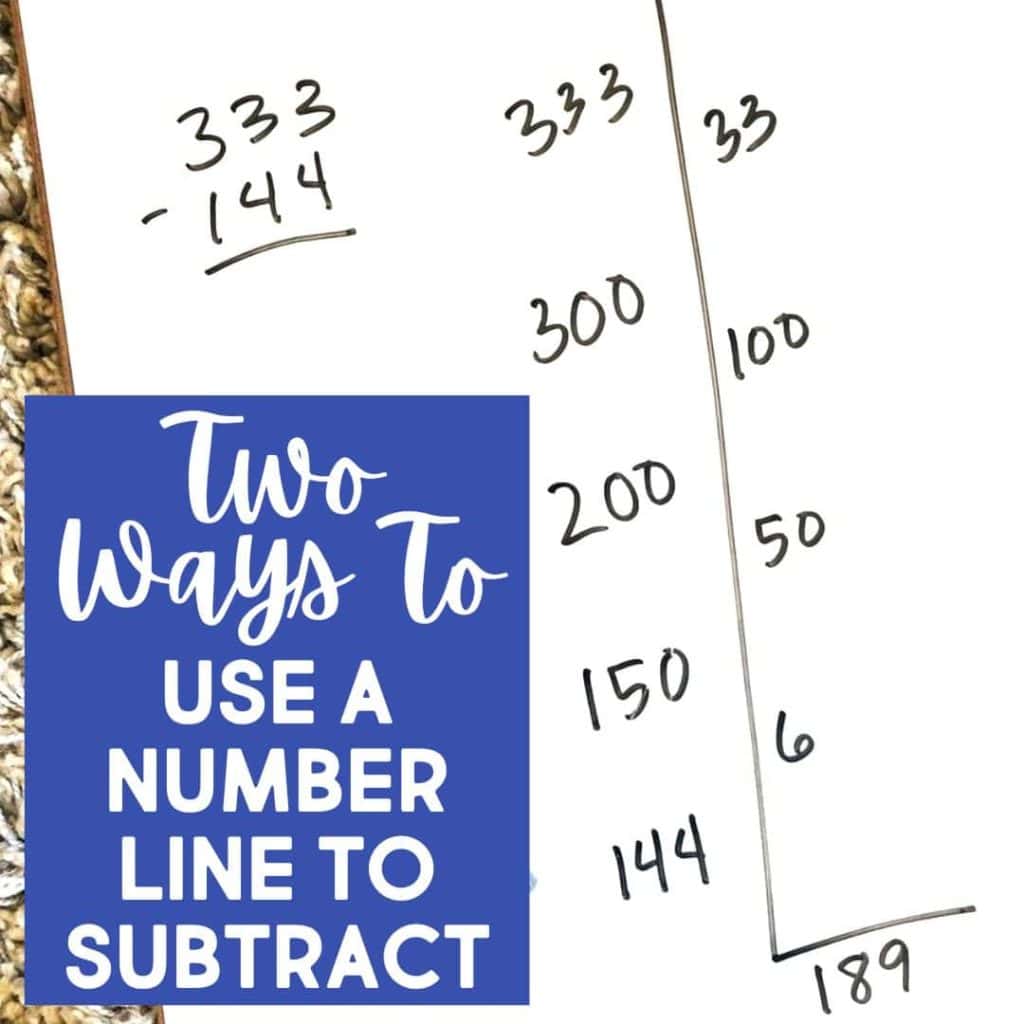
Example: 333 − 144
Start at 144
Jump to 150
Jump to 200
Jump to 300
Jump to 333
Add the jumps together to find the difference.
This approach helps students find the difference more efficiently than subtracting backward by ones.
Here is an example where a vertical number line is used with the count-up strategy for subtracting three-digit numbers.
In this image, the problem is 333-144. We put 333 at the top and 144 at the bottom. I drew a line on the right side. We listed “friendly numbers” on the left and the “jumps” on the right side. At the bottom, I drew a line to mimic the bottom of a math problem, and the sum of the jumps is at the bottom.

The straight lines help students organize their thinking and separate the two sides of the number line. The value of the jumps is on the right each friendly number is on the left. Draw a line at the bottom and add the jumps together.
More about Vertical Numberlines with THree Digit Numbers
See more ideas about using veritcal number lines and friendly numbers for three-digit subtraction.
Friendly Numbers
Friendly numbers are multiples of 10 or 100 that make jumps easier.
Instead of jumping randomly, students aim for numbers like 150, 200, or 300 to keep their thinking organized. Teaching students to look for friendly numbers first makes subtraction on a number line faster and more accurate.
Moving from Labeled to Open Number Lines
Many students can place numbers correctly when tens are marked, but using an open number line in second grade requires a deeper understanding.
The real growth happens when labels are removed.
An open number line requires students to:
- Decide spacing
- Determine interval size
- Use scale appropriately
If students struggle when labels disappear, that is usually a scale issue — not a math issue.
That’s where building your own number line becomes powerful.
Create a Number Line with Base-10 Blocks
While observing a few students do our computer-based math program, I noticed that about 10 of my students were struggling with number lines. Specifically they were struggling with placing numbers on a number line without labels. They had passed the previous levels, which asked them to place numbers on a number line with the 10s labeled, but they couldn’t do it without the labels or vertical markers.
I had them take out their number lines with the 10’s marked, but it was larger than the one on the screen. The kiddos tried to put it up to the screen and match the end marks up, trying to find where the 10’s would be. They did not realize that number lines can represent the same values at different scales. This conversation about scale on a number line helped students understand that spacing represents value, not just visual distance.

So, we made our own, larger number line and had a discussion about scale. My students are familiar with base-10 blocks, so I used what they knew (a ten) and placed them together in a line to make 100. I did this with the students, asking them along the way how many we had, what the value was, etc.
This was a wonderful exercise to get students thinking about scale but also helped them see that each interval is a ten.
Practicing Number Lines in Everyday Classroom Routines
Number lines do not need to live only in math lessons. Reinforcing a second grade number line during daily routines helps students build automaticity with place value.
We use them during class routines.
For example, when tracking homework stars, we:
- Count totals
- Break apart numbers
- Add tens first
- Add ones next
- Place totals on a growing number line
When we hit 186 stars, we extended the number line to 1000.
Students counted by 100s, identified 500, and located 186 using tens and ones.
That kind of real-world repetition builds number sense far more effectively than isolated worksheets.
This is what our chart looked like at the end of one day.

After a few days our chart looked like this:

Our task today was to figure out how many stars we had for the whole week. (The chart was filled in on the orange and yellow, but not the green and did not have the total).
We expanded each number into tens and ones, added the tens first, then combined the ones. Students saw how 186 could be located by finding 100, then counting by 10s to 180, and finally adding 6 more.
Since we got 186 stars, I had to make a new number line:
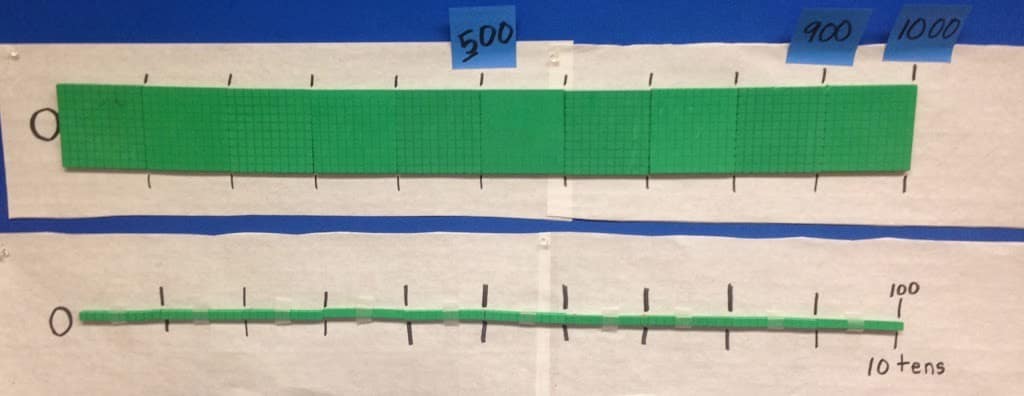
This one is using hundreds blocks and goes up to 1000. Students could name each 100 as we added each block and could count by 100s. Not all of them were too confident about naming 1000. We figured out where 500 was on the chart and did do a sticky note for 186. We found 100, then counted by 10s to get to 180.
I’m really hoping that these base-10 number lines will help students see how different numbers are related to one another.
Common Mistakes When Teaching Number Lines
Students often struggle with:
- Scale and spacing
- Making jumps that are too small
- Forgetting to add jumps at the end
- Confusing subtraction direction
- Relying on 1-jumps for every problem
When this happens, slow down and return to place value language.
Ask:
How many tens are we adding?
How many ones?
What friendly number could help?
The number line should support thinking, not replace it.
Why Number Lines Build Long-Term Math Success
In second grade, number lines build:
- Flexible thinking
- Decomposition skills
- Mental math
- Confidence with larger numbers
These same strategies later support:
- Fractions
- Decimals
- Negative numbers
- Algebraic reasoning
A strong second grade number line strategy grows with students and lays the groundwork for understanding fractions and decimals in later grades.
Final Thoughts on Teaching Number Lines
A well-taught second grade number line strategy transforms addition and subtraction from procedural steps into meaningful number relationships.
When students understand jumps of 10 and 100, use friendly numbers, and think about scale, they are doing real math thinking.
And when a student tells you that you “forgot to do math” after an entire lesson built around a number line — that’s when you know it’s working.
Watch: Number Line Strategy in Action
Below is a video I created about number lines.

Thank for helping readers to learn strategies with regards of numbers. I really enjoy it.
Your suggestions are right on. This is exactly what we are working on in my second grade class. I will have to try adding on a 100s chart and the vertical number line with the kiddos who are still struggling with this whole concept.
Do you have subtraction task cards with the hundreds chart?
No, I don’t. I’ll consider making some, though!
What is the Numbers Talk Book that you are referring to?
This is it! https://amzn.to/3hVhEXc