
Energy Science Stations for Fourth Grade
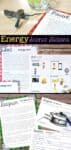
The Energy Science Stations for Fourth Grade focuses on energy transfer and conservation of energy in moving and colliding objects, light energy, and the transfer of energy from electrical to other types of energy. The Energy Science Stations encompass Next Generation Science Standards PS3.A-D and ETS1.A.

By working through this mega-set of stations, students gain a robust understanding of energy, energy transfer, and conservation of energy. There are 10 different stations to use in your classroom.
These stations address the 4th grade energy standards, which are part of the largest physical science year in the elementary NGSS sequence. My physical science guide for elementary students has the full picture of 4th grade physical science — and how energy connects to the waves standards taught in the same year.

Energy Science Stations BUNDLE – Transfer of Energy & Forces
Energy Science Stations for Fourth Grade Next Generation Science Standards include 10 different science stations where students can deepen their understanding of energy, transfer of energy and forces.
Background about the Energy Science Stations
In Fourth Grade, the Engineering Standards are incorporated within the Disciplinary Core Ideas (DCI) of these science standards. For this reason, we incorporated the engineering standards within the science stations. For example, in 4-PS3, 4- ETS1.A is listed as one of the DCIs.
We created the 4-PS3 Energy Science Stations to include, not only the physical science concept of energy but also the engineering practice of “defining engineering problems.” We used the Investigate science station in the science station set to meet this engineering DCI.
Why combine 4.PS3.A-D?
In 4-PS3, energy, energy transfer, and conservation of energy are closely related topics that are built upon and intertwine with each other. For this reason, we chose to combine the four physical science Disciplinary Core Idea (DCI) standards into one mega-station station set. There would have been much overlap between station sets had we created four separate sets of stations.
Here is how the DCIs are intertwined:
- The DCI 4-PS3.A defines energy, relates energy and speed, and discusses how energy is moved through light, sound, and electricity. This DCI integrates all three main topics of 4-PS3.
- The DCI 4-PS3.B discusses energy transfer and conservation in moving and/or colliding objects, light energy, and the transfer of energy from electrical to other types of energy. This DCI integrates all three main topics of 4-PS3, as well as incorporating all the information in 4-PS3.A.
- The DCI 4-PS3.C discusses energy transfers in collisions, which is also part of 4-PS3.B. This DCI also integrates the energy and energy transfer topics of 4-PS3, and it is not unreasonable to also introduce and discuss how energy is conserved in collisions.
- The DCI 4-PS3.D discusses conservation of energy as energy is transferred from one form to another. This DCI integrates all three topics of 4-PS3, and is a topic that is covered in great detail in 4-PS3.A and B.
An In-depth look at the Energy Science Stations
This mega set of Energy Science Stations contains 10 different stations as well as several additional resources to use in the implementation of the stations and teaching of these concepts.
Students are encouraged to use their Science Journals with the task cards, but worksheets are provided for each of the energy science stations. Included are checklists to monitor student progress through the stations. The Science Stations are designed to last about 20 minutes each. Teachers implement the stations in a variety of ways, including one station a day for 10 days or 2 a day for five days.
Vocabulary Cards
Included in all of the science stations are vocabulary cards in two formats. The cards come in a three-part card that can be used as another station. On the three-part card is the vocabulary card, picture, and definition. Match all three for a complete set.
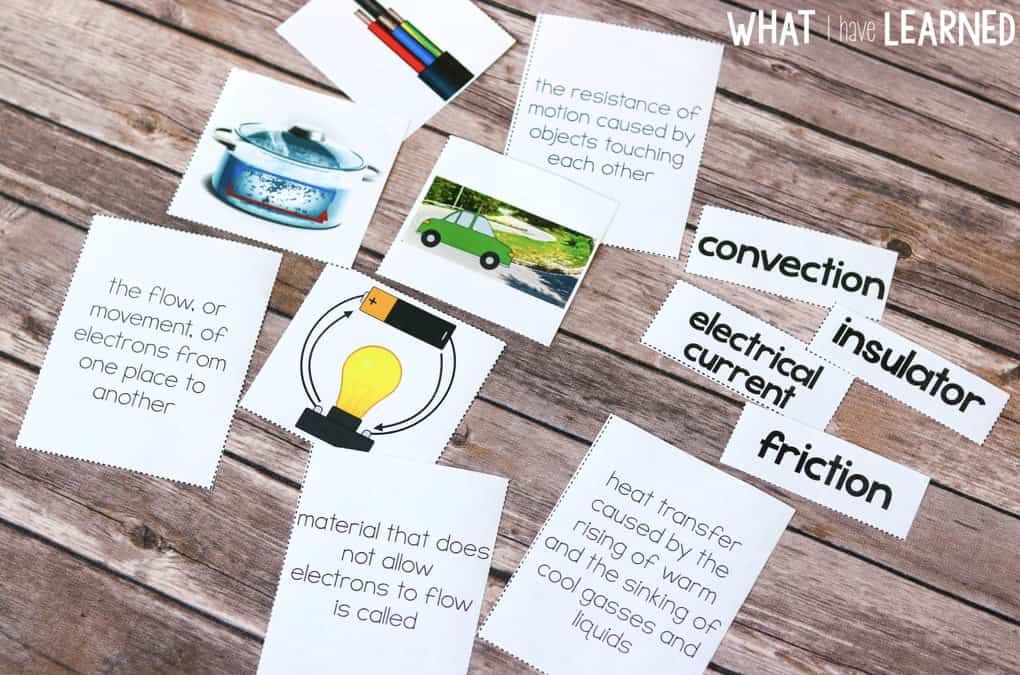
Also included for easy display are large cards with the word and definition. Both of the two different types of vocabulary cards work well in pocket charts as well.

Differentiated Responses
These Science Stations have several different ways students can display their understanding. Most of the variations are similar to each other but differentiated for various classrooms and learning styles.
Included are worksheets for both short-answer and fill-in-the-blank and task cards for both short-answer and multiple choice responses.
To provide even more support, give students a word list for the fill-in-the-blank options.
Watch a Video on Energy Science Stations
In this science station, students watch one of two videos about energy. One video, pictured below, gives an overview of energy and goes over the forms of energy. The second video specifically focuses on potential and kinetic energy through the application of rollercoasters. Students identify how the rollercoaster moves and the different types of energy at different points on the track.

Play a Video Game Energy Science Stations
What student doesn’t love video games? This station has two videos games about different types of energy and light. The video games require a computer. They walk students through a series of activities and simulations. As with all the stations, this station includes differentiated responses. Below is an example of the fill-in-the-blank and multiple-choice task cards.

Investigate Kinetic and Potential Energy
This Investigation is a Marble Engineering Challenge where students create a rollercoaster simulation using pipe insulation and a marble. Students are given general instructions and criteria that they must meet.
For this investigation, the criteria are (1) the marble must not have any help along the track to keep moving after the initial drop, (2) no materials other than what is offered may be used in the construction of the roller coaster, and (3) the marble must come to a complete stop at the end of the roller coaster with a high-friction surface and not by hitting a wall or being caught in a trap.
Trial and error are expected here. Students should be allowed to change their design until their roller coaster meets all the criteria.
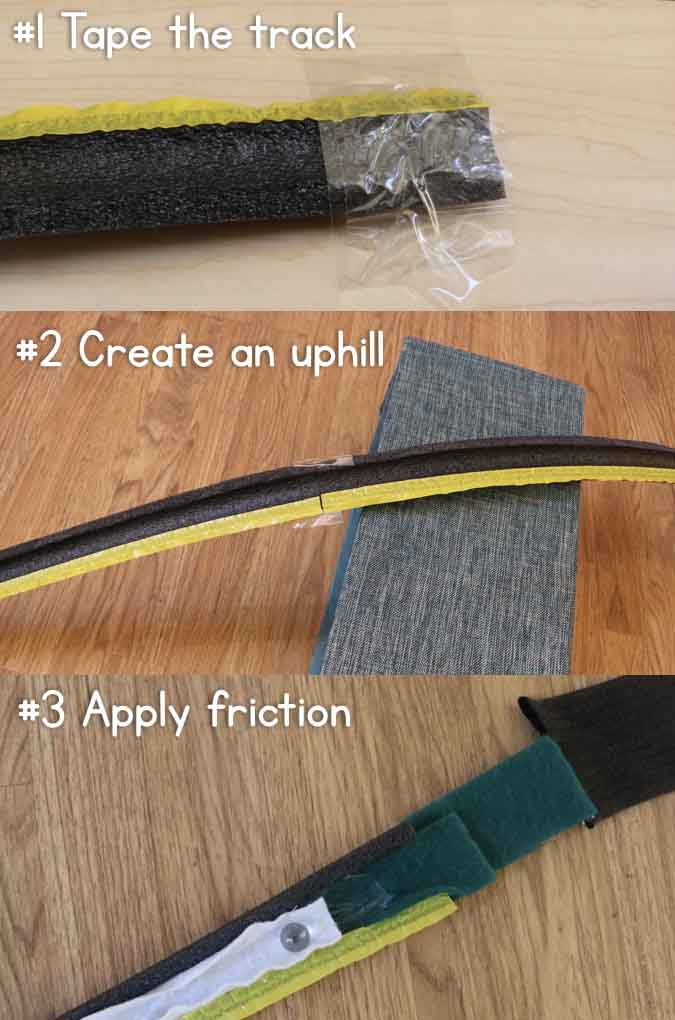
Above is an example of one way to set up the track and create friction at the end. I love this station because students can be creative. This is an opportunity to give students freedom to investigate science.
After the Investigation, students respond on the activity sheet by drawing their track and writing. In addition to the activity sheet are the same type of differentiated responses as in all the other stations.

Draw a Diagram of Thermal Energy
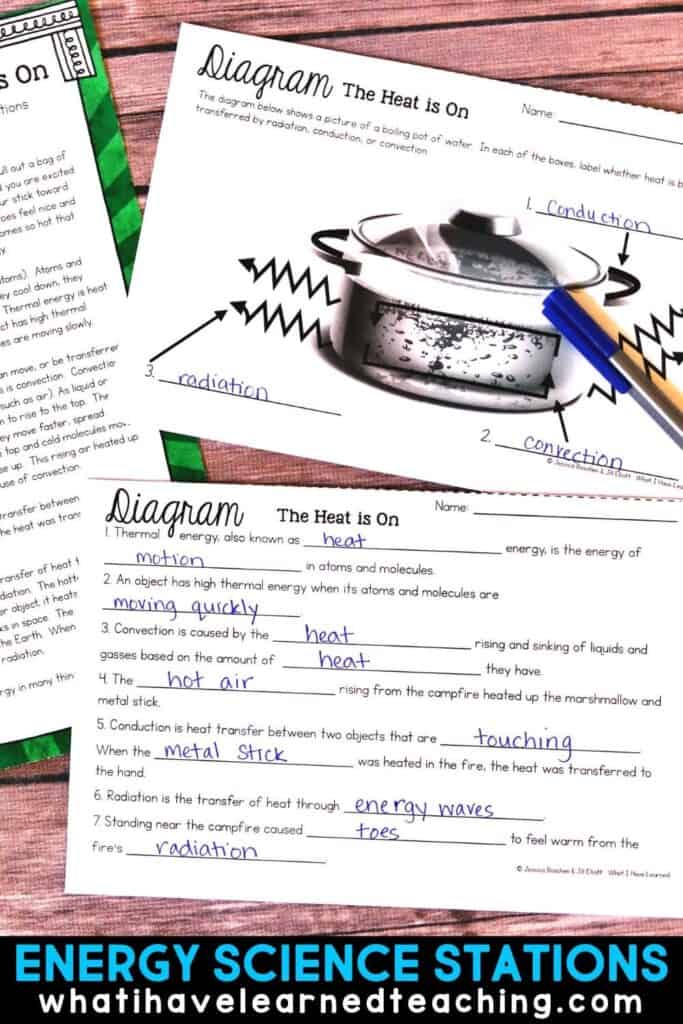
In this Diagram station, students read a passage about thermal energy and label the diagram with convection, conduction, and radiation. Also included are the differentiated responses. Below is the fill-in-the-blank response sheet.
Read a Passage about Sound Energy
In this science station, students read about sound energy. Students take a look at pitch and volume and their effect on sound waves. Included are the four types of differentiated responses.

Create a Model #1 of the Law of Conservation of Energy
This particular set of science stations is a mega set that includes two Model and two Explore stations to address all of the standards. The first Model station looks at the Law of Conservation through the application of car crashes. Students use what they learned about energy, speed, and mass to see how energy transfers between the two cars.

Students record their responses on the activity sheet. The recording sheet has room for predictions and results. Also included are the differentiated responses where students reflect on kinetic energy, friction, and mass.
Create a Model #2 of Electrical Energy in Batteries
The second Model station has students make a battery cell and model how to create one-cell, two-cell and five-cell batteries to light a bulb. Directions are provided for the model you see below.
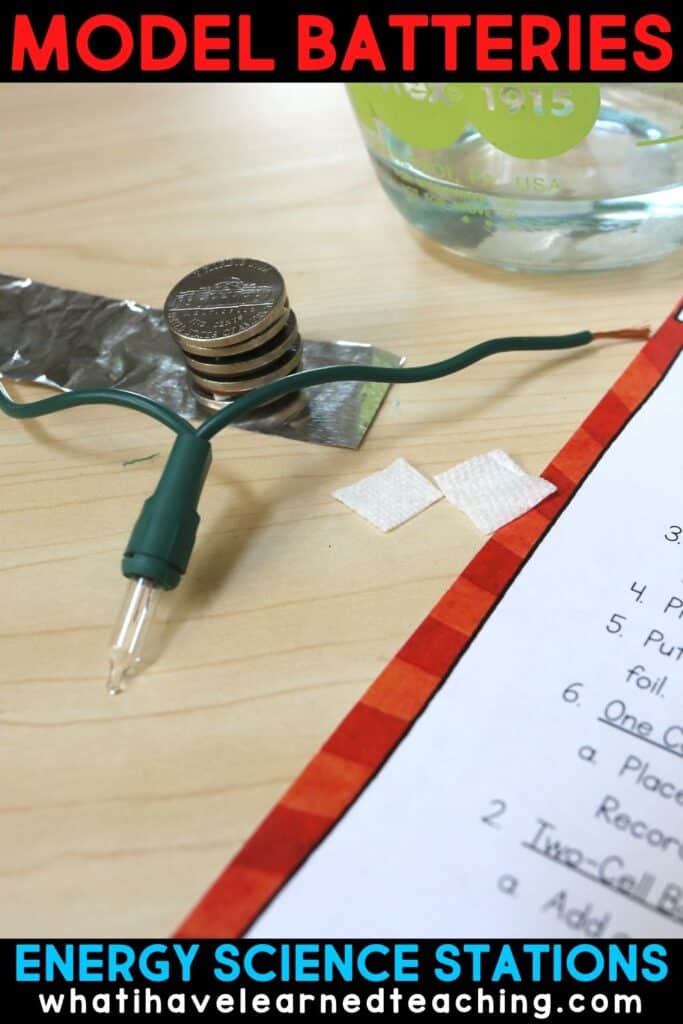
This station can be extended to experiment with other electrical components and other materials to make the batteries. By providing more materials, students can explore what may work well together to create the battery. These optional extensions would meet the engineering strand for the standard.
Explore #1 Electrical Energy Circuits
Students love exploring electricity. In this Light It Up station students explore how to light a bulb with a variety of metal, wooden, and plastic materials. There is a short reading passage that teaches students how electrons flow through a circuit in a closed loop. Using the information from the passage, students explore how to create a closed-loop circuit.

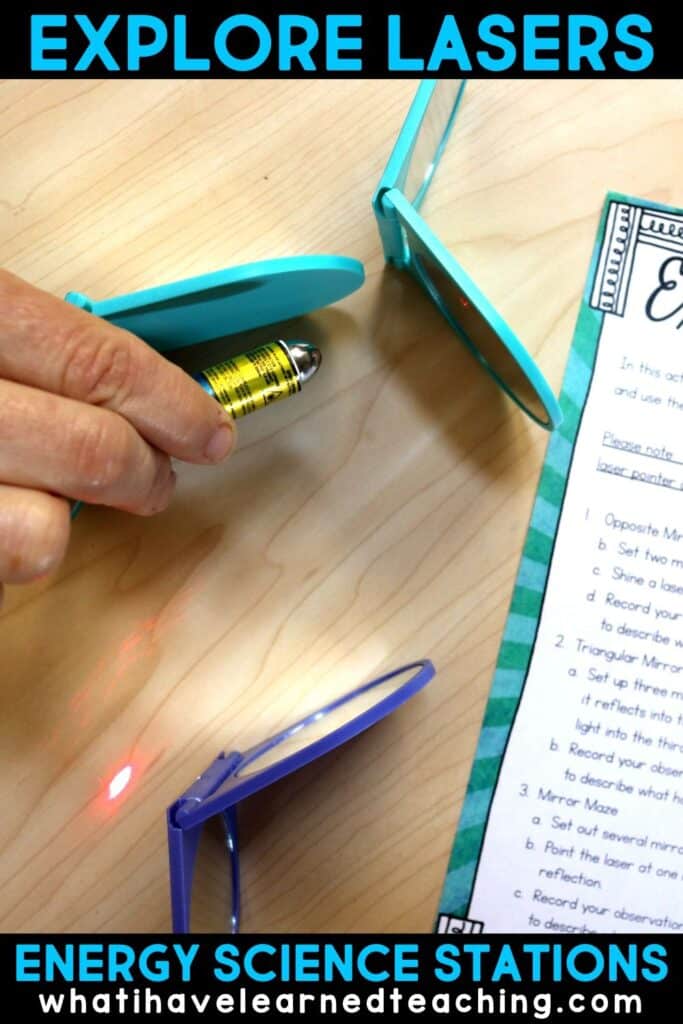
Explore #2 Laser Light Energy
In this second Explore station students read about different light energy. Students learn about wavelengths and laser lights and explore how light can be reflected in multiple mirrors. Students explore how laser lights are used in a variety of applications.
Sort Different Types of Energy
In this sorting activity, students read about kinetic energy, potential energy, sound energy, electrical energy, and thermal energy. Students then sort pictures into those five types of energy. The sort can be completed as a worksheet like a picture below or with included color cards. The station also includes the differentiated responses.

Energy Science Stations BUNDLE – Transfer of Energy & Forces
Energy Science Stations for Fourth Grade Next Generation Science Standards include 10 different science stations where students can deepen their understanding of energy, transfer of energy and forces.
How to Purchase
The Energy Science Stations for Fourth Grade can be purchased on my website or on Teachers Pay Teachers. You can also purchase the BUNDLE for a reduced price.
Other Fourth Grade Science Stations for NGSS
We have many other science stations aligned with the NGSS for fourth grade:
-
 Product on sale4th Grade NGSS Science Station Yearlong BUNDLEOriginal price was: $287.57.$159.00Current price is: $159.00.
 -
-
-
-
-
-
-
-
-
-
-






Wow! This looks awesome!
I love learning stations or centers. Students learn so much not only from the activities but from feedback between each other. This is great for inclusion classrooms, too. Great ideas!
Hi! I purchased your stations bundle and we are currently using, Its amazing, the only thing that we are having trouble with is the Model were students build their own battery, but we can´t get it work. Any tips you would like to give me? Thank you so much!
Hi, Helen,
I’m glad you like the science stations!
I have some ideas/troubleshooting tips. When I did this, it worked for me.
1. It could be that you is using an old/more dilute solution of vinegar. Make sure this is a newer/regular concentration of vinegar. Sometimes off-brand (dollar store) vinegar is cheap for a reason.
2. The pieces of paper between the coins cannot be sopping wet. They need to be soaked, but not dripping. The edges of the coins need to be dry. We want the electrons to conduct through the battery, not around the battery.
3. Similar to above, make sure the papers between the coins do not peek out from the sides of the coins. This will affect where and how the electrons flow.
4. Make sure the foil is dry.
5. The paper needs to have some substance and “squish” to it. I used Kirkland paper towels. I don’t think it would work as well with computer paper or industrial paper towels. I haven’t tried it with these types of papers, so they might work. It’s my guess that they aren’t as good at keeping the right amount of electrolyte solution in the right spot.
If it doesn’t work beyond this, try it with more than one cell. Skip the one-cell step. It should work. Again, I was able to make it work.
Do you have this for 5th grade?
No, sorry we haven’t have created science stations for 5th yet. It’s on our list, though!
Hi! These seem amazing! Is there a blog post or some other instructions on how to use these stations? For example, do you teach a unit first and then these are supplemental or are these the unit? Do you teach the stations first or are they just read directions and go?
Great question! I do have a blog post on setting up science stations. It’s a bit more logistical with how-to suggestions.
When designing the science stations, we weren’t sure how much prior knowledge students would have before encountering the station. We included reading passages to build up some prior knowledge. The reading passages are optional on all stations but the READ station. The reading passages support the work of the station. So do the comprehension questions. They are one more way for students to respond.
Ideally, teachers would teach the content in a direct instruction format before students participate in the science stations. Realistically, teachers are crunched for time. Some teachers use some of the stations for direct instruction, some teachers only all of the stations for direct instruction, some don’t do the direct instruction. There’s no one-right-way.
For third grade, we have developed 5E units, which will be coming for the other grade levels. Those units have suggestions on how to integrate the science stations in with the 5E units.
Most stations are “read and go”. The Explore, Model, and Investigate stations are more hands-on have, more directions, and may require more teacher intervention during the stations to redirect students. The Watch, Play, Read, and Sort are more independent. Diagram falls in the middle, but often on the side of more independent.
Hope that helps!