
Some students keep breaking the rules no matter how many warnings I give, and they need feedback more often than the rest of the class. A daily behavior chart gives them that feedback in small chunks across the day. I have used behavior charts for years, and two changes, letting students choose a goal and adding a simple rubric, made them work far better.

Here is when and why I use a daily behavior chart, and what to put on one.
When to Use a Daily Behavior Chart
I use behavior charts on and off throughout the year. It depends on the student and their needs at that time in the classroom. I tend to use a chart with students who seem to be pushing all my buttons all day long. I find that I get more and more frustrated with the student, and the warnings and loss of privileges just aren’t working anymore.
In reality, I gauge a student’s behavior based on my feelings and how I react to it. If I can go with the flow, I let it go, but if I’m feeling put out by the behavior, I address it. In comes a chart. It’s for my sanity as much as theirs.
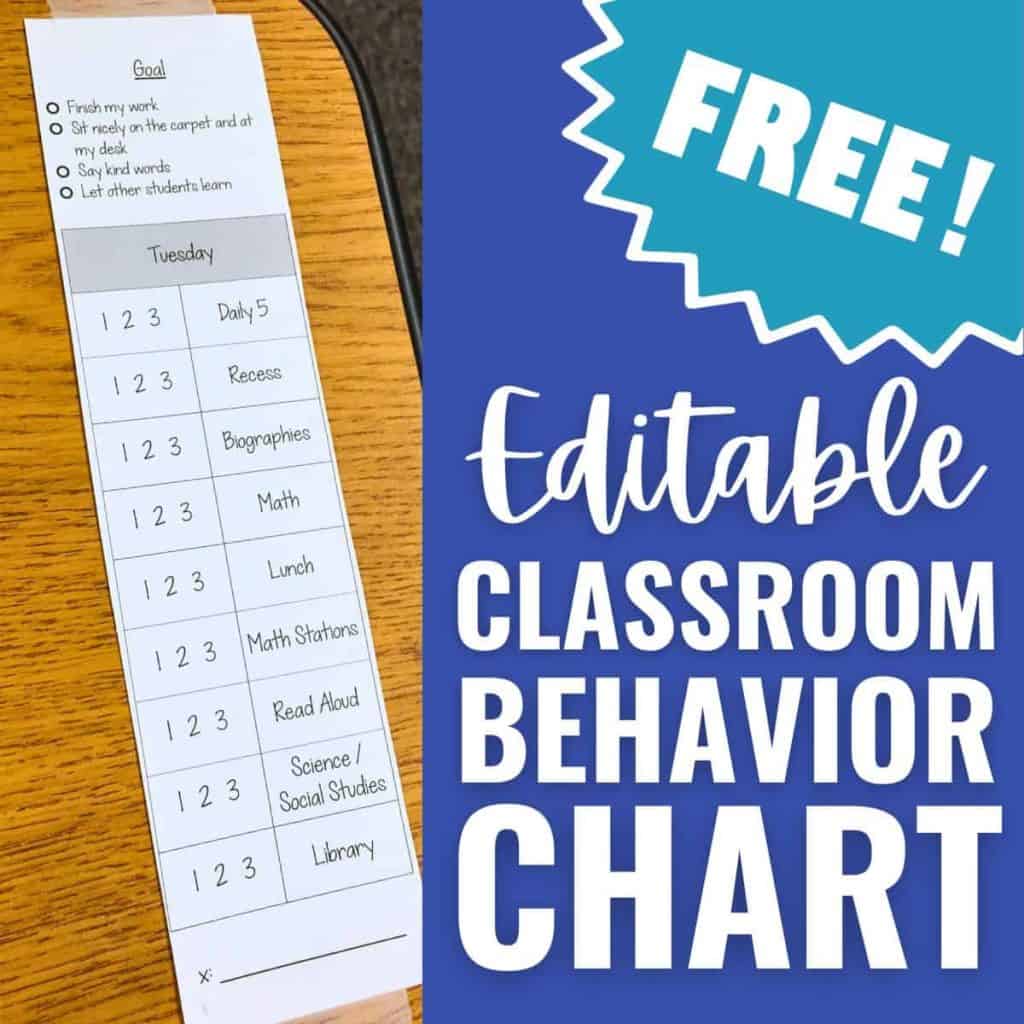
Why Use a Behavior Chart in Your Classroom
The behavior chart helps me focus on a certain student’s behavior for a shorter chunk of time. Rather than an impression of a student over the course of a day, I can stop and think about the student’s behavior within a 30-60 minute period.
This shorter time frame works for both my reflection and the student’s ability to focus. If a student has to “be good” all day, it’s really hard, but if they can focus on their behavior in shorter increments, it’s much more manageable.
How to Use a Daily Behavior Chart for Elementary Students
Here is how a day with the chart looks:
- At the start of the day, the student chooses one goal from the top of the chart.
- At each transition between activities, I score that time slot on a three-point rubric.
- At the end of the day, the student adds up their points and works to earn more the next day.
- A parent signs the chart so I know the family has seen it.
- I usually need the chart for just a few weeks at a time.
I have changed my behavior chart a few times over the years, and two changes made the biggest difference.

Things to Include on a Behavior Chart
Behavior charts should include several components that support student involvement, feedback, and parent involvement. Those include:
- Incremental time slots
- A place for parent signature
- Specific goals that students are working toward
- A rubric that students understand
One thing a behavior chart needs is increments of time. I use our natural transition times between activities. I have a strip for each day, as our daily schedule is slightly different. Each new period of the day is another chance to do well.
You also need a place for a parent’s signature. Ideally, you’d meet with the parent and set up a reward system so that if the child achieves their goal, they receive something at home. This type of communication is integral to the child’s success. I added a signature so that I can be sure the parent has seen the chart.

Looking for a reward to pair with the chart? Check out these free classroom incentives and rewards.
This year, I added two key components. I added specific goals at the top of the chart. These are major behaviors that I’ve seen in a couple of my students this year. I ask students to choose a goal to work on each day. I then evaluate their behavior based on that goal. In reality, the goals are so tightly intertwined that I use a more global approach when assessing the student. However, having specific goals allows students to focus on one aspect of their behavior.
The other component I added this year is a rubric score. I made it simple with just three points. This gives me not just a yes/no option, but a middle option that provides flexibility. At the end of the day, the student adds up their points and works toward earning more points the next day.
The two changes, adding goals and having the student self-select the goal, and adding the rubric have made all the difference. I still use the chart several times a school year to refocus students, but I usually only need it for a few weeks at a time.
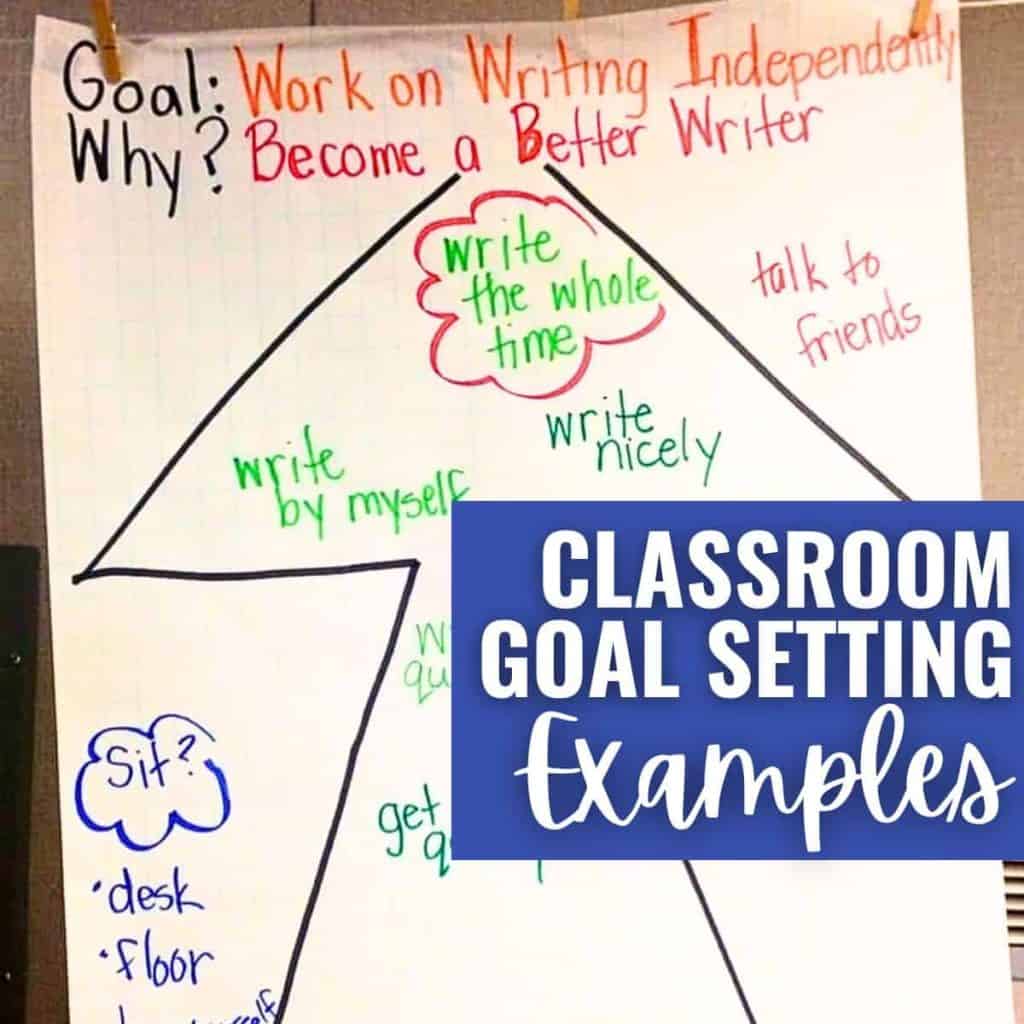
Students choose their own goals on the chart. This post shows how I use anchor charts for goal setting to build independence.
Using a Daily Behavior Chart by Grade Level
The same daily behavior chart works across elementary, but students’ support needs change with age. Here is how I would adjust the time slots, the goal, and the scoring for each grade band.
Kindergarten and 1st Grade
Keep the chart short. Three or four time slots tied to your natural transitions is plenty, such as morning, before lunch, after lunch, and the end of the day. Swap the numbers in the rubric for pictures or colors, like a smiley face, a straight face, and a sad face, so students can read it without help. Write the goal as one short, positive sentence, such as “I keep my hands to myself,” and read it aloud together before the first time slot. Younger students need feedback right away, so score each slot at the transition while the behavior is still fresh.
2nd and 3rd Grade
Add more time slots so the chart follows your daily schedule, with a new chance to do well at each period. Students at this age can handle a rubric with words and pictures. Let them choose their goal from a short list of two or three, then read it aloud before the day starts. At the end of the day, have students add up their own points with a quick check from you.
4th and 5th Grade
Upper elementary students can use the full schedule and take more ownership. Have students score themselves first at each transition, then compare their score with yours. When the two scores differ, that is a short conversation about what they noticed. Students choose their own goal, add up their points at the end of the day, and use the total to set a goal for tomorrow. The parent signature still matters at this age, since it keeps home and school on the same page.
Do you have suggestions on ways you have used behavior charts in your room? I’d love to hear more in the comments below!

Thanks so much for sharing! I really like how you’ve broken it up by the daily routines. I’ve only used this for a few kids that needed some extra support and I’ve usually used a visual cue, but I love the rubric!
Brandi
Swinging for Success
You may have just saved my sanity!
Chrissy
Thank you, thank you, thank you. I have been using this for the past three weeks. I was at my breaking point with several students and this has turned everything around. The resource is so simple and I love how I can edit it for my own personal schedule. This will be my go to resource for years I am sure!
You’re welcome! I have found it very useful for my students for a period of time. It’s still doing the trick with one of my kiddos because of the parent support. The other student is going to need some extra incentives to work toward those threes! He’s keeping me on my toes this year!
I love your chart. In my classroom we call it a contract and it includes a place for the student to circle yes or no to accomplishing her goal and then a place for me to circle if I agree. At each recess she brings it to me before lining up and it’s already filled out by her. Then I circle agree or not. Most of the work is on the student. Parents know to expect it at the end of the day so I don’t need a signature. When a goal starts to become unnecessary we take it off or replace it with a new one.
Great idea! This is a great way to hold students accountable and reflect on their behavior versus being told how they did during the day. Would you mind sharing?
Sure! Click on the image or link above to enter your email address and receive the download.
Hi!! I really like your behavior chart. I teach elementary music. So I basically see each classroom once a week for 45 min. I see 36 different classrooms from Kinder all the way to 5th grade. In each grade level I have about 3 to 5 students that really give me a run for my money….in terms of their behavior and motivation to participate. How could I modify your chart for those few kiddos in each grade level to improve behavior and increase their level of participation?
~Amanda
Since you teach so many groups of students, what about creating an incentive per grade level? The class with the most “points” (stickers, marbles, etc.) gets a reward of some sort on the last day or at the end of the marking period.
I have tried this in the past, but this is really hard to “stay on top of” when your classroom is a revolving door all day everyday. The majority of my students are great participators and have very few misbehaving moments. I was looking for something like your example that I could use just for that handful of kids that I have “trouble” with.
I agree it’s hard to manage a classroom when the participants are always changing!
I currently use this with three of my students. It’s been very effective with one of them. Partially effective with another, and not so effective with the third. The reason is home involvement. The level of effectiveness for the behavior charts is directly correlated to parents asking about it every evening.
So what do you do when the chart does not work?
Great question! I’d analyze why it isn’t working and take a look at deeper issues that might be in place. The best place to ask this question is others at your school site who are familiar with you and the student. There are so many different possibilities for why it might not be working. Most of the time, the 1:1 connection a behavior chart can form between the teacher and a student is enough. The behavior chart helps the teacher become a cheerleader for the student and rewards positive behavior and goal setting. Sometimes it is not enough and there are deeper issues at play that need further intervention.
Jessica,
Thank you so much for the behavior charts. They will really come in handy for the upcoming school year. Your site is great. I look forward to learning a lot from you.
Deb Rogers
You’re welcome! I love passing along new learnings as I discover them.
Hi Jessica. I absolutely love the information provided on here. I wanted to know your thoughts on behavioral charts that use an emoji indicator (happy/neutral/sad faces) rather than the numerical indicators. Thanks Kim
I would gauge it by the students’ response. I used them in Kinder, where they understood the faces a bit better than a number scale. However, now that I’ve used numbers for a few years, I might not use emotion again if I taught Kinder because it denotes an approval / disapproval type of response, rather than a reflection. You want the scale to be neutral, not judgmental. So, if you can do that with faces, then use them, but if you can’t then use a number scale. I wonder if there could be a different representation for a 1, 2, 3 other than faces and numbers.
Thank you for these! They will be perfect for when we set and evaluate our goals during CICO!
I like how small this chart is. I’ve used behavior charts exactly like this, but clunkier. I also like that idea of focusing on ONE goal a day. Mine are clunky because they are focusing on three or four goals.
My BIGGEST question is . . . how do you transition OUT of the behavior chart? I know when I need to use them, and I know that they work well for me, but then I’m stuck with them all year! Either I, the parents, or the students begin to overly rely on them and when they are removed someone ends up ruining all the progress. Either the student goes into attention withdrawals, the parents get upset about not having CONSTANT communication, or I struggle to integrate the student back into the classroom management plan with consistency.
Any advice?
Great question! I tend to just stop using it gradually. Like, I’ll forget to put it on the students’ desk and partway through the day he or she will realize it’s missing. I’ll ask if we needed it and we decide if we do / don’t. Or, sometimes, I’ll approach it with the student ahead of time and say, let’s try today with no chart.
An alternative is to edit the chart and start making it for longer time slots, like for the entire morning, rather than just a subject area.
As for integrating the student back into the regular plan, I never take them out of the regular classroom management system. The behavior chart is just a layer of the system. So, while we’re using the behavior chart, I’m still doing all of the other pieces of “the system” – which, in all honesty is more about me being consistent and having well-planned lessons.
thank you so mush
These are great! I use them for students with specific behavioral goals. It helps me monitor their progress and provides evidence when mastering goals according to the students’ IEP!!
I would love a copy of your behavior chart, but I am unable to download it. I even looked in your TPT store and couldn’t find it. How can I get a copy?
Thanks.
Click the image to sign up for my newsletter. You will receive a link to download it in an email.
I was not able to print your points behavior chart. Is there another link?
You can sign up to receive the link via email. Click on the image in the blog post to sign up.
I could not download the free behavior chart. It looks great. I have seen lots of versions but really like yours.
Hi, Dana,
Click on the photo at the bottom of the post. Enter your email and you’ll be emailed a link to download it.
What is the incentive that students are working for? Do the points get them something?? Please elaborate on the point system and reinforcement.
Students work toward whatever incentive we decide on together. Often times, it’s 10 minutes of tech time at the end of the day or a special lunch with the teacher. You could even ask another teacher for that student to be a helper or enlist the child’s parents to offer a reward at home. Some students need a daily reward incentive. Others can work toward something larger.
I would really be interested if we could get this chart translated into a Spanish version, as well! I really love it–it’s so straightforward. Most of my students’ parents only speak Spanish so in order to communicate the chart it would be nice. If anyone sees this and is inclined…thank you!
Thanks for the encouragement to have it translated! This is a fully editable PowerPoint file. You will likely want to adjust it for your classroom schedule and routines, so translating the original wouldn’t be of much value. We all have different parts of our day and call them different things.
While it’s not the best source, Google translate can be good for small projects like this. Also, if you have a trusted parent, staff member, or friend who can look it over, that always works, too. I find that while it may not be perfect, parents appreciate the effort and overlook minor mistakes as long as they get the gist of what I’m trying to communicate.
Hi Jessica!
I was wondering if you could elaborate more on what the 1 2 and 3 points mean? Also, what is the total that the student
needs in order to be rewarded?
Thank you!
Great question! It’s a rubric. 3 for great behavior, 2 for okay, 1 for needs improvement. You can also add up the points to get a cumulative for the entire day. Use it to set a baseline and work toward improvement!
As a teacher supported with many different resources, I honestly just fell in love! This is something I have been looking for and truly believe I can happily use 🙂