
Atoms and Molecules Science Activities for 5th grade
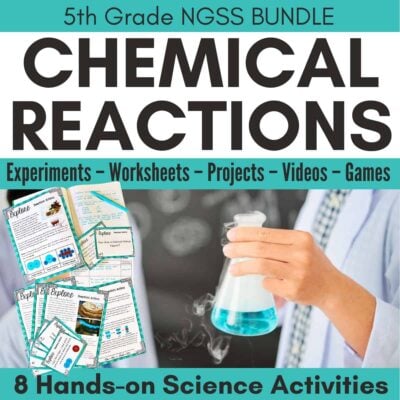
These Atoms and Molecules Science Stations include eight different science stations where students deepen their understanding of atoms and molecules, including the structures and properties of matter. The focus is on Fifth Grade Next Generation Science Standard 5-PS1-1.

Atoms and molecules are at the heart of the 5th grade matter standards, which build directly on the properties of matter students investigated in 2nd grade. My physical science guide for elementary students has the full 5th grade physical science scope with resources for each standard.
What is Included in the Fifth Grade Science Stations
In these science stations, students learn about atoms and molecules, matter, and the Periodic Table. Students model an atom, explore dissolvable solutions, and sort molecules and elements and more!
The science stations contain challenging material for fifth graders, with new words and concepts in easy to implement, interactive stations. They are are designed to help students understand how atoms and molecules exist in the matter around us. Students also learn about solutions and the Periodic Table.
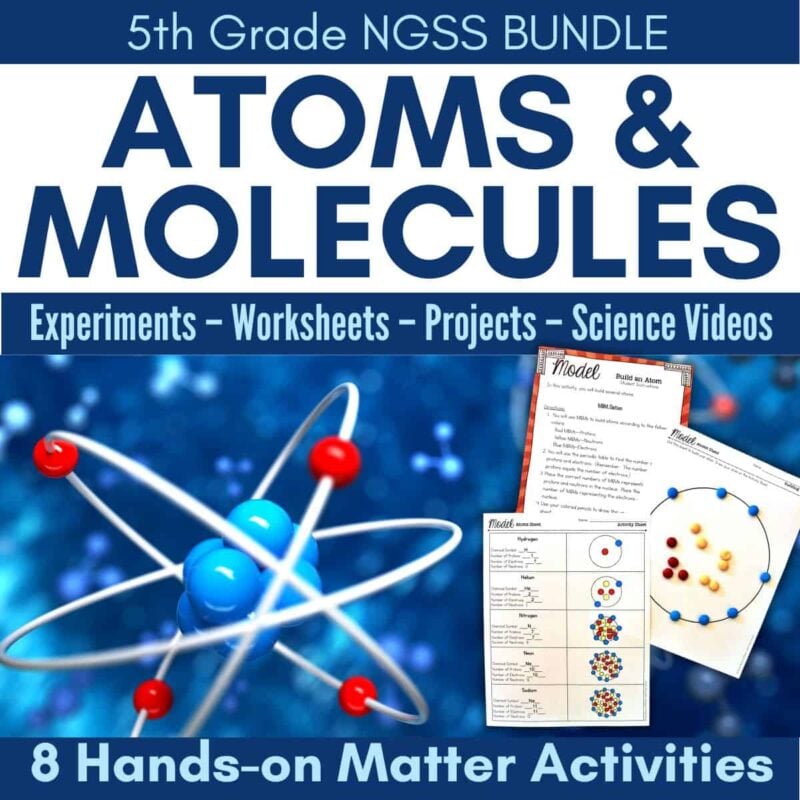
Atoms & Molecules Science Station BUNDLE
These Atoms & Molecules Next Generation Science Stations include eight different science stations where students deepen their understanding of atoms and molecules, including the structures and properties of matter. The focus is on 5-PS1-1.
-
 Product on sale5th Grade NGSS Science Station Yearlong BUNDLEOriginal price was: $316.00.$177.87Current price is: $177.87.
 -
-
-
-
-
-
-
-
-
-
Product on salePhysical Science Station BUNDLE for 5th grade Matter and Its InteractionsOriginal price was: $92.00.$49.97Current price is: $49.97.
-




Focus on NGSS Standards for 5-PS1-1
Next Generation Science Standards are written to be “Three Dimensional.” The three dimensions are Performance Expectation, Disciplinary Core Idea, and Science and Engineering Practices/Crosscutting Concepts.
The Atoms and Molecules Science Stations Unit focuses on these standards:
- Performance Expectation 5-PS1-1. Develop a model to describe that matter is made of particles too small to be seen.
- Disciplinary Core Idea 5-PS1.A: Structure and Properties of Matter – students gain an understanding of how particles that are too small to see exist and can be detected in various ways.
- Science and Engineering Practices: Develop a model to describe phenomena. (5-PS1-1)
- Crosscutting Concepts: Scale, Proportion, and Quantity: Natural objects exist from the very small to the immensely large. (5-PS1-1)
Big Idea Posters of Atoms & Molecules
Big Idea Posters are included in all of our science stations. These posters focus on key details. They make a great display for your science wall. Only the BUNDLE of all of the Atoms & Molecules Stations comes with the Big Idea Posters.

Vocabulary Cards
Included are two sets of vocabulary cards. One set has only the word and definition. The other set includes a picture.

These vocabulary cards can also be used as a ninth center where students match the word, picture, and definition. Only the BUNDLE of all of the Atoms & Molecules Stations comes with the Vocabulary Cards.
Differentiated Responses for Each Science Station
Like all the science stations, the Atoms and Molecules Science Stations have a variety of ways for students to interact with the station. Each station includes five different ways to respond to the experience at the station:
- short answer questions
- fill-in-the-blank questions without a word bank
- fill-in-the-blank with a word bank
- task cards with short answers
- task cards with multiple choice
All the variations are similar to one another, but require a different level of independence. The fill-in-the-blank is the easiest and perfect for your students who struggle with reading. The short answer is the most difficult as it requires students to construct their own responses without much support.
Choose the format that best fits your classroom and students. Students are also encouraged to use their science journal task cards. Answer keys are included.
Some activities also include an activity sheet or worksheet in addition to the differentiated responses. This activity sheet is the “work” of the station while the differentiated responses require students to think broadly about the topic and concept.
Reading Passages
All stations, except the Watch and Play stations include reading passages. Most of the reading passages are optional, but they do build students’ background knowledge and solidify key concepts.
The reading passages come in two formats. You’ll see versions of all of these formats in the below photographs. Both versions have the same text, but different layouts.
- Full-page with pink border
- Two-Column with no border
Google Classroom Components
All of our fifth grade science stations come with components easily integrated with Google Classroom. Google Forms and Google Slides are included for most stations.
- A Google Form™️ with Reading Passage & Differentiated Questions is available for the Watch, Investigate, Diagram, Read, Model, Explore and Sort stations.
- Google Slides™️ with Activity Directions & Worksheets are available for for Investigate, Diagram, Model, Explore, Sort
Most of the hands-on activities still require physical components, but we have provided the directions and recording sheets in Google Slides.
Watch a Video about Atoms and Molecules
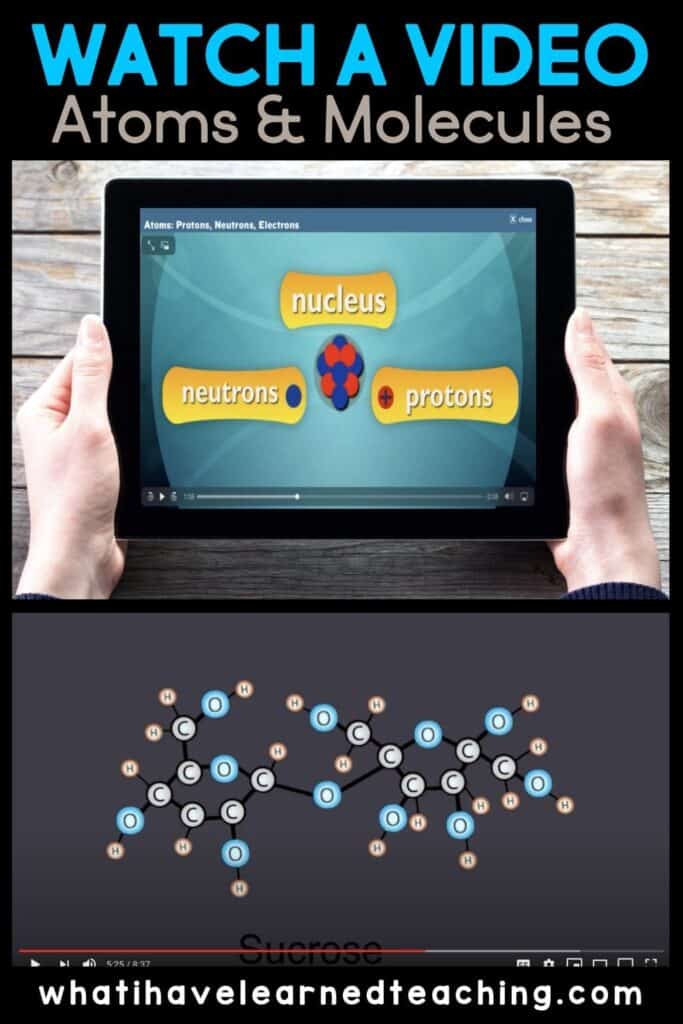
The WATCH station includes two videos. Students watch a video and then answer questions about what they learned in the video. Each video has differentiated questions as well as a Google Form with the video link and questions. The WATCH a Video station is perfect for Distance Learning.
Play a Game
The PLAY station in 5th grade is different from our other grade levels. It does not contain video games. While the games were fun, we found the technology to be a barrier to learning.
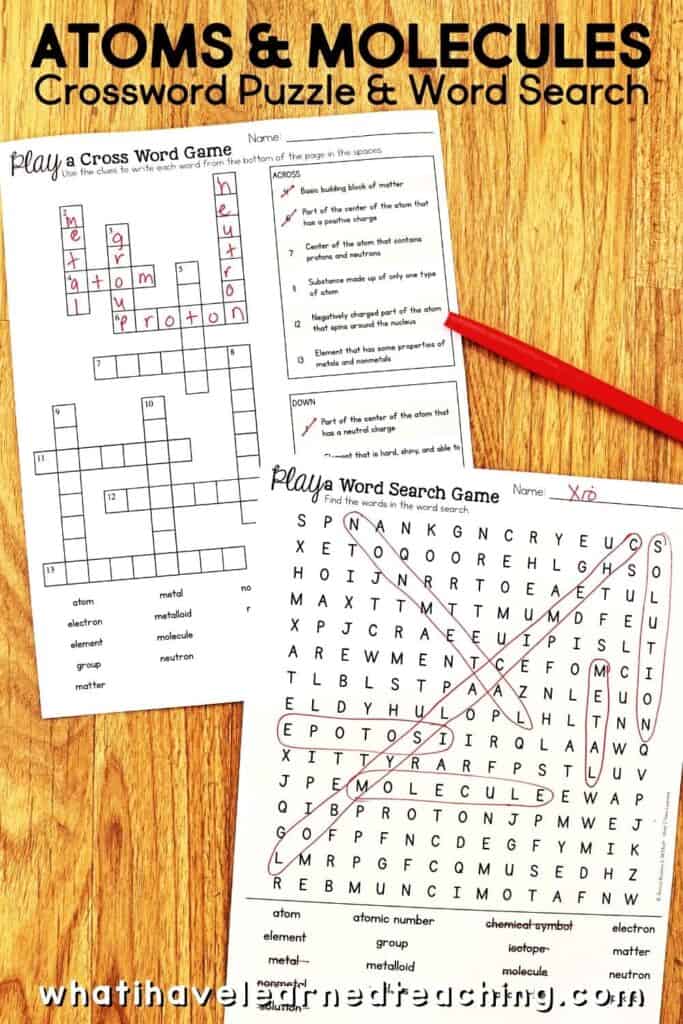
Instead, we have created a board game, word search, and crossword puzzle. The board game has question cards and a game sheet. Students move through the board game answering questions.

The crossword and word search puzzles include vocabulary words and concepts from the unit. Both the crossword puzzle and word search puzzle are available in a print format and a digital format. The digital format provides immediate feedback.
Investigate the Properties of Matter
In this Investigate Matter science station, students read about matter and conduct an investigation to determine if air and other things we cannot see are made of matter. Students weight objects before and after a change to see if the mass changes.
Below is an image of the reading passage and short answer task cards with student responses in a science journal.
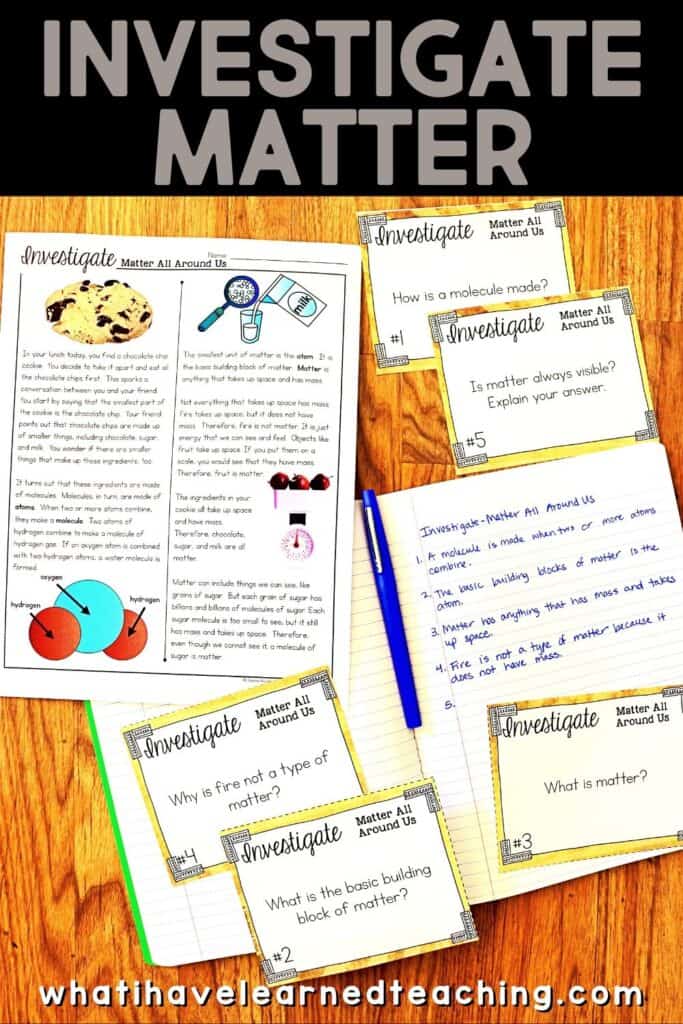
Diagram the Periodic Table
In this Diagram station, students work with the Periodic Table. They are given a copy of the Periodic Table of Elements and color it to look like a provided sample. After coloring, students cut apart their puzzle and put it back together.

Below is the reading passage and short answer questions for the diagram station.

Read about Matter Everywhere
In this Read station, students read about matter, atoms and molecules. You can see the reading passage below.

Like many of the science stations, the reading passage includes differentiated responses. The Read station is great for distance learning. It includes a link to a Google Form with the reading passage and differentiated responses.
Model an Atom
This Build an Atom station is a yummy one! In this station, students build an atom using M&Ms. Directions are also included for using pom-poms if you would like a non-food version of the activity.
In this activity, students model several different atoms and record the number of protons and electrons. They also draw the atom on their recording sheet.

Before building the atom, students read about the components of atoms to build background knowledge. After the activity, students can answer questions on one of the included worksheets or in their science journals.
-
Product on sale5th Grade NGSS Science Station Yearlong BUNDLEOriginal price was: $316.00.$177.87Current price is: $177.87.
-
-
-
-
-
-
-
-
-
-
Product on salePhysical Science Station BUNDLE for 5th grade Matter and Its InteractionsOriginal price was: $92.00.$49.97Current price is: $49.97.
-

Explore Solutions
In the Explore Science Station students explore what happens when sugar becomes part of a solution and when it is separated from a solution.
This experiment requires several days where students explore how the solution changes after heating and evaporation.
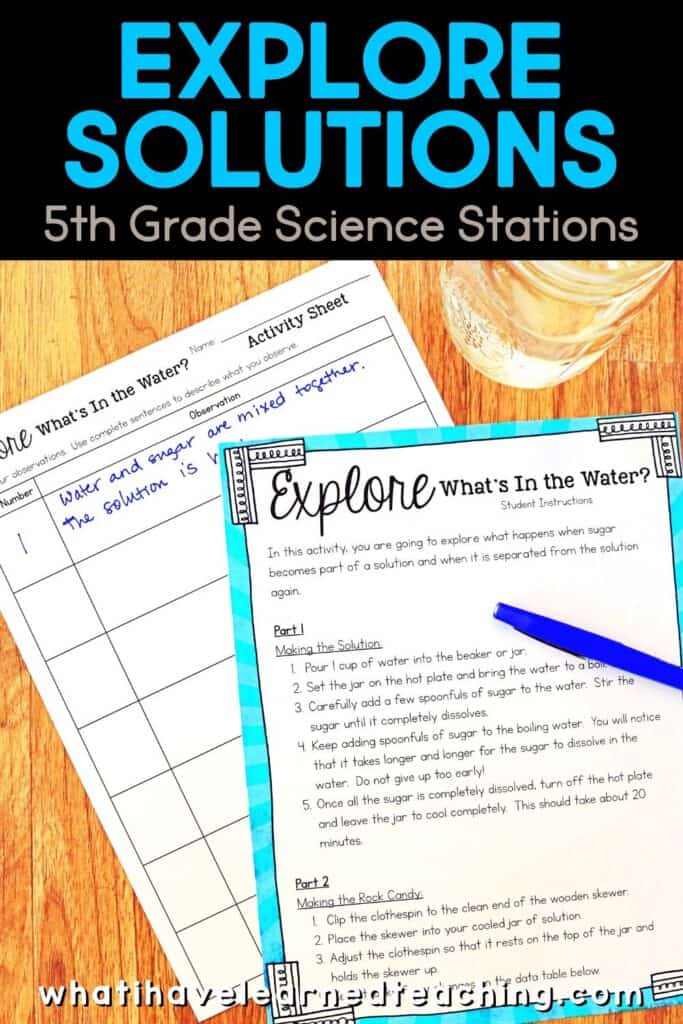
Like all of our science stations, this one comes with a reading passage, activity, recording sheets, and differentiated questions.

Sort Molecule, Element or Both
In this Sort Molecules & Elements science station, students read about atoms and molecules. They then sort material into three categories: element, molecule or both.
The sort comes in with color cards that you see below. It also comes with a black and white cut and paste worksheet, in addition to a reading passage and differentiated questions.
Students then answer questions about the sort within their science journals, on the included worksheets, or in the Google From™️.

Atoms & Molecules Science Station BUNDLE
These Atoms & Molecules Next Generation Science Stations include eight different science stations where students deepen their understanding of atoms and molecules, including the structures and properties of matter. The focus is on 5-PS1-1.
How to Purchase the Fifth Grade Atoms & Molecules Science Stations
The Atoms & Molecules Science Stations are available on my website and on Teachers Pay Teachers.
- Atoms & Molecules BUNDLE
- Watch a Video Science Stations
- Play a Game Science Station
- Investigate the Properties of Matter Science Station
- Diagram the Periodic Table Science Stations
- Read about Matter Science Station
- Model an Atom Science Station
- Explore Solutions Science Station
- Sort Molecule, Element, or Both Science Station

Awesome.