
Students with IEPs – Tips to Collaborating with Service Providers
Do you have students in your classroom with IEPs? Students with IEPs often have unique challenges in the general classroom setting and those challenges can be very diverse, from academic to behavior issues. Georgia from The Exuberant Educator is here today to share with you five ways that a general education teacher can collaborate with service providers.

Having a student with an Individualized Education Program (IEP) in your classroom can be overwhelming, even for a veteran teacher. There are laws to follow, goals to meet, and service providers to collaborate with when it comes to these students. Some students with disabilities require minimal support from the special education teacher in the general education classroom, while others may require the services of a special education teacher, speech-language pathologist, occupational therapist, physical therapist, and possibly a separate case manager!
It may seem like a headache, but working with service providers doesn’t have to be stressful. In fact, when everyone collaborates together, service providers can provide a wonderful support system that will help you most effectively teach your students. Here are some tips for working with various service providers:
1. Read the student’s IEP
While this may seem obvious to some teachers, I know some teachers who don’t do this. I get sighs from teachers at the beginning of in-service week when I share IEPs with them. I know that the last thing you want to do as you prepare for the new school year is read a 20+ page document with lots of jargon – remember that I didn’t particularly enjoy writing it, either!
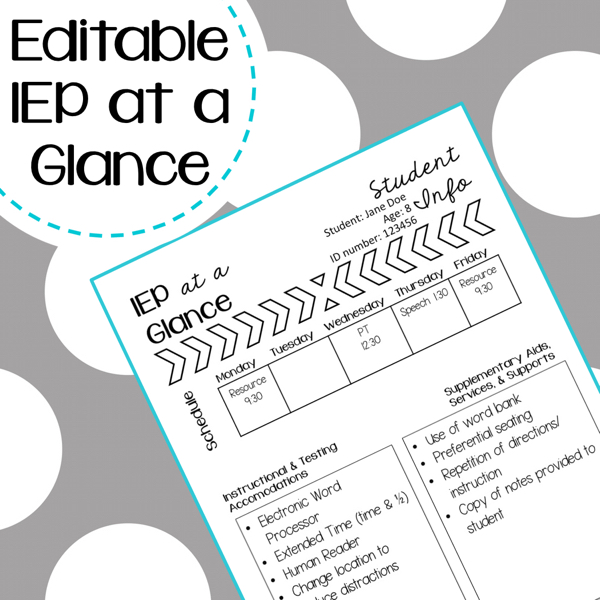
A student’s IEP contains a wealth of information about the student, including their present levels of academic performance, supplementary aids and services they require, special education and related services to be provided, and their goals. The IEP will help you learn about your student and start to prepare you to best meet their needs. Oftentimes, the special education teacher or case manager will provide you with an “IEP at a Glance.” This is a condensed sheet that includes the most important information from the student’s IEP. Use this to occasionally check in and make sure you’re following everything you need to be.
If your case manager doesn’t provide you with one, you can download the one I use for my students here HERE. Remember – this is a legal document! You are required by law to follow it. In some cases, a child will have a Behavior Intervention Plan (BIP) or other reports in addition to their IEP. Again, these are important documents to read and will help you set your student up for success. It’s not fun when a parent or administrator wants to know why you’re not following the plans!
2. Ask questions
After reading a 20+ page document with a ton of information (and jargon), I’m sure you’ll have lots of questions. I expect this as the case manager and special educator! For your student’s sake, please ask us ANY questions you may have. As the special educator, I often have questions for the related service providers or other special educators. I’m not an expert in speech, OT, or PT, and we don’t expect you to be either!
In an elementary school setting, we’ve likely been working with a student since they were initially qualified. This may also mean that we’ve been working with them for five years by the time you have them in your class! We’re happy to share the information that we have in order to help you be successful with them.
3. Communicate and collaborate
Communication is key when working with a large team of professionals. Although we all work with the same student, each one of us is working through a different lens. Communicating the student’s strengths, needs, and growth is so important when working with the IEP team, including the child’s parents. Collaborating is also crucial. We can work together to plan instruction, services, aids, and supports for the student. We are each expert in our own areas, and collaborating can benefit not only your student with an IEP, but all of your students!
4. Be open and flexible
As a classroom teacher, I know you have your own rules, expectations, procedures, and routines. That’s part of your expertise, after all! A special education teacher or service provider’s area of expertise is working with students with disabilities. When you have a student with an IEP in your classroom, it’s vital to work together to find a balance between your expectations and needs for the classroom and the student’s needs. This is NOT to say that a student can’t follow your procedures and meet your expectations, but they may need some individualized aids and supports to get there.
Be open with service providers about what you or the student need support with, what’s working, and what’s not. We’ll most likely have lots of suggestions for you to try! Please give our suggestions a chance – even if they sound crazy! For instance, I’ve worked with teachers to have students bounce on yoga balls, walk around the classroom, lay on the floor, chew gum, and play with fidgets while listening or working. Some of you may say, “That sounds like my classroom on a regular basis!” That’s great! Finding a happy balance often requires thinking out of the box and trying unconventional ideas.
On the flip side, be honest with us if there are things you’re not willing to try. You know your classroom dynamics better than us. If I brought a yoga ball into a classroom with a different dynamic, it may cause more drama in the classroom than it was worth! Some teachers might hate students chewing gum in class or seeing a student bounce around. That’s okay! Part of being open and flexible is telling us what you’re willing (and not willing) to do. We’ll all work together to find strategies for you to use that work for you, the student, and your class.
5. Be respectful
This one encompasses a lot. Working with several additional professionals is not always easy and can be overwhelming. The year is bound to go much more smoothly if everyone is respectful of each other. For you, this might mean opening your room to the service provider, working with their schedule to accommodate your student, or meeting with them to discuss your student’s progress.
As I’m sure you know, special education includes a TON of paperwork and meetings. Please be respectful of paperwork deadlines and meeting dates! We hate having to hunt you down as much as you hate being hunted down. Having a positive, respectful relationship with service providers will make the year (and future years) go much more smoothly. Here’s to a collaborative and productive year!

Georgia is an elementary special education resource teacher in her third year of teaching. She works with K-5 students with mild to moderate disabilities in the classroom and small group settings. You can find her on TeachersPayTeachers. You can also check out her brand new blog, The Exuberant Educator.
Jessica BOschen
Jessica is a teacher, homeschool parent, and entrepreneur. She shares her passion for teaching and education on What I Have Learned. Jessica has 16 years of experience teaching elementary school and currently homeschools her two middle and high school boys. She enjoys scaffolding learning for students, focusing on helping our most challenging learners achieve success in all academic areas.