
Cardboard Arcade Games: A Classroom Project Kids Love

When a boy named Caine spent his summer building a cardboard arcade in his dad’s auto parts shop, someone filmed a short documentary about it. If you haven’t seen it, watch it here — it’s nine minutes of a kid who had cardboard, tape, and time, and built something remarkable from nothing.
Showing that video to a second-grade class at the end of the school year sparked a project that is still worth repeating. Cardboard arcade games in the classroom work the same way Caine’s did: students plan a game, gather materials, build it over a few days, and then play each other’s creations. The project costs almost nothing. What students get out of it — real design thinking, construction problem-solving, and the satisfaction of making something that works — is hard to replicate with worksheets.
This post covers how the project ran from start to finish: the planning template, the games students made, how to gather materials, what construction looked like, and what to do differently next time.
Why This Project Is Worth Running
This is not a craft project where every student makes the same thing. Each student designs a different game, which means each student solves different problems. The group building a cardboard soccer field needs completely different materials and makes completely different decisions than the pair building a marble maze or a balloon pop station.
That design variety is what makes the project work. Students who are planning a soccer game with a scoreboard are thinking about how the ball moves, how goals are scored, and how to keep track of points. Students building a marble maze are thinking about wall height, path width, and how to keep the marble from escaping. These are real engineering problems, and second graders take them seriously.
The other thing that makes this project worth running: it works at any grade level where students can draw a plan and use tape. The planning structure below scales up easily — older students can be expected to think through more constraints, test their designs, and document revisions.
The Planning Template
Before any student picked up a piece of cardboard, every student completed a game plan. This is the most important part of the project. Students who skip straight to building often end up with something that doesn’t work and can’t explain why.
The planning template had four components:
Who — the names of the students on the team. This project works well as pairs, though some students worked solo.
What — the name or type of game.
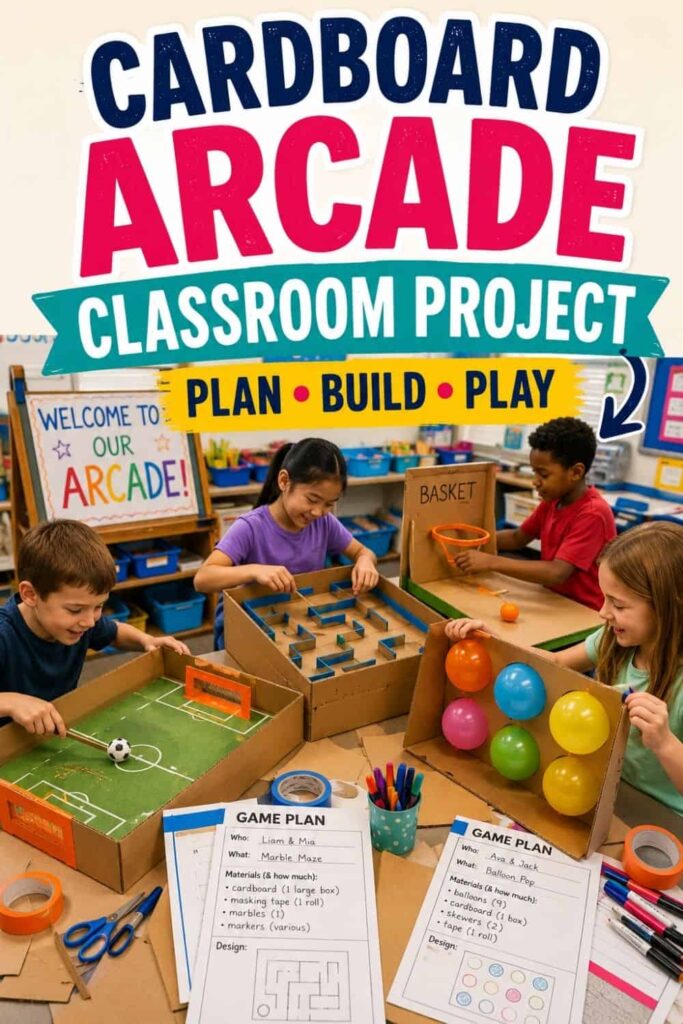
Materials — every material needed, plus quantities. The prompt on the anchor chart said “& how much” next to materials, which turned out to be essential. Students who wrote “balloons” without specifying how many ran into problems. Students doing a balloon pop game also initially forgot to specify how players would actually pop the balloons — that gap came out during the plan review.
Design — a diagram of what the finished game would look like, drawn by the student.
Every plan had to be reviewed before construction started. That conversation was where most of the real planning happened. Students who hadn’t thought through their design carefully enough discovered that during the review, not during construction — which saved a lot of time and frustration.


Cardboard Arcade Game Ideas Students Made
Second graders came up with more variety than expected. Most drew direct inspiration from the Caine’s Arcade video, which is a legitimate starting point — watching someone else’s approach gives students a mental model before they start designing their own. Here are the games that came out of this class:
Cardboard soccer game. Two students built a large flat cardboard field with goal areas at each end, marked in orange tape. Along one edge, they wrote a scoreboard in marker — entirely their own addition, not something that was prompted. A small stick controlled the ball. The game needed two players and had clear rules from the beginning.
Balloon pop. A group built a cardboard frame to hold inflated balloons in place for players to pop. The main planning challenge was something they hadn’t anticipated: how would players actually pop the balloons? That question came up during the plan review and sent them back to their design before construction started.
Marble maze. This was the teacher’s own demo game — a cardboard box with masking tape walls inside forming a maze path and a marble to navigate through. Building a demo first gave students a concrete example and made the construction challenges visible: tape walls on cardboard are harder to keep upright than they look.
Ring toss / basketball. One student built a cardboard backboard and used tape to form a ring attached to it. A marble served as the ball. The finished game sat on a flat cardboard base on the desk and had a planning sheet showing the game design right alongside it.


Gathering Materials
Most of the cardboard came from donations. Other teachers and parents were asked at the start of the project, and the room filled up with boxes quickly. Produce boxes, shipping boxes, and smaller cereal boxes all worked — the variety in size and thickness was actually useful, since different games needed different materials.
A dollar store run covered the rest: toy soldiers, balloons, marbles, and a few other small items. Total cost for this class was around $10.
One thing worth telling students during the planning stage: the question is not just “what do you need?” but “how much?” A student who lists “cardboard” without thinking through whether they need a large flat sheet or a small box will hit a roadblock. Building those specific questions into the planning template saves confusion during construction.
Construction Days
Plan for two full class periods. Some games come together in one session; others need more time. Have a plan for students who finish early — in this class, those students used extra time to practice playing their game, which also served as a useful test of whether it worked.
A few practical things to know before running construction:
Adults need to handle cutting. Box cutters and scissors strong enough to cut corrugated cardboard are not safe for second graders to use independently. Doing the structural cuts ahead of time, or having an adult available to cut on request, prevents both safety problems and project delays.
Not every game will work. One pair’s game was too complex to finish in the time available, partly because the scope was too large and partly because one partner was absent for part of construction. That’s a real outcome, and it’s worth having a brief conversation with students about it — what would they do differently with more time? What made the scope too big?
Game Day
On game day, the student-made arcade games ran alongside commercial board and table games as options for the class to play. Students rotated between stations, playing each other’s cardboard creations and looking at how different groups had solved different design problems.
The student-made games drew the most interest. Students noticed details in each other’s work — the scoreboard on the soccer game was a particular point of admiration — and asked questions about how things were built. That conversation between students about their own designs is something a commercial game can’t produce.
What to Do Differently
A few things worth changing if you run this:
Build in structured reflection at each stage. The end of the school year was busy, and students didn’t get enough time to reflect on the process. Questions worth asking at each stage: What’s working? What isn’t? Does the game work the way you planned it? What would you change? Those conversations are part of what makes a project genuinely educational rather than just a fun activity at the end of the year.
Invite another class. Several students asked whether other classes would come to play the games. Bringing in another class for game day adds real stakes — students care more about whether a game works when other kids they don’t know are going to try it. It’s also a natural audience for the student-made scoreboard and rules.
Run the project earlier in the year. Starting it at the end of the year made it a one-time experience. The same structure — plan, build, test, reflect — could run multiple times across the year with different constraints: different materials, a different game type, a different target player. Running it in October and then again in April would let students apply what they learned the first time.
The Caine’s Arcade Connection
The Caine’s Arcade documentary is worth showing in its entirety before introducing the project. Students in this class were genuinely moved by seeing a kid close to their own age build something functional and thoughtful out of materials that most people throw away. The video is about nine minutes long and runs as a whole-class watch without any additional setup.
Caine’s story also led to the Imagination Foundation and the Global Cardboard Challenge, which ran for several years and connected classrooms around the world who were doing exactly this kind of project. The video doesn’t feel dated — a kid with cardboard and tape making something from nothing holds up.
Cardboard, tape, and two or three class periods. That’s what this project costs. What students get out of it is visible on game day, when a second grader explains the rules of a game they built themselves and watches another student try to play it.

I did a Caine’s Arcade with my kiddos, too. I approached it a little differently. I got all my boxes from Costco then sent them home with the kids. They had two weeks to create their game. I teach in a highly impacted school and dont get much homework back , so I wondered how it would go. It was fabulous!! All but two of my students returned their games and they were amazing!! We invited some 1st and 2nd graders down to play. Everyone loved it!! I also tried STEM challenges and genius hour this year. Both were a big hit and encouraged higher-level thinking. I’ll be doing all these things again this year.
That’s awesome! What a way to involve the parents and this is my ideal “homework” assignment as it’s not worksheets and busy work! I kinda threw it together at the end of the year last year, so I didn’t plan it out so well. I loved the concept of it, though. I bet older kiddos would really get involved with it.
I love your ideas. I do STEAM in my classroom and am always looking for ideas. Thanks for sharing!! Can you tell me where you got the picture of the little girl and background of city.? Is it for sale?
Linda