
Non-Examples in Math: Definition and Examples by Concept
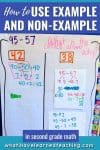
A non-example in math is a problem, model, or situation that does NOT fit the definition of the concept being taught. Where an example shows students what something is, a non-example shows students what it is not. Used together, examples and non-examples give students a more precise understanding of a math concept than examples alone can provide.

If you are teaching students that a fraction represents equal parts, showing a correctly divided model makes sense. But showing a model with unequal parts right beside it, and naming it as a non-example, is what makes the equal-parts requirement concrete. The contrast is where the understanding forms.
This guide covers non-examples for seven commonly taught math concepts in grades 2-5, from regrouping and multiplication in the primary grades through fractions, factors, multiples, and expressions in the upper elementary years.
Why the Example and Non-Example Strategy Works
When students see only examples of a concept, they often pick up on surface features rather than the defining ones. A student who sees only problems that require regrouping might think regrouping is just about “carrying a number,” without understanding when and why it applies. A student who only sees factor pairs for 12 might assume any number smaller than 12 is a factor.
Non-examples interrupt that pattern. Showing a problem or model that looks close but does not fit forces students to look at exactly what defines the concept. That comparison between example and non-example is where the understanding clicks, not just the procedure.
This strategy is also one of the most useful tools for building math vocabulary in grades 2-5. Definitions are easy to copy down and hard to actually use. Non-examples test whether students can apply a definition, not just recite it.
Non-Examples for Common Math Concepts
Regrouping (Grades 2-3)
Regrouping in addition happens when the digits in one place value sum to 10 or more. Regrouping in subtraction happens when the digit being subtracted is larger than the digit it is being subtracted from. A non-example of regrouping is a problem where neither condition applies.
Example of regrouping: 47 + 35. In the ones place, 7 + 5 = 12. Because the sum is greater than 9, regrouping is needed. Write the 2 in the ones place and carry the 1 to the tens place.
Non-example of regrouping: 42 + 35. In the ones place, 2 + 5 = 7. Because 7 is less than 10, no regrouping is needed. Write the 7 in the ones place and continue with the tens.
Sorting a set of problems into “requires regrouping” and “does not require regrouping” before solving gives students practice identifying when the concept applies. This works especially well at the start of a regrouping unit, before students have internalized the condition that triggers it. Non-examples make that condition visible.

Multiplication: Equal Groups (Grade 3)
Multiplication represents equal groups. The defining feature is that each group must be the same size. Situations where the groups are different sizes are non-examples of multiplication, even when there are multiple groups.
Example of multiplication: 4 bags with 6 apples each. This is 4 × 6 = 24. The groups are equal.
Non-example of multiplication: A bag with 6 apples, a bag with 4 apples, and a bag with 2 apples. The groups are not equal. This is an addition situation (6 + 4 + 2 = 12), not a multiplication situation.
This distinction matters most in third grade when students are building the foundational concept of multiplication. Sorting word problems into “multiplication” and “not multiplication” before writing equations helps students see that equal groups are what make a problem a multiplication problem — not just the presence of multiple amounts.
Fractions: Equal Parts (Grades 3-5)
A fraction represents equal parts of a whole. The parts the whole is divided into must be the same size. A model where the parts are not equal is a non-example of a fraction, even if the right number of parts are shaded.
Example of 3/4: A rectangle divided into 4 equal parts with 3 parts shaded. The four parts are the same size, so the shaded area correctly represents 3/4.
Non-example of 3/4: A rectangle divided into 4 unequal parts with 3 parts shaded. Because the parts are not equal, the shaded area does not represent 3/4, even though 3 out of 4 sections are shaded.
This is one of the most important non-examples to teach in third grade. Students who skip over the equal-parts requirement will accept any divided model as a fraction, which creates misconceptions that are difficult to correct in fourth and fifth grade.
For fifth grade, non-examples of equivalent fractions are also useful. 1/2 and 2/4 are equivalent (same value). 1/2 and 2/6 are NOT equivalent (different values). Showing non-equivalent pairs alongside equivalent pairs helps students distinguish the concept from the procedure of finding equivalent fractions.
Factors (Grade 4)
A factor of a number divides that number evenly, with no remainder. A number that does not divide evenly is a non-example of a factor.
Example of a factor of 12: 3. Because 3 × 4 = 12, or 12 ÷ 3 = 4 with no remainder, 3 is a factor of 12.
Non-example of a factor of 12: 5. Because 12 ÷ 5 = 2 remainder 2, 5 does not divide 12 evenly. 5 is not a factor of 12.
Another useful non-example: 13. Students sometimes think a factor just has to be smaller than the number. But a factor also has to divide it evenly. 13 is smaller than some multiples of 12, but 13 is not a factor of 12.
Pairs of examples and non-examples work well here as a quick check: is 4 a factor of 18? (No — 18 ÷ 4 = 4 remainder 2.) Is 6 a factor of 18? (Yes — 18 ÷ 6 = 3.) Running through several pairs before asking students to generate their own factor pairs reduces the common error of listing non-factors.
Multiples (Grade 4)
A multiple of a number is the result of multiplying that number by any whole number. A number that cannot be produced that way is a non-example of a multiple.
Example of a multiple of 6: 18. Because 6 × 3 = 18, the number 18 is a multiple of 6.
Non-example of a multiple of 6: 14. There is no whole number you can multiply 6 by to get 14. It falls between 6 × 2 = 12 and 6 × 3 = 18.
Multiples and factors are often confused because they are taught around the same time. A useful anchor: a multiple is what you get when you multiply (bigger or equal), while a factor is what you multiply with (smaller or equal to the original number). Non-examples of each, shown side by side, reinforce that distinction.
Numerical Expressions (Grade 5)
A numerical expression is a combination of numbers and operations. It does not contain an equal sign. An equation or a statement with an equal sign is a non-example of an expression.
Example of a numerical expression: (4 + 3) × 2. This combines numbers and operations. It represents a quantity but does not state what that quantity equals.
Non-example of a numerical expression: (4 + 3) × 2 = 14. Adding the equal sign changes what the statement is. It is now an equation — it makes a claim about equality. An expression describes a quantity; an equation states a relationship.
Fifth graders who are just learning to write and interpret expressions often place an equal sign out of habit, turning expressions into equations without realizing it. Non-examples make the difference between the two explicit before students practice writing their own.
Equations (Grade 5)
An equation is a mathematical statement showing that two expressions are equal. The equal sign is the defining feature. Without it, the statement is an expression, not an equation.
Example of an equation: 4 × 6 = 24. The equal sign connects the expression on the left (4 × 6) with the value on the right (24), stating that they are equal.
Non-example of an equation: 4 × 6. This is a numerical expression. It represents a quantity (24) but does not state what it equals. Without the equal sign, there is no equation.
Another non-example worth using: 4 × 6 > 20. This is an inequality. It makes a comparison rather than an equality statement, and uses a different symbol.
Using Non-Examples in Your Math Lessons
The most direct approach is a sorting activity. Give students a set of problems, models, or expressions and ask them to sort each into “example” or “non-example” for the concept you are teaching. Keep the definition visible throughout — on the board, in their math journals, or on an anchor chart.
After sorting, ask students to explain their reasoning for each non-example in writing or as a quick partner discussion. “This is not a factor of 12 because…” requires students to use the definition, which reinforces it more than sorting alone. Students who can explain a non-example understand the concept. Students who can only identify examples may still be pattern-matching.
A second approach is to present the non-example first. Show a model or problem that does not fit the concept and let students figure out what is wrong with it before you introduce the correct version. This works especially well for fractions and equal groups in multiplication, where the flaw in the non-example is visible once students know to look for it.
For vocabulary-heavy concepts like factors, multiples, and expressions, a labeled anchor chart works well as a running reference. As you introduce each new concept, add an example and a non-example to the chart. Over the course of the unit, the chart becomes a reference students can return to when the distinctions blur.
The example and non-example strategy asks students to use a definition rather than just memorize one. Whether you are teaching regrouping to second graders or numerical expressions to fifth graders, the structure is the same: show both sides clearly, name both explicitly, and let the contrast do the teaching.

Non example for a variable