
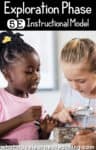
Teachers using the 5E instructional model know that the Explore phase is where students begin investigating a new science concept. Instead of listening to explanations, students work with materials, ask questions, and look for patterns.

During this stage of the learning cycle, students test ideas and investigate a phenomenon before scientific vocabulary and explanations are introduced. In this article, you’ll see what happens during the Explore phase and several examples of activities you can use in your classroom.
5E Instructional Model Recap
The 5E instructional model is a framework for inquiry-based science instruction. Students build understanding through five phases:
This article focuses on the Explore phase, which is the second step in the learning cycle.
If you are new to the model, start with this article:
What Happens During the 5E Explore Phase
Students Investigate the Phenomenon
During the 5E Explore phase, students investigate a phenomenon before formal instruction begins. They work with materials, test ideas, and discuss observations with classmates.
Teachers guide the experience through questions and structured activities, but students do most of the thinking and problem-solving.
Students are not introduced to formal vocabulary or scientific explanations at this stage. Instead, the teacher allows students to investigate the problem through hands-on exploration activities in collaborative groups.
Students Participate in Multiple Explore Activities
Teachers typically provide two or more experiences during the Explore phase. These activities help students connect their prior knowledge to what they are observing.
As students explore, they begin noticing patterns and questioning their assumptions. Misconceptions may surface and be challenged through direct observation. Students often begin forming their own questions and tentative hypotheses about what is happening.
Students Practice Scientific Investigation Skills
Many Explore activities include a simple scientific investigation. These investigations help students develop laboratory skills and gain experience with the scientific process.
With teacher guidance, students may:
- Identify and control variables
- Decide which observations to record
- Determine what type of data to collect
These experiences help students begin thinking like scientists before formal explanations are introduced.
Students Work and Reflect in Collaborative Groups
The Explore phase works best when students collaborate in small groups. Group discussions allow students to listen to different perspectives, share ideas, and refine their thinking.
Students are given time to reflect on their investigations and discuss their observations. Teachers guide reflection by asking questions that encourage students to think about what they observed and why it might have happened.
At this stage, students are not yet drawing final conclusions. Instead, they are gathering evidence, asking questions, and building curiosity that will lead into the Explain phase.
6 Types of 5E Explore Activities
There are many ways a teacher can encourage student exploration into a new topic. Here are a few ideas:
Laboratory Investigation
Students investigate a question using materials provided by the teacher. They design simple experiments, collect observations, and begin identifying variables.
Students form a hypothesis and design an experiment to test their ideas. Along the way, the teacher should ask leading questions, helping students to identify and control for variables.
Online Simulation
Using websites such as PhET or Gizmos, students can perform simple virtual experiments. As they change variables, the outcomes change. This allows students to make observations from which to form hypotheses.
Creating a Model
Have the students create a 2-D or 3-D diagram or model of what they know without defining key terms. The teacher asks open-ended questions, helping students to consider different aspects of the model they are creating.
Observation Station
Students observe a set of objects or a demonstration of the topic. The teacher carefully constructs questions to lead them through the observation (see below). Students consider all aspects of what they have observed, formulating hypotheses about it and determining how they would find out more information.
Solving a Problem
Describe a real-world problem within the topic the teacher is introducing. Students will consider what they know about the topic and come up with a solution to the problem. The teacher asks leading and open-ended questions to help students consider all sides of the problem.
Reading Articles
The articles should not be instructive. They should not define the key concepts and vocabulary terms. Rather, they should provide some specific information on real-life aspects of the topic. This can be the springboard for class or group discussions, in which students combine their prior knowledge with the information in the article to explore more about the topic.
Questions Teachers Ask During the 5E Explore Phase
The goal of the 5E instructional model is to guide students through inquiry-based learning. A key part of inquiry is asking thoughtful questions.
During the Explore phase, teachers guide thinking through open-ended questions. These questions help students notice patterns and generate explanations. They are somewhat more direct than the Engage questions.
Examples of open-ended questions are:
- What if ______________ ?
- Have you considered what might happen when you ____________________ ?
- Why do you suppose _____?
- What might you do to find the answer to ____________________________ ?
- Is there any information you do not yet have? Where could you find this information?
- What might happen if you __________________ ?
- Why did you decide to _____________________ ?
- What patterns did you notice?
- What else might have caused _____?
- What did you expect to find and why?
- What do you think could be an alternative explanation?
- What evidence do you have about _______________?
Why the Explore Phase Is Important
The Foundation for the Rest of the Lesson
The Engage and Explore phases form the foundation of the 5E learning cycle.
During these stages, students gather observations, test ideas, and begin identifying patterns. These early experiences prepare them for the Explain phase, when scientific concepts and vocabulary are introduced.
Resist the Urge to Explain Too Soon
It can be tempting for teachers to explain the science concepts during the Explore phase. Many of us want students to understand the ideas right away, and it can feel uncomfortable not answering their questions directly.
The explanations will come later in the lesson. During the Explore phase, the goal is to allow students to investigate the phenomenon and develop their own questions.
By the end of this stage, students should be curious about the concept and eager to find answers.
The Teacher’s Role During Exploration
During this phase, the teacher observes and listens carefully to student discussions. The teacher asks guiding questions, probes student thinking, and supports investigations without giving direct answers.
If students move too far off track, the teacher gently redirects them so their investigation stays focused on the topic.
What Students Are Doing
Students are given time and space to think through the problem. With guidance from the teacher, they explore ideas and test their thinking through investigation.
During this phase, students may:
- Form hypotheses
- Conduct investigations
- Record observations and data
- Discuss ideas with group members
Students listen to one another, share ideas, and revise their thinking as new evidence appears.
Preparing for the Explain Phase
Students are not yet drawing final conclusions during the Explore phase. Instead, they collect evidence and develop questions that will lead into the Explain phase.
Once observations have been recorded and ideas discussed, students are ready to move into the Explain phase, where scientific vocabulary and concepts are formally introduced.
5E Instructional Model Series
This article is part of a series about teaching science using the 5E instructional model. Each post focuses on one stage of the learning cycle.
Here are links to the other articles in this series:
- Part 1: Why I Love the 5E Model of Science Instruction
- Part 2: Why Use the 5Es?
- Part 3: What are the 5Es?
- Part 4: Engage Lessons
- Part 5: Explore Lessons
- Part 6: Explain Lessons
- Part 7: Extend Lessons
- Part 8: Evaluate Lessons
- Part 9: Our 5E Science Lessons
Example of a 5E Explore Lesson
Below is an example exploration where students explore the effects of friction.
Students receive different surfaces such as sandpaper, plastic, and cardboard. They slide a block across each surface and measure how far it travels.
Students record observations and discuss patterns they notice.
At this stage, the teacher does not introduce the term friction. Students simply investigate the phenomenon and begin wondering why the results differ.
This type of investigation prepares students for the Explain phase, where the scientific concept will be formally introduced.
5E Lesson Plans for Third Grade
We have created NGSS-aligned 5E Unit Plans for third and fourth grades. In these lessons, students are led through each NGSS Performance Expectation using the 5E Model of Instruction
3rd Grade 5E Units
Here are our 5E units for third grade.





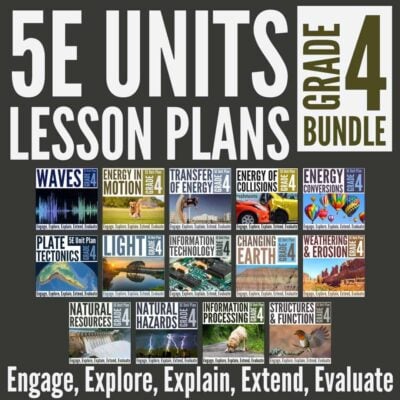
4th Grade 5E Units
Here are the 4th grade units:



Free 5E Instructional Model Posters
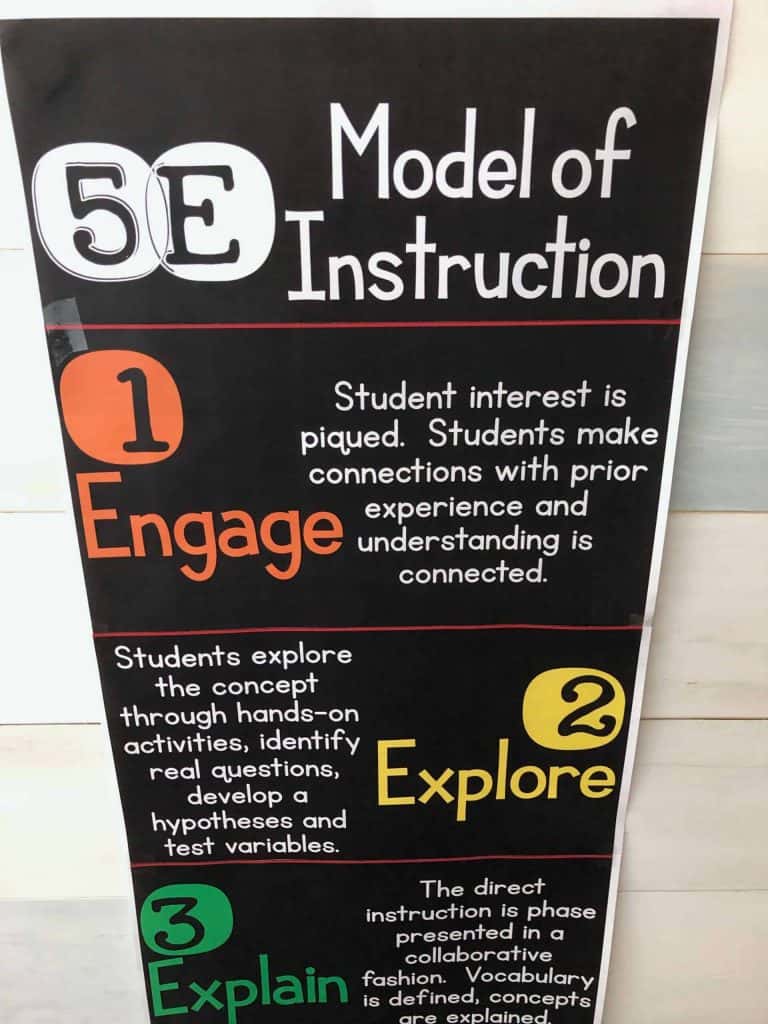
Want a simple way to help students understand the 5E learning cycle? These free classroom posters show the five phases of the 5E instructional model. Display the posters individually during lessons or tape them together to create a visual chart of the entire process.
Enter your email below, and I’ll send the free 5E posters straight to your inbox.

This is a wonderful post! It explained everything so well and I love all the extensions and examples you included!