
Do your students struggle to solve word problems? I am a big proponent of helping students understand the context of a word problem and solve it while understanding what is going on in the problem. Below is a word problem routine I came across a couple of years ago and integrated into how I teach students to solve word problems.

This structured routine integrates with my Addition & Subtraction Word Problems Grouped by Problem Type and just adds another layer to the process.
Components of this Word Problem Routine
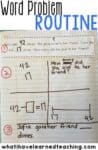
This word problem routine makes several features of word problems explicit, including the numbers, the question, the equation, a model, and the “answer.”
Can you see the three numbers above: 1, 2, and 3? Those delineate the problem, the work, and the answer. Within the work section, students create a four-square to outline the numbers, question, equation, and model.
How do I use this word problem routine in the classroom?
I introduced this routine partway through the year, meaning we had already done quite a bit of work with analyzing word problems with blank spaces for the numbers. My students knew how to read a word problem and find the action, but we were starting to use larger numbers, and some of them needed a more concrete, structured system.
Set up the Work Area
To begin, I have students glue the problem in their journals and draw a four-square and a line across the bottom. We number the sections 1, 2, and 3, and make it explicit that the sections are the problem, the work, and the answer.
Read and Analyze the Problem
We read the problem and analyze the action to create the equation. In this problem, the character gave something to someone. Gave is a verb that denotes subtraction.
At this point, we write down the question and the equation, leaving blank spaces for the numbers. We determine the unknown in the problem.
Although we don’t write it on the copy above, we discuss the start, change, and result to determine which is unknown. This is not a new concept for students, as we started using that vocabulary on day one of solving word problems.
Give Students the Numbers
I give students the numbers for the word problem, adjusting them for students who need easier work or more of a challenge. Students write the numbers in the problem in the first box, in the equation, and then use the numbers to determine an appropriate model.
Most often, I will model a problem using a number line, but students are free to choose their own models as long as they can explain their thinking using the model.
Solve the Problem
Students are then given time to solve the problem and work through the model. I circulate to help students as needed and encourage a few to try a different strategy of the work is too easy or to challenging.
Write about the Process
This structured word problem routine lets students write about the problem and analyze their process. By breaking down the “work” area into numbers, question, equation, and model, students are able to see how the process moves through stages rather than them just “knowing” the answer. Students can use the routine to write about each stage of the process.
Variations
The work area is not set in stone. You can rearrange the boxes to fit your classroom and how you teach students to solve word problems. One area that I change is the question box. I sometimes make it an “action” box where students write in the word or phrase that tells them the operation. In this case, it would be the word “gave.”
Do you want a free sample of the word problems I use in my classroom?
I love scaffolding learning for students and helping them to figure out how they’re learning something. Below are some products and blog posts about solving word problems.

Hi Jessica,
Question: I have read your other blogs about the Start, Change, Result word problem method……do you have your students use both of these methods? Do you prefer one over the other?
I prefer the more in-depth teaching by problem types (start, change, result for join and separate problems). However, that doesn’t mean you can’t use this routine with problem types. In the “read and analyze” section, you can list the start, change, and result, identifying what is unknown. This is a routine for solving word problems, more of a process or a set of steps. The identification of the components of the word problem by problem type (for join and separate problems, that’s start, change and result), is a piece of the process or a strategy in the “analyze” step. Hope all that makes sense 🙂 . They’re not mutually exclusive, but can be used together. I do start with the word problem analysis before introducing this routine, though. I want students to be able to read a word problem and identify its components. Either way, the goal is to eventually remove scaffolds so that students internalize any and all strategies and processes.