
Free 0-99 Circular Number Chart
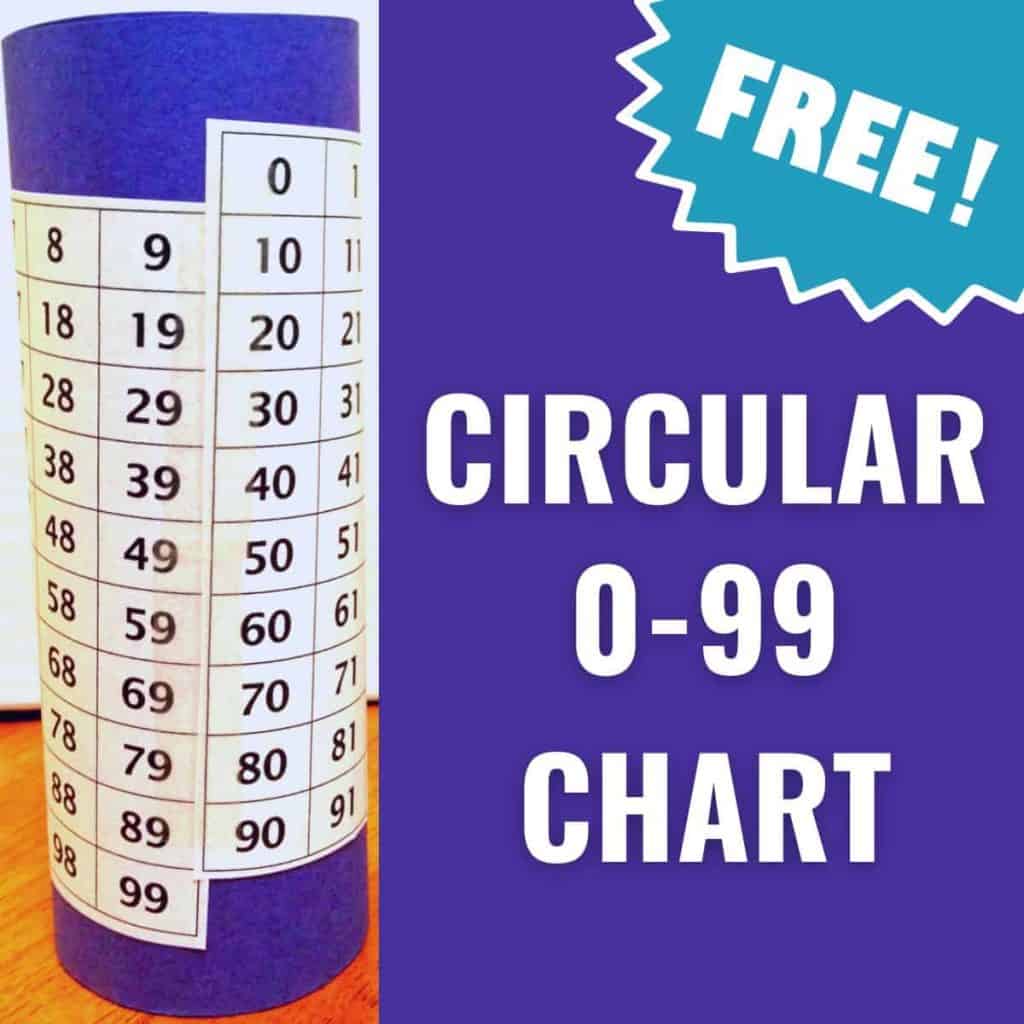
With a circular hundreds chart, students can effortlessly count and smoothly transition across tens. This simple 0-99 chart aids students in counting numbers within the range of 100. Its user-friendly number chart enables students to cross a 10 when adding or subtracting two-digit numbers with a three-dimensional model.

We all use 100’s charts, but they’ve never really made sense to me. Why is the 10’s place on the right-hand side? Shouldn’t the formation of a two-digit number signify a shift to the next row? And, what happened to zero?
So, what can you do?
Use a 0-99 Chart
This is the 0-99 Chart that I use in the classroom I used this when I taught third grade and taught number patterns. I whipped it out again when I taught a 1/2 combo a couple of years ago.

The 0-99 chart makes more intuitive sense to me. The biggest benefit is that the numbers of one “ten” are on one row. They are “regrouped” at the end of the row and physically a student needs to go to the next line to get to the next number. This matches our counting structure.
Our math programs use 100s charts, so I teach students how to use both, to give them a variety of tools and choices about what makes sense for them.
If you want to go one step further . . .
Create a Circular Chart
I’ve always had students who have had trouble counting forward and backward, especially across a group of ten. Recently, I had the bright idea of making this two- dimensional chart somewhat three-dimensional.
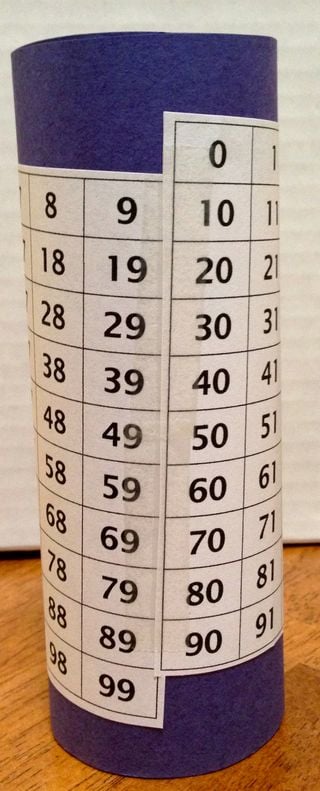
If you bend the 0-99 chart around in a circle so that the rows match up (i.e.: 9 is next to 10, 19 is next to 20, etc.) and tape the sides down, you will have one continuous 0- 99 chart.
Students will easily be able to “cross” the ten and be able to count forward and backward with ease. I put some construction paper in the middle to help reinforce it. This could also be extended to larger numbers, like 100-199, 600-699, etc.
The circular chart connects our number system.
Ways to Use a Circular Number Chart
There are a number of ways to use a circular hundreds chart in the classroom. I have used it with students who have difficulty using a two-dimensional hundreds chart when counting, adding or subtracting. But the possibilities don’t stop there!
Here are more engaging ways to use a circular 0-99 chart:
1. Skip Counting Practice
Have students use a marker or small object to skip count by 2s, 5s, or 10s. The circular format visually reinforces the rhythm and pattern of skip counting, especially as students “wrap around” the chart.
2. Multiples & Patterns Discovery
Give students different colored markers to highlight multiples of a number (e.g., multiples of 3 in blue, multiples of 4 in red). The circular layout reveals beautiful number patterns and can help spark discussions about factors and common multiples.
3. Mental Math Moves
Have students place a finger on a number and then add or subtract 9, 11, 20, or any other number. The circular chart helps them visualize how numbers are grouped and makes these mental jumps more intuitive.
4. Number Line Alternative
Instead of laying out a long number line, use the circular chart for solving problems that involve counting on or counting back. It’s compact, portable, and just as effective—if not more!
5. Game Board Fun
Turn the circular chart into a math board game! Add a spinner or dice and have students land on numbers to solve math facts, compare values, or complete number sentences.
6. Odd and Even Number Sort
Have students use two colors (e.g., red for odd, blue for even) to mark the chart. The circular view helps them spot alternating patterns and reinforces understanding of parity.
7. Highlight Benchmarks and Landmarks
Mark benchmark numbers like 25, 50, 75, and 99. Use these to help students estimate sums, recognize midpoints, and develop number sense.
Download the 0-99 Chart
Included in the printable 0-99 Chart packet are four versions of the 0-99 chart. One 0-99 chart reads from top to bottom and the other from bottom to top. There are two sizes of each. Click on the link to download.
Bottoms Up! Reverse the Chart

Above is another variation of the chart. Why do thermometers go from bottom to top, but hundreds charts from top to bottom? I don’t have an answer. My point is, sometimes kiddos need to see things in different ways until something clicks and makes sense to them. Find what works best for your students and continually adjust until you figure out what fits best for them.
Do you have any tips or tricks for teaching students to use a hundreds chart? I’d love to hear about them below.

Very creative use of the 99’s chart. I also believe that the 99’s chart makes more sense than the 100’s chart.
I’m going to post a link to your blog from my blog with this great idea.
Deborah
splitmultigradeclassroom.blogspot.com
ummm, I can’t find the download link for the freebie. So sad.
I can’t find it either. Looks like a great idea! I
Thanks for fixing the link, I got it now. Look forward to using this with the kids. I especially like the 3D tube as a way to demonstrate the cross over. Have you seen where you can cut along the line at the bottom and turn it into a long number line? We did that for 100 day last year and it made a big difference.
thank you! I see children struggle with 100 squares a lot. I’m doing this from now on. You’re a star 🙂
Can you tell me what you have it wrapped around? It looks like a pool noodle 🙂
It’s a piece of construction paper. I wrapped the 100s chart first and then put the construction paper in the middle and taped the sides. It just created some extra stability.
I’ve been trying to get a little girl to understand how numbers get bigger for weeks. Even the m&m trick worked for smaller numbers, but because she rarely handles money, she doesn’t understand the big big numbers.
I think the upside down numbers chart just might make sense to her!!!
Oh, I’m so glad! Yes, some kiddos just need to see things from a different perspective.
What is the M&M trick?
I retired after 37 years and am recently tutoring in k/1. I have changed my 100 chart since the 90’s! I just showed it to the teachers I work with. Just cut the tens off one side and tape to the other…fill in the zero at the top. I tell the kiddos it’s because the tens are the start of the “family of”. Always worked better for me.
I love using this chart. You don’t happen to have a 100-199 chart?
I do but it’s within a product: https://www.teacherspayteachers.com/Product/Two-Digit-and-Three-Digit-Addition-Task-Cards-Using-100s-Charts-1613287
Good ideas for the 100 Chart. I didn’t pen your posts for awhile; I think I didn’t recognize your title.
Any chance you could prep a 120 chart for this instead of the 100 chart? Some kids really, REALLY struggle counting on beyond 100. Our math curriculum uses 120 charts. Thanks for the consideration. This is a great idea in general!
Not at this time. But you can use any printable 120 chart and make it circular using the instructions above. You basically just need to meet the two ends together in the right place.