

Teaching responsibility in the elementary classroom works best when you weave it into daily routines rather than treating it as a one-time lesson. Responsibility is a trait students develop over time, and there are practical ways to build it throughout the school year.

Teaching character is an important aspect of our classrooms. Responsibility is a key character trait that we focus on every year. How do we teach responsibility? Here are several key ways to focus on student responsibility.
Responsibility is one of the monthly character traits I focus on every year. Sometimes just making a character trait explicit and focusing on it helps students to pay attention to their behavior.
This concept also works with goal setting. Making the small aspects of behavior and academic skills explicit helps students to focus on the trait and make it a part of their daily habits.
What Does Responsibility Look Like in the Classroom?
Before teaching students what responsibility means, it helps to make it concrete. Here are specific examples of responsibility I look for in my classroom:
- Turning in homework and assignments on time
- Cleaning up materials without being reminded
- Returning library books by the due date
- Keeping a desk or locker organized
- Telling a teacher when something is wrong instead of ignoring it
- Bringing the right supplies to class each day
- Following directions the first time they are given
- Taking care of classroom materials and shared supplies
- Completing classroom jobs without being asked
- Owning a mistake and asking what to do differently next time
When students have concrete examples, they know exactly what you mean when you say “be responsible.” Abstract character traits stick better when students can picture what they look like in action.
How do you teach your students how to be responsible? Here are a few suggestions:
Teach Responsibility by Modeling It
Build your own practice of responsibility within your classroom.
Straighten things up, put things in order, pick things up, etc. Students notice what you do more than what you say. If you straighten things up, keep your desk organized, and follow through on your own commitments, students will start to mirror those habits.
Let students help you out with small jobs to teach responsibility
There are a ton of little things in my classroom that need to be done daily. I give students the responsibility of some of these small tasks, like filing papers, sharpening pencils, and straightening up our library. It gets the tasks off my plate and puts them on theirs.

Build a classroom job system
This is similar to letting students help out, but creates a system for it. I have tried various classroom job systems over the years, and while I like the idea, no formal system ever lasted for me. The complexity of rotating jobs, training new students, and managing the chart ended up adding work rather than removing it.
What works better in my classroom is a simpler approach: I keep a short mental list of recurring tasks and assign them in the moment to whoever is available and ready. The jobs I rely on most are table captain (wiping down the table at the end of an activity), paper distributor (passing out or collecting materials), and line leader for transitions. When a student doesn’t follow through on a small job, I don’t make a big deal out of it. I simply do it myself and note that I’ll ask someone else next time. Students quickly learn that being chosen for a task is a small form of trust, and most of them want to keep it.

Need ideas on how to set up your classroom and implement classroom jobs?
Show students how you want things to look via photographs
My smartphone has made it easy to photograph how I want things to look, and I use this tool more than almost anything else to set up classroom expectations. The areas I photograph most often are student supply boxes (with everything sorted and the lid closed), the book bin (spines facing out, sorted by level), the floor around desks (clear of paper scraps and pencils), and the whiteboard ledge (only current materials on it, nothing stacked).
I print the photos in color, laminate them, and post them at eye level next to the relevant area. I update them at the start of each school year and sometimes mid-year if I rearrange the room or add a new system. If you have a projector or a classroom TV, you can also display the photos digitally at the end of the day as a cleanup checklist rather than printing them. Students doing a classroom job can use the photo to check their work before coming to tell me they are done.
Praise students for being responsible
Hand out compliments willingly. If you praise students for being responsible all day, you will have students rise to meet your expectations.
Provide structure so that students know what to do
Give clear directions and make sure students know your expectations. If they know what to do, like taking photos above, they will know exactly how to show responsibility. Clear directions and plenty of scaffolding go a long way.
Have clear consequences that match the lack of responsibility
Consequences work best when students can see the logic, which means the consequence should always connect directly to the behavior. A messy desk gets cleaned. Books left on the floor get picked up, plus a few others nearby. Materials left out at the end of the day get organized before a student joins any transition.
The key to making this feel like natural cause-and-effect rather than punishment is the way you explain it. I keep the language neutral and matter-of-fact: “Your job was to keep your area organized, and it isn’t, so we are going to take care of that now.” No frustration in the voice, no lecture attached to it.
When students hear the same calm explanation every time, they stop experiencing the consequence as something that happens to them and start understanding it as something that follows from a choice they made. Over time, that shift is where real responsibility starts to develop.
Talk about it
Revisit this concept throughout the year. The more you make it upfront and central in students’ minds, the more they will realize its importance. Since we are so busy in the classroom, consider creating a weekly or monthly routine of revisiting some of these core character traits.
Focus on one way to be responsible and show students you’re looking for it
Narrowing the focus to one behavior at a time is one of the most effective ways to make responsibility feel achievable rather than overwhelming. For example, I have run a neat desk challenge that lasts a full week. Each morning, I do a quiet walk around the room and note which desks are organized. Students who keep a neat desk every day of the week by Friday get a small recognition, which in my classroom has been as simple as choosing their seat for Monday or being first in line.
What I notice during the challenge is that the students who maintain their desks all week tend to be the same ones who also remember materials, turn in work, and follow other routines more consistently. The challenge creates a visible, specific target, which makes it easier for students to monitor their own behavior throughout the day rather than waiting for feedback from me.
In my classroom, I created a responsibility anchor chart to help students know what responsibility means. It lists common characteristics and specific examples they can refer to.
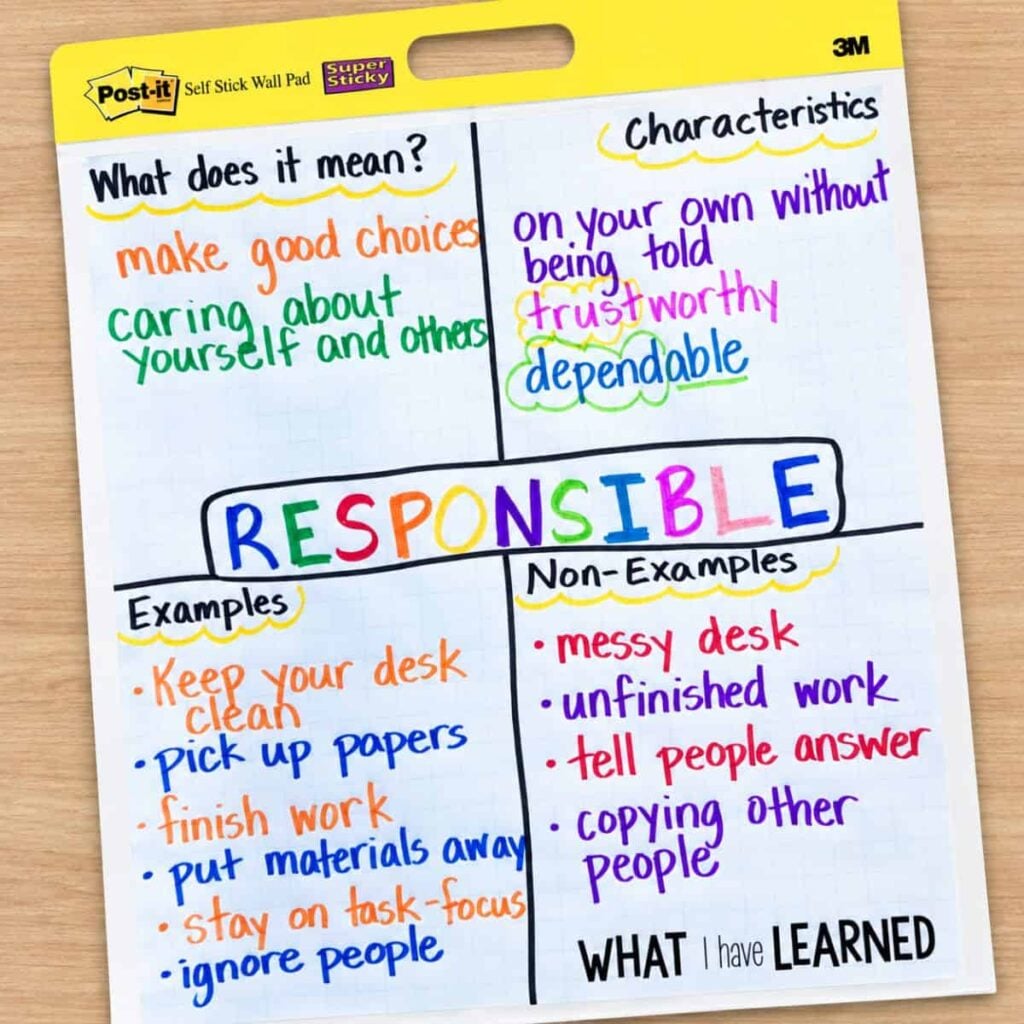
Building a culture of responsibility takes time, but the strategies above compound — once students know what responsible behavior looks like and have concrete ways to practice it, reminders become less frequent over time. If you are looking for resources to support character education alongside academic skills.
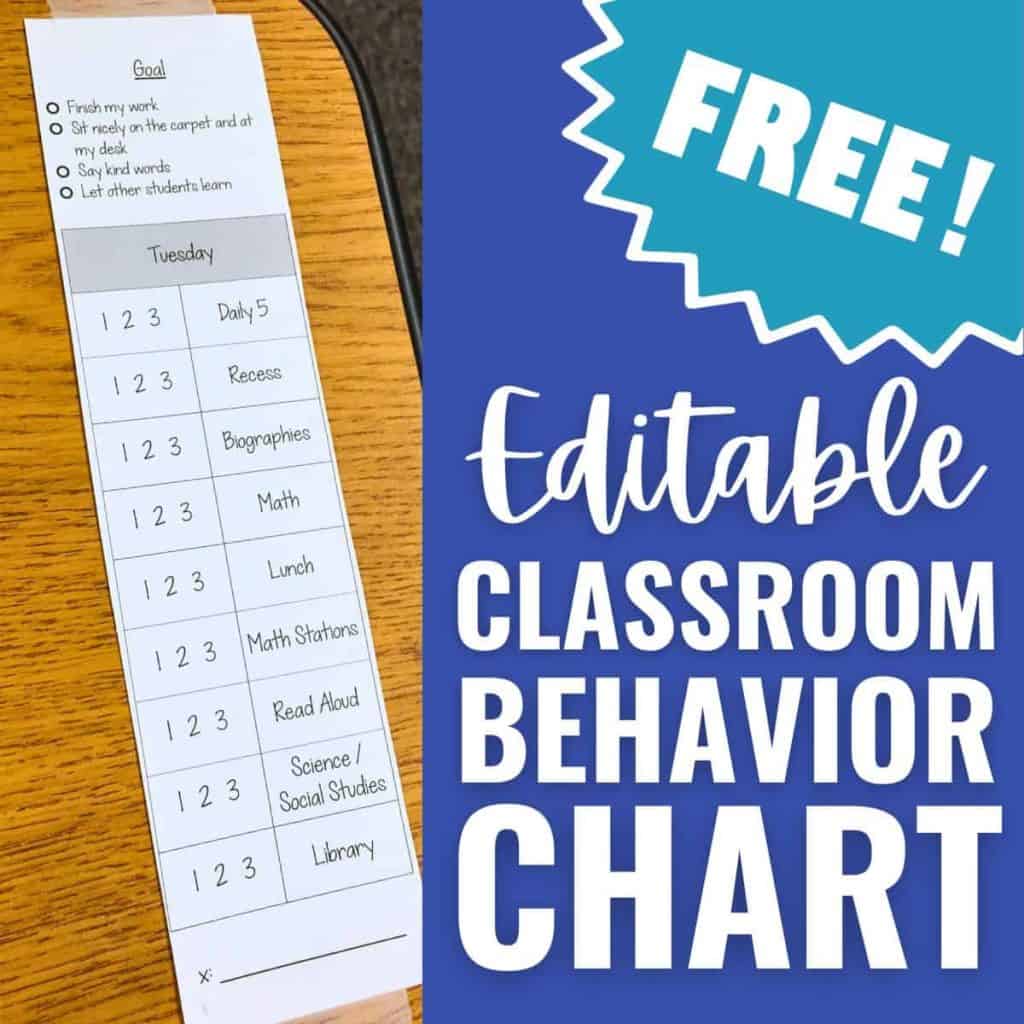

I love Sean Covey’s 7 Habits of Happy Kids. Two of the habits relate to responsibility – Be Proactive & Put First Things First. The kids love to review the habits at the beginning of each day as a chant with hand motions. Here’s a Pinterest board with some of the resources I’ve used and collected: https://www.pinterest.com/kellialaina/7-habits-of-happy-kids/
Make extrinsic learning intrinsic. Too much time wasted on cute and colorful models YOU doing all of the work.
Yeah, learning by doing but kids learn using models and aided by visual support. Teachers need to do what they have to do in order to cover the different learning styles, and that doesn’t mean the teacher is doing all the work.
The tip of modeling responsible behavior really speaks to me. Children are super-observant and are picking up on more than we’d like sometimes! And one alternative to the easy (and sometimes default) “good-job” praise is to thank the student for demonstrating responsible behavior. Modeling gratefulness teaches gratefulness.
Great tips for teaching responsibility. I like the anchor chart.
I like your ideas! I would just add that I have the kids fill in the anchor chart with their ideas. It may mean I remake the chart to simplify it, but I can usually synthesize all ideas into just a few big ideas (good modeling if synthesizing, too). Lastly, I am cared with praise. I tend to acknowledge the behavior rather than the child “You turned your work in on time. You showed responsibility.” This allows the student to own his actions.
Great tips we don’t have responsibility carts but thanks for the idea and a great reminder to help kids
Wonderful idea to share and care!
Thank you for caring about the being before the knowing!
Great ideas and resources to use with a classroom.
As a PE teacher, I teach a different character word each week. What I found was that once we changed words, the students didn’t focus on the previous words, so I had to teach them that it is one thing to learn the meaning of the words and another to practice them. So, I found some character badges on Pinterest and I use those to award students who show the different character traits that are taught. It has helped a lot as the students work hard to display good character to receive their badge. The badges are displayed on a wall that says “Rocking Good Character.” I do love the anchor chart, so I will definitely add that next year.
For older students, I love the Character Club series. The first one teaches about compassion and the second integrity…Responsibility is on the list
One day after school my 5th Grader was explaining his new daily job in his classroom.I asked him about it. He explained that his teacher has a job for every member of the class. This is their responsibility for an entire month. She gives them about 5 to 7 minutes at the end of the day, plays fun music and will intermittently reward students for their efforts to keep the motivation strong.. I marched myself down to fifth grade and asked questions and gathered ideas . Realizing that this was exactly what my second grade classroom needed, the next Monday I set my class down for a morning meeting. We brainstormed and one by one each member of our class selected a job of their choosing. I clarified and modeled what the expectations were for each job. This was life changing for my classroom! It was no longer only my responsibility, but OUR responsibility to keep our classroom tidy and neat. I found that students were invested in the jobs and even volunteered to do jobs for their friends when they were absent. My classroom has never been so tidy consistently. In fact, I was ready to check out for the school year by 2:30 on the last day of school which has never happened in the 20 years I have been a teacher!